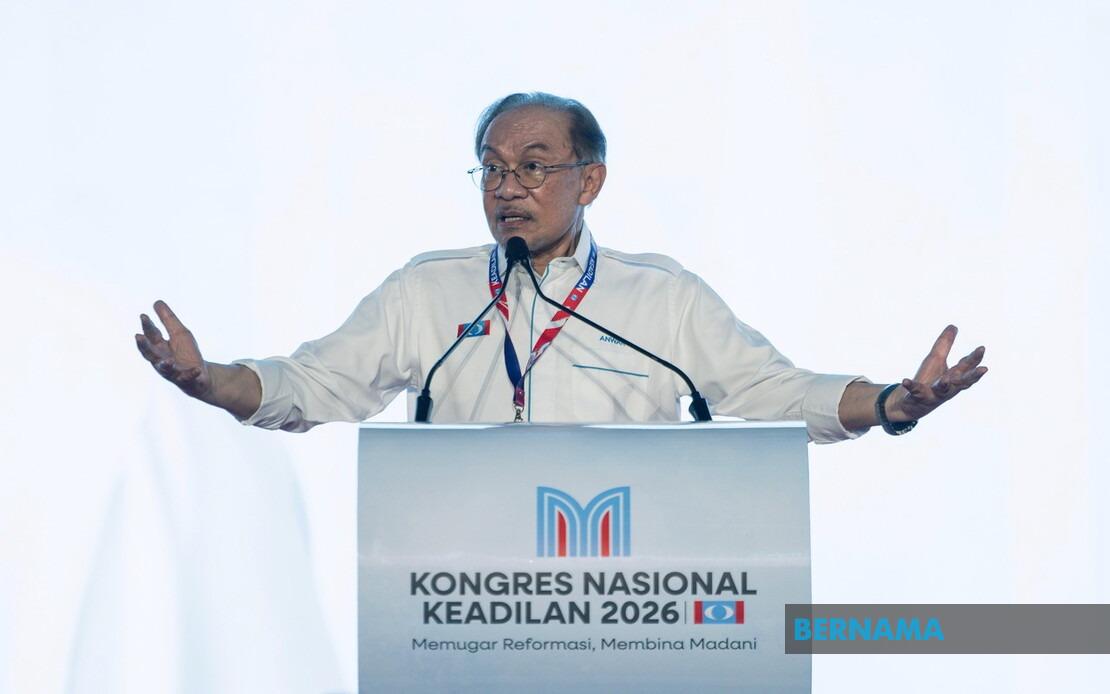
The Malaysian government has green-lit a fresh RM1 million funding boost destined for each parliamentary constituency across the nation, with the explicit goal of channelling resources directly into addressing immediate community concerns without the friction of lengthy bureaucratic procedures. Prime Minister Datuk Seri Anwar Ibrahim unveiled the initiative during his closing address at the 2026 PKR National Congress held at the Melaka International Trade Centre, framing the move as a defining commitment of the MADANI administration to strengthen assistance mechanisms at the grassroots level.
In his remarks, Anwar emphasised that the allocation represents a tangible commitment to accelerating the resolution of local issues, particularly those touching on social welfare, essential infrastructure, and community wellbeing. The additional funding is designed to circumvent the delays that typically emerge from multilayered approval chains, instead empowering local representatives to respond swiftly to constituent needs. This decentralised approach stands in contrast to traditional disbursement models that channel resources through multiple government tiers, a process that historically slows delivery to communities requiring urgent intervention.
Anwar, who simultaneously holds the Finance Ministry portfolio, positioned the new allocation as a complementary measure bolstering existing social safety nets. The government's welfare architecture already encompasses the Sumbangan Tunai Rahmah and Sumbangan Asas Rahmah initiatives, which together represent a RM16 billion commitment to household financial relief. The additional constituency-level funding aims to close remaining gaps where immediate local solutions prove necessary, particularly in addressing unanticipated community demands or emerging welfare challenges.
The announcement reflects a broader policy trajectory centred on translating national economic gains into tangible improvements in household circumstances. Anwar highlighted that poverty eradication and cost-of-living mitigation remain cornerstones of the administration's agenda, pointing to the reduction of hardcore poverty to 0.09 per cent as evidence of progress. Yet the Prime Minister acknowledged that macroeconomic improvements do not automatically filter down to individuals and families unless paired with deliberate, targeted programmes designed to reach vulnerable populations across income brackets.
The breadth of the existing assistance framework underscores the government's attempt to ensure no demographic segment remains excluded from support mechanisms. Whether targeting the bottom forty per cent of earners, middle-income households, or specific needs such as education, food subsidies, or housing finance, the portfolio of initiatives seeks to provide comprehensive protection. Anwar stressed that such programmes must operate without perpetuating communal divisions or favouring particular groups, a rhetorical signal emphasising the inclusive design of welfare delivery across Malaysia's multicultural society.
Despite the announcement's positive framing, its effectiveness hinges significantly on implementation quality and grassroots mobilisation. Anwar urged PKR party cadres and branch-level machinery to venture into communities and educate constituents about available assistance, acknowledging a persistent implementation gap. Awareness of welfare programmes does not automatically translate into uptake; citizens must understand eligibility criteria, application procedures, and benefit levels to actualise support. The Prime Minister's explicit call for ground-level engagement suggests recognition that distribution alone proves insufficient without complementary communication efforts.
The timing of the announcement, delivered at a party congress rather than a formal parliamentary session, carries strategic significance within Malaysia's political context. By unveiling the initiative through the PKR forum, Anwar reinforced the party's association with welfare advancement whilst reinforcing messaging to the party's membership and supporters. This tactic intertwines electoral positioning with policy announcement, a common practice in Malaysian politics where government and ruling coalition interests frequently overlap in public communication.
For Malaysian constituents, the announcement addresses a persistent frustration regarding responsiveness to local concerns. Parliamentary representatives now possess additional discretionary resources to deploy for immediate community needs without requiring ministerial approval or navigating lengthy departmental channels. This structural change potentially enhances accountability mechanisms, as MPs bear direct responsibility for deploying constituency allocations in visible, community-benefiting ways. In states and federal territories where opposition parties control parliamentary seats, the allocation mechanism presumably extends to those constituencies as well, though implementation monitoring will reveal whether fund deployment reflects genuine equity or undergoes political filtering.
The announcement also carries implications for Malaysia's broader fiscal framework and budgetary flexibility. Allocating RM1 million across approximately 222 parliamentary constituencies represents a commitment of roughly RM222 million annually, a figure that warrants examination within the context of total federal spending and existing welfare expenditures. Whether this constitutes additional fiscal space or represents reallocation from other programmes remains unclear from the announcement itself, leaving questions about the budgetary sustainability and long-term financial planning behind the initiative.
From a Southeast Asian perspective, Malaysia's approach reflects regional trends toward decentralised social provisioning and localised community investment. Regional governments across the Association of Southeast Asian Nations have increasingly recognised that centralised welfare systems struggle to address the diverse needs of geographically dispersed populations with varying development levels. By empowering constituency-level leaders with resources and discretion, Malaysia joins peer nations in experimenting with governance models that balance oversight with flexibility. However, the success of such models depends critically on transparency mechanisms, anti-corruption safeguards, and genuine accountability frameworks that prevent resource capture by political elites.
The effectiveness of the initiative will ultimately depend on how party machinery and government officials operationalise the allocation. Clear guidelines defining eligible expenditures, transparent selection processes for beneficiaries, and auditable record-keeping prove essential to prevent the programme devolving into patronage distribution. Moreover, constituency-level MPs require capacity building regarding project evaluation and financial management to ensure resources generate genuine community benefit rather than becoming conduits for political favours or ineffective spending. The coming months will reveal whether the announcement translates into substantive improvements in grassroots service delivery or remains largely symbolic.

