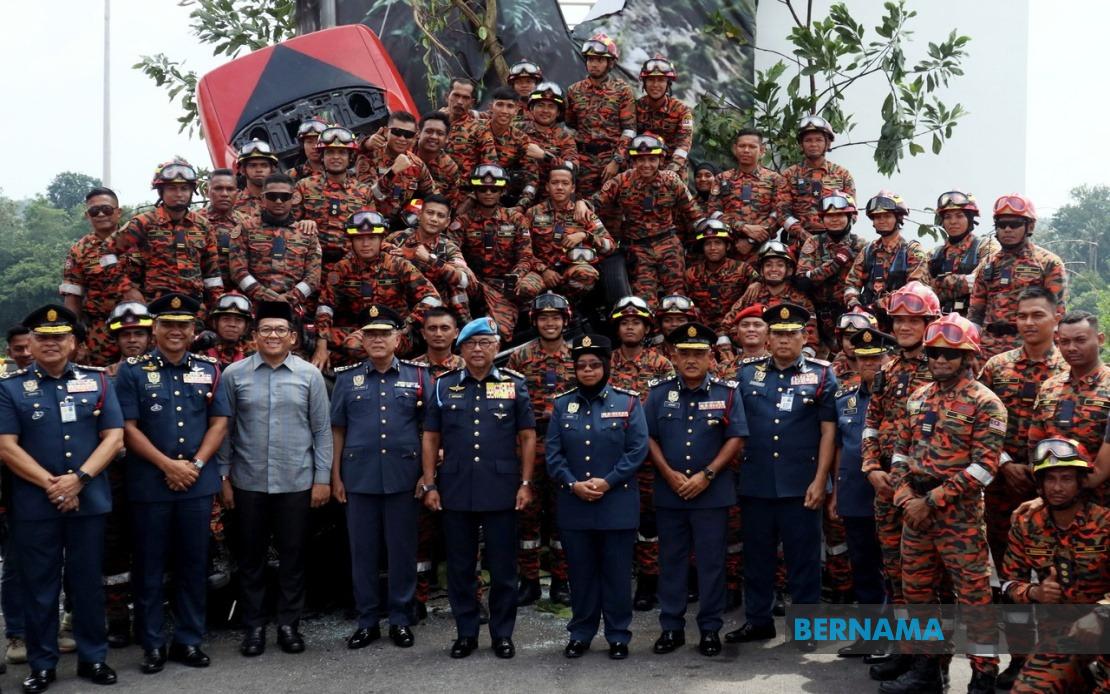
The Federal Government has announced an annual allocation of RM278.9 million to support 86 development initiatives by the Malaysian Fire and Rescue Department (JBPM) under the First Rolling Plan of the 13th Malaysia Plan (13MP). Deputy minister of Housing and Local Government Datuk Aiman Athirah Sabu disclosed that the fund encompasses 27 fresh undertakings alongside 59 projects already in progress, representing a substantial commitment to strengthening emergency response infrastructure nationwide.
The announcement underscores the government's recognition that fire and rescue services form a critical pillar of public safety infrastructure, requiring sustained investment to meet evolving community needs across both urban and rural settings. This allocation reflects broader prioritisation of emergency services within the medium-term development framework, signalling confidence in the JBPM's operational capacity to deliver measurable outcomes. The scale of commitment—nearly RM279 million annually—demonstrates that despite competing fiscal demands, the administration views comprehensive fire station networks as fundamental to nationwide development goals.
Pahang has emerged as a particular focus for fire and rescue expansion, with seven significant facility projects currently advancing through implementation stages under both the 12th Malaysia Plan (12MP) and the 13MP's initial rolling phase. These undertakings span the acquisition and construction of new fire and rescue stations (BBP) across strategically important locations including Gohtong Jaya, Benta, Tioman, Bentong, Kuantan, Triang, and Tanjung Lumpur. The scope of activity demonstrates coordinated state-level planning rather than ad hoc facility development, suggesting systematic mapping of coverage gaps and demographic shifts requiring enhanced emergency services presence.
Among these projects, the newly operational Sungai Lembing BBP represents a RM6 million investment completed on a seven-acre site, marking the 29th fire and rescue station established in Pahang. The facility commenced operations on 15 February, positioning itself to serve approximately 15,000 residents within Sungai Lembing township and adjacent communities. For a locality with historical mining heritage, the modern emergency station symbolises integration of contemporary safety infrastructure into heritage conservation narratives increasingly prominent in Malaysian regional development.
Deputy minister Aiman Athirah articulated an expanded institutional vision beyond traditional fire suppression functions. She emphasised the Sungai Lembing station's potential to evolve into a comprehensive community safety hub—a multipurpose centre delivering knowledge dissemination, technical skills training, and public awareness initiatives aimed at cultivating grassroots lifesaving capacity. This conceptualisation reflects international best practice approaches where fire stations serve dual roles as emergency response facilities and community education platforms, contributing to resilience-building at neighbourhood levels.
For Malaysian readers, this approach carries particular significance given the nation's diverse geography spanning urban high-rise concentrations, sprawling suburban developments, industrial zones, and scattered rural settlements. Equipping fire stations as community learning centres allows them to address localised hazard profiles—whether workplace safety in manufacturing areas, electrical risks in congested shophouses, or agricultural fire prevention in rural constituencies—through contextualised programming rather than standardised approaches.
The Deputy Economy Minister and Paya Besar Member of Parliament Datuk Mohd Shahar Abdullah contextualised the Sungai Lembing station within broader heritage town revitalisation efforts. He identified fire and rescue infrastructure as complementary to conservation initiatives including cinema restoration, ecotourism product development, digital museum construction, tunnel upgrading, and aspirational UNESCO World Heritage Site designation. This positioning demonstrates emerging recognition that modern safety systems enhance rather than compete with heritage preservation agendas, enabling authentic community functioning alongside tourism and cultural objectives.
Sungai Lembing's trajectory exemplifies post-industrial town regeneration challenges throughout Southeast Asia, where former mining or resource-dependent communities require strategic repositioning toward sustainable tourism and heritage economy models. Integrating contemporary emergency services infrastructure into such transformations serves multiple functions: it enables safe community living standards essential for residential retention, facilitates visitor confidence in heritage tourism products, and demonstrates institutional commitment to locality futures extending beyond historical narratives.
The fire and rescue expansion programme carries implications for Malaysian regional competitiveness and service delivery credibility. Countries and states competing within ASEAN tourism and investment landscapes increasingly evaluate infrastructure quality across multiple dimensions beyond traditional business corridors. Modern emergency response systems, visible through contemporary station facilities and professional presence, signal operational maturity and institutional reliability—factors increasingly influencing relocation decisions for international business operations and high-value tourism investment.
For Pahang specifically, the cumulative development activity—embracing facility construction, equipment acquisition, and personnel stationing—represents significant economic stimulus distributed across multiple towns and rural areas. Fire station construction generates local employment, procures materials from regional suppliers, and establishes permanent institutional presences in secondary towns sometimes overlooked by centralised development planning. The broader 13MP allocation ensures this dynamic extends beyond Pahang to address coverage gaps nationwide.
The involvement of senior state leadership, including Pahang Menteri Besar Datuk Seri Wan Rosdy Wan Ismail and the Sultan of Pahang Al-Sultan Abdullah Ri'ayatuddin Al-Mustafa Billah Shah in the Sungai Lembing station inauguration, underscores political priority assigned to emergency services infrastructure. Such high-level participation legitimises the initiative within state governance hierarchies and signals sustained commitment beyond single budget cycles, potentially encouraging institutional planning horizons extending toward long-term sustainability rather than project-to-project fragmentation.
Moving forward, the RM278.9 million annual allocation's effectiveness will depend substantially on implementation consistency, personnel training adequacy, and maintenance commitment. Malaysian stakeholders accustomed to infrastructure initiatives should monitor not merely construction completion but subsequent operational integration, ensuring new stations achieve stated community service objectives rather than functioning as underutilised facilities. The government's willingness to fund 13MP rolling plans across multiple years suggests recognition that fire and rescue capability development demands sustained investment rather than episodic spending, a disciplined approach that may set precedent for other critical services competing for development resources.

