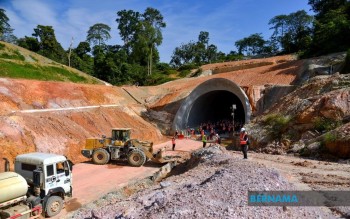
Malaysia's federal government has given the green light to a substantial package of 46 development projects destined for the Pasir Puteh parliamentary constituency in Kelantan, with an aggregate budget ceiling of RM207.2 million targeted for 2026. The portfolio of initiatives reflects a deliberate government strategy to harness the momentum of major infrastructure investments, particularly the East Coast Rail Link, to catalyse economic expansion across the country's northeastern corridor. Deputy Economy Minister Datuk Mohd Shahar Abdullah disclosed the approval during parliamentary proceedings on July 13, highlighting how the proposed developments align with broader national planning objectives under the 13th Malaysia Plan.
At the heart of this investment push lies an ambitious vision to transform the area surrounding Pasir Puteh into a dedicated logistics and downstream industrial zone. The approved projects encompass land acquisition, site preparation, and foundational infrastructure development specifically designed to support industrial operators seeking proximity to the ECRL cargo station. This targeted approach differs from generic regional development, instead focusing infrastructure spending where existing assets and geographical advantages create genuine comparative strengths. The government's methodology reflects recognition that modern economic development requires deliberate clustering of complementary activities rather than dispersed, isolated projects.
The strategic logic underpinning these investments becomes clearer when considering Pasir Puteh's locational advantages. The proposed industrial zone benefits from immediate access to the ECRL's cargo handling capabilities, while sitting within reasonable distance of the Tok Bali Supply Base, a maritime logistics facility that has historically served offshore oil and gas operations. This convergence of rail and maritime infrastructure creates what planners describe as a multi-modal logistics advantage, potentially attractive to companies seeking to minimise transportation costs and maximise supply chain flexibility. For Malaysian manufacturers and regional trading firms, such infrastructure integration can significantly improve competitiveness compared to operating from inland locations requiring longer final-mile delivery routes.
Deputy Minister Mohd Shahar emphasised during parliament that the government's approach extends beyond simply allocating money to individual projects. Rather, the funding framework operates within a structured masterplan known as the ECRL Integrated Land Use Master Plan, abbreviated as PGTA-ECRL. This planning instrument coordinates land use decisions, infrastructure sequencing, and investment timing across multiple stakeholders to ensure that private sector activities can actually materialise once government-funded backbone infrastructure arrives. Without such coordinated planning, expensive public infrastructure often sits underutilised because surrounding land remains fragmented, unserviced, or claimed for incompatible purposes. The masterplan approach demonstrates how Malaysia's approach to ECRL catalysis has evolved since the megaproject's inception, moving beyond simply completing the railway toward creating functional economic ecosystems around its stations.
For Kelantan, historically one of Malaysia's lower-income states measured by per-capita GDP, such targeted investment carries genuine significance. The projects promise direct employment during construction phases, whilst the anticipated industrial clustering offers sustained job creation once operational. Beyond employment, downstream industrial development typically generates local multiplier effects as workers spend wages in communities, suppliers emerge to serve facility operators, and ancillary service providers establish themselves. The government's framing explicitly acknowledges development inequality between regions as a policy concern, with Deputy Minister Mohd Shahar noting that infrastructure spending decisions now incorporate regional equity objectives alongside pure economic return considerations.
The temporal dimension of these initiatives warrants attention for investors and regional planners monitoring Kelantan's transformation. Mohd Shahar confirmed that projects within the 13th Malaysia Plan framework are scheduled to commence during 2024 and extend through 2030, providing a seven-year implementation window. This extended timeline reflects the reality that major infrastructure zones require phased development, with early projects establishing foundational capacity before subsequent tranches build out supporting facilities. For private enterprises contemplating investment in the emerging Pasir Puteh industrial zone, this timeline offers visible government commitment signalled through approved budget allocations, though execution risks remain inherent to any long-term development programme.
The government's accountability mechanism for tracking project progress merits consideration for transparency advocates and fiscal watchdogs. Deputy Minister Mohd Shahar indicated that the MyRMK system, Malaysia's digital project monitoring platform, will track advancement across these initiatives with periodic parliamentary reporting. This commitment to transparent progress reporting represents an evolution from historical practice where infrastructure spending sometimes proceeded without rigorous public accountability measures. For Malaysian stakeholders seeking assurance that the RM207.2 million commitment will be efficiently deployed, the monitoring framework provides at least a structural mechanism for oversight, though actual performance will depend on implementation rigour and government follow-through on reporting commitments.
The broader context for these Pasir Puteh investments involves Malaysia's strategic pivot toward leveraging the ECRL as an economic catalyst rather than merely a transport corridor. The megaproject, once controversial due to its financing terms and initially uncertain commercial viability, has increasingly been positioned as a foundation for regional value-creation strategies. Pasir Puteh represents merely one node within the broader ECRL network stretching from Port Klang through Selangor, Pahang, Terengganu, and Kelantan toward Thailand. However, the Kelantan endpoint's relative distance from Malaysia's economically dominant Klang Valley means that deliberate economic incentives and infrastructure clustering become essential for attracting private investment that might otherwise concentrate closer to existing population and manufacturing centres.
The industrial development strategy reflects government recognition that different regions possess distinct competitive advantages that should inform investment prioritisation. Deputy Minister Mohd Shahar explained that under the 13MP framework, resource allocation decisions consider each locality's inherent strengths, whether logistics, tourism, agriculture, or other sectors. This principle-based approach suggests a departure from indiscriminate spending toward more targeted initiatives aligned with regional comparative advantages. For Pasir Puteh, logistics and downstream industrial processing represent acknowledged strengths given ECRL accessibility and maritime proximity, justifying concentrated infrastructure investment in these domains rather than attempting to force alternative economic activities better suited to other locations.
The implications for neighbouring regions and the broader Southeast Asian context deserve consideration. Malaysia's deliberate effort to generate economic spillovers from the ECRL through industrial clustering mirrors strategies deployed across the region by neighbouring Thailand, Vietnam, and increasingly Indonesia as they seek to ensure that major infrastructure investments generate broad-based prosperity rather than concentrated gains. The Pasir Puteh approach suggests that ASEAN nations recognise merely building transport infrastructure proves insufficient without complementary land-use planning and industrial estate development that enables businesses to actually utilise those connections. This evolving understanding should inform how regional governments approach their own infrastructure megaprojects and regional connectivity initiatives.
For Malaysian businesses and foreign investors considering industrial expansion in Malaysia's eastern corridor, the Pasir Puteh portfolio represents a tangible government signal regarding regional development priorities and infrastructure investment sequencing. The RM207.2 million commitment, combined with explicit masterplanning and monitoring mechanisms, suggests government seriousness about establishing Kelantan as a logistics hub rather than treating announcements as rhetorical flourishes. However, realisation of this vision ultimately depends on whether private sector actors actually establish operations once infrastructure becomes available, requiring that government infrastructure investments prove genuinely valuable to businesses rather than solutions in search of problems. The coming years will reveal whether the Pasir Puteh ECRL zone emerges as a functional economic hub or becomes another instance of infrastructure infrastructure without sustainable economic activity.

