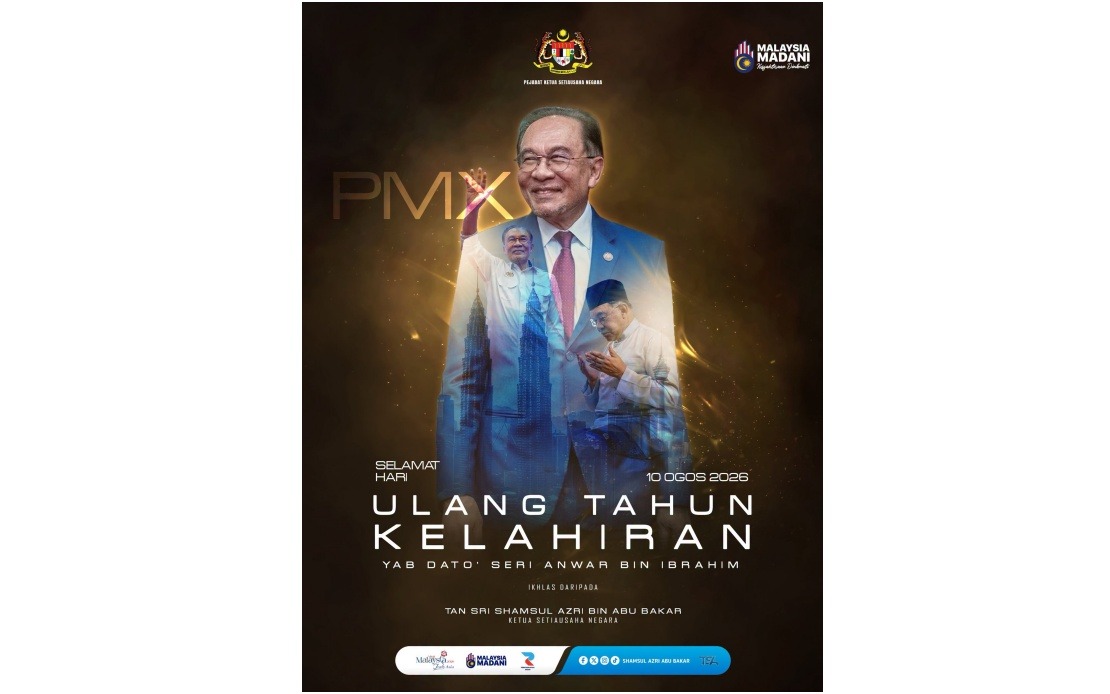
Prime Minister Datuk Seri Anwar Ibrahim received warm birthday wishes from the country's top administrative and political leadership on August 10 as he marked his 79th birthday. The gestures reflected the institutional support backing his administration, with key figures from across government expressing their well-wishes and reaffirming their commitment to his policy agenda.
Chief Secretary to the Government Tan Sri Shamsul Azri Abu Bakar led the official tributes, issuing a statement through Facebook that conveyed hopes for the Prime Minister's continued good health, strength, and wisdom as he guides the nation. The CSG's message carried particular significance given his role as the country's most senior civil servant and his direct responsibility for ensuring the machinery of government functions effectively in support of the Prime Minister's directives.
Beyond personal well-wishes, Shamsul Azri used the occasion to reaffirm the civil service's commitment to the government's broader reform agenda. He pledged that the entire bureaucratic apparatus would remain steadfast in supporting the Prime Minister's aspirations for transforming the public sector to better serve Malaysian citizens. This statement underscored the administration's focus on institutional modernisation and improved governance, themes that have featured prominently in recent policy discussions at the highest levels of government.
The Prime Minister's Office also participated in the birthday acknowledgements, releasing a video message that framed the milestone within the context of governmental endeavour. The recorded message emphasised continuity of effort, the fulfilment of public trust, and reliance on divine guidance—messaging that resonated with the spiritual and ethical dimensions often invoked in Malaysian political discourse. The statement's emphasis on ongoing efforts suggested an administration narrative centred on persistent commitment to national objectives despite the complexities of governance.
The Malaysia MADANI initiative, the government's overarching policy framework, similarly extended birthday wishes through its official social media channels. The message sought Allah's protection for the Prime Minister and expressed hope that he would continue to derive strength for his labours on behalf of the nation and its people. The invocation of the MADANI platform in these well-wishes reinforced the thematic unity across government institutions in promoting the administration's core policy vision.
At 79 years old, Anwar Ibrahim continues as one of Southeast Asia's longest-serving contemporary prime ministers, bringing decades of political experience to the office. His leadership spans a period of significant economic and social challenges, including the ongoing management of Malaysia's fiscal position, infrastructure development, and efforts to strengthen democratic institutions. The birthday tributes from institutional leaders reflected broader confidence in his continued stewardship during a complex domestic and regional environment.
The coordinated nature of these birthday messages—spanning the office of the Prime Minister, the civil service hierarchy, and the MADANI policy framework—illustrated the interconnected nature of Malaysia's political and administrative structures. Such public acknowledgements, while ceremonial in character, serve to reinforce institutional cohesion and demonstrate alignment between political leadership and bureaucratic machinery at a time when effective coordination between these elements remains crucial for policy implementation.
The emphasis on health and strength in these messages carried implicit recognition of the demanding nature of the Prime Minister's role. Leading a nation of over 33 million people, overseeing a complex federal system, managing economic policy during periods of global uncertainty, and navigating the intricate dynamics of Malaysian coalition politics demands substantial physical and mental resilience. The well-wishers' focus on these attributes reflected understanding of the rigours inherent in Malaysia's highest political office.
For Malaysian observers and those tracking regional governance, these institutional expressions also signalled continuity in leadership direction. Rather than marking a moment of reflection on tenure or contemplation of succession, the messages framed the birthday as an occasion for renewed commitment to ongoing work. This framing suggested that despite the Prime Minister's age, the administration's focus remained forward-looking, concentrated on the implementation of its policy agenda and institutional reforms.
The birthday tributes also reflected Malaysia's particular political culture, in which expressions of respect for senior leaders carry significant weight within institutional hierarchies. The CSG's public statement, in particular, carried implications for how the civil service perceives its relationship with political leadership and the legitimacy of the government's reform agenda within the bureaucracy. Such endorsements from administrative elites can influence how policies are received and implemented throughout government departments and agencies.

