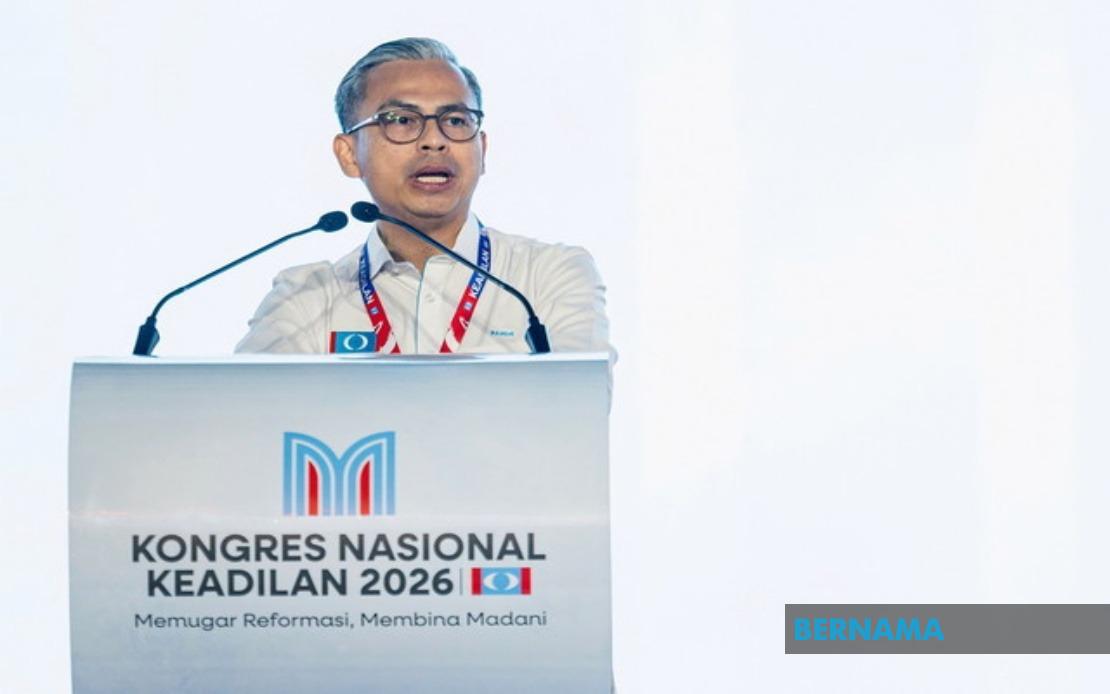
The Malaysian government faces a persistent messaging challenge: its macroeconomic achievements are failing to resonate with ordinary citizens in their daily lives. This gap between headline economic performance and public perception became the focal point at the 2026 PKR National Congress in Melaka, where Communications Minister Datuk Seri Fahmi Fadzil signalled an overhaul of how the administration communicates its accomplishments to voters.
Fahmi, who holds the dual roles of PKR information chief and government Communications Minister, framed the problem candidly during his winding-up speech to party delegates. Many Malaysians, he observed, remain unaware of or unmoved by policies introduced under PKR president Datuk Seri Anwar Ibrahim's leadership, despite their technical success in stabilising the broader economy. The disconnect suggests that macroeconomic indicators—the "pot economy" in Fahmi's terminology—mean little to families grappling with cost-of-living pressures, employment uncertainty, or eroding purchasing power. This perception gap represents a genuine political vulnerability for the government, particularly as it approaches the next general election.
The minister's acknowledgement reflects a broader challenge facing ruling coalitions worldwide: translating abstract economic management into tangible, relatable benefits that voters can experience directly. In Malaysia's context, this is especially pressing given that the administration inherited a fiscally stressed economy and has pursued disciplined macroeconomic policies. Yet if these efforts remain invisible to the average household, the political dividend shrinks considerably. Fahmi's candour suggests that PKR leadership recognises this deficit and views it as correctable through improved strategy rather than fundamental policy failure.
To bridge this chasm, Fahmi outlined a multi-pronged communications strategy centred on emotional resonance rather than technical detail. The government intends to expand smaller-scale engagement sessions—town halls, discussion forums, and grassroots dialogues—that allow ministers and officials to explain policies in relaxed settings where questions can flow naturally. This shift moves away from formal, top-down announcements towards two-way conversation. The rationale is sound: people absorb information differently depending on context, and informal settings encourage the kind of deep comprehension that formal statements rarely achieve. By leveraging division chiefs and grassroots leaders within PKR's organisational structure, the government aims to translate national policy into localised, comprehensible narratives.
Crucially, Fahmi emphasised that the emotional dimension of communication has been underweighted. Policies must not merely be understood intellectually but must resonate emotionally—they must "find a place in the hearts of the people," as he put it. This recognition signals a move away from technocratic messaging towards storytelling that connects policy outcomes to lived experience. For instance, rather than touting GDP growth figures, communications might highlight how specific policy decisions have created jobs in a particular community or reduced costs for small traders. This approach requires far greater sophistication in messaging than the standard government press release.
A secondary but important component of the revised strategy addresses the weaponisation of misinformation, particularly on sensitive topics. Fahmi highlighted that since the Johor state election, the Malaysian Communications and Multimedia Commission identified and flagged over 8,410 fake accounts exploiting the "3R issues"—religion, race, and the royal institution. These accounts deliberately spread divisive falsehoods designed to polarise voters and erode trust in government. By combating coordinated inauthentic behaviour on social media platforms, the government seeks to create clearer information space in which genuine policy discussion can occur. Without addressing this manipulation, even improved government communications risk being drowned out by louder, more emotionally charged but false narratives.
Fahmi's remarks on media relations also signal a recalibration. The minister explicitly rejected any characterisation of his approach as media control, instead framing it as fact-checking conducted "in an orderly and courteous manner." This distinction matters, particularly for international observers and Malaysian civil society groups sensitive to press freedom concerns. The approach suggests the government will not suppress critical journalism but will formally challenge demonstrably false claims. Whether media outlets and journalists view this as constructive or as a de facto pressure tactic will likely depend on implementation.
The involvement of PKR's Wanita wing in the revised communications framework also warrants attention. Women's organisations often enjoy deeper community penetration than formal government structures, particularly in smaller towns and rural areas. By formalising cooperation with this wing, the party aims to access networks and trust relationships that can amplify authentic messaging more effectively than traditional bureaucratic channels. This represents a recognition that political communications in the modern era require non-governmental intermediaries to carry credibility.
For Malaysia and Southeast Asian observers, Fahmi's acknowledgement carries broader implications. Across the region, newly elected or reformist governments frequently discover that policy competence and electoral promises do not automatically translate into public satisfaction. The gap between what governments accomplish in technical terms and what citizens perceive reflects not merely communications failure but also the inherent difficulty of connecting macroeconomic management to microeconomic reality. Fahmi's strategy—emphasising grassroots engagement, emotional resonance, and digital integrity—mirrors approaches adopted by governments from Indonesia to Thailand as they grapple with similar perception problems.
The success of PKR's revised communications approach remains to be tested. Enhanced messaging can shift perceptions at the margins, but it cannot overcome fundamental policy failures or genuine economic hardship. If Malaysians continue to face real pressure on household finances despite government claims of economic success, no amount of improved communications will restore confidence. The effectiveness of Fahmi's strategy will ultimately hinge on whether government policies are indeed delivering material benefits that communications can credibly amplify—and whether the administration can sustain focus on this agenda beyond the immediate post-congress period.

