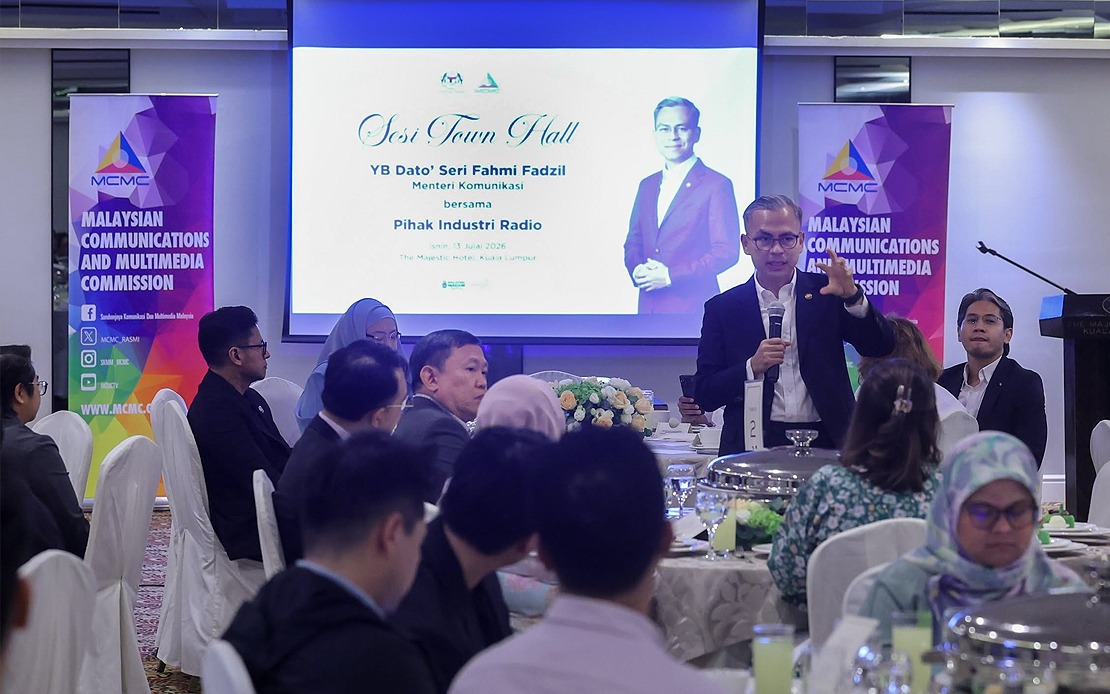
The Malaysian government has committed to conducting a thorough examination of the radio broadcasting sector through a formal study of the National Broadcasting Policy, Communications Minister Datuk Seri Fahmi Fadzil announced on July 13. The review will be spearheaded by the Malaysian Communications and Multimedia Commission (MCMC) and forms part of broader efforts to revitalise the nation's broadcasting ecosystem in alignment with the National Creative Industry Policy and the Orange Economy Council's strategic initiatives.
Fahmi's announcement follows a substantive town hall engagement with radio industry stakeholders, during which sector representatives were invited to share insights on current challenges, opportunities, and recommendations for industry development. The consultation process represents a deliberate attempt by the government to ground its policy review in practical, market-level intelligence rather than relying solely on bureaucratic analysis. This inclusive approach signals recognition that sustainable regulatory frameworks must be built with input from those operating within the sector daily.
The scope of the MCMC's investigation encompasses several interconnected dimensions of radio broadcasting sustainability. Among the priority areas for examination are strategies to elevate homegrown musical content on Malaysian radio stations, an issue of particular importance given competition from streaming platforms and international content. The review will also assess various licensing models currently in operation to determine whether existing frameworks adequately support station viability while serving public interest objectives.
Industry sustainability emerged as a central concern during the town hall discussions. Radio stations across Malaysia face mounting pressure from cord-cutting trends, the proliferation of digital audio platforms, and shifting listener demographics—challenges not unique to Malaysia but particularly acute in a market where streaming services have achieved rapid adoption. The government's willingness to systematically examine licensing arrangements and financial sustainability mechanisms suggests acknowledgment that traditional regulatory approaches may require updating to reflect contemporary listening patterns and revenue generation realities.
The digital landscape's rapid evolution presents both existential challenge and transformation opportunity for Malaysia's radio sector. As listeners increasingly access audio content through on-demand services, podcasts, and social media platforms, traditional FM and AM broadcasters must redefine their value proposition. The MCMC study will ostensibly examine how radio can maintain relevance and competitive positioning without abandoning the medium's historical strengths—its immediacy, intimacy, and accessibility to diverse geographic and demographic audiences across the country.
Local music content enhancement carries particular significance for Malaysia's creative industries. Radio stations function as crucial discovery mechanisms for Malaysian musicians, yet international content dominates many playlists due to licensing economics and perceived listener preferences. A policy framework encouraging greater airtime for local artists could simultaneously support the music industry's growth, strengthen cultural identity through broadcasting, and provide stations with differentiated programming that digital platforms struggle to replicate.
The Orange Economy Council's involvement in this initiative reflects the government's positioning of the creative and cultural sectors as economic drivers. Radio broadcasting's role extends beyond entertainment—it represents a platform for local talent development, community engagement, and cultural expression. By anchoring the radio industry review within this broader creative economy framework rather than treating broadcasting in isolation, policymakers signal that sector revival is understood as integral to larger national development objectives.
Fahmi emphasised the government's commitment to ongoing collaboration with industry players, indicating that the MCMC study will likely feed into iterative policy dialogue rather than representing a top-down mandated restructuring. This collaborative posture proves particularly important given the political sensitivity surrounding media regulation in Malaysia. Broadcasters and industry bodies will expect meaningful incorporation of their recommendations into any subsequent policy adjustments, and government acknowledgment of this partnership approach may forestall regulatory backlash.
The timing of this policy review aligns with broader Southeast Asian trends in broadcasting regulation. Across the region, governments confront similar pressures to modernise radio licensing frameworks, support local content production, and maintain public service broadcasting values amid digital disruption. Malaysia's approach—combining formal policy review with stakeholder consultation—mirrors developments in countries like Indonesia and Thailand, suggesting possible scope for regional collaboration or learning on broadcasting governance issues.
For Malaysian radio stations, the MCMC study presents both uncertainty and opportunity. Uncertainty stems from regulatory unpredictability—existing operators cannot yet determine how policy recommendations will affect licensing costs, ownership concentration limits, or content obligations. Opportunity exists for stations to influence emerging frameworks through substantive engagement with the review process, potentially advocating for regulatory streamlining or commercial flexibility that current arrangements constrain.
The study's outcome will likely influence Malaysia's radio landscape for the coming decade. A policy framework that successfully addresses industry sustainability while supporting local talent development and maintaining public service objectives would represent genuine accomplishment. Conversely, if recommendations prove too prescriptive or fail to adapt licensing models to digital-era economics, the sector risks continued contraction regardless of policy intentions.
Beyond commercial implications, the government's approach signals investment in preserving radio as a distinct medium within Malaysia's increasingly crowded audio marketplace. As smartphone penetration and internet access expand throughout the country, radio's capacity to reach diverse audiences—including those with limited data availability or digital literacy—makes it a valuable tool for information dissemination, particularly outside urban centres. The MCMC review implicitly recognises this public utility dimension alongside commercial sustainability concerns.

