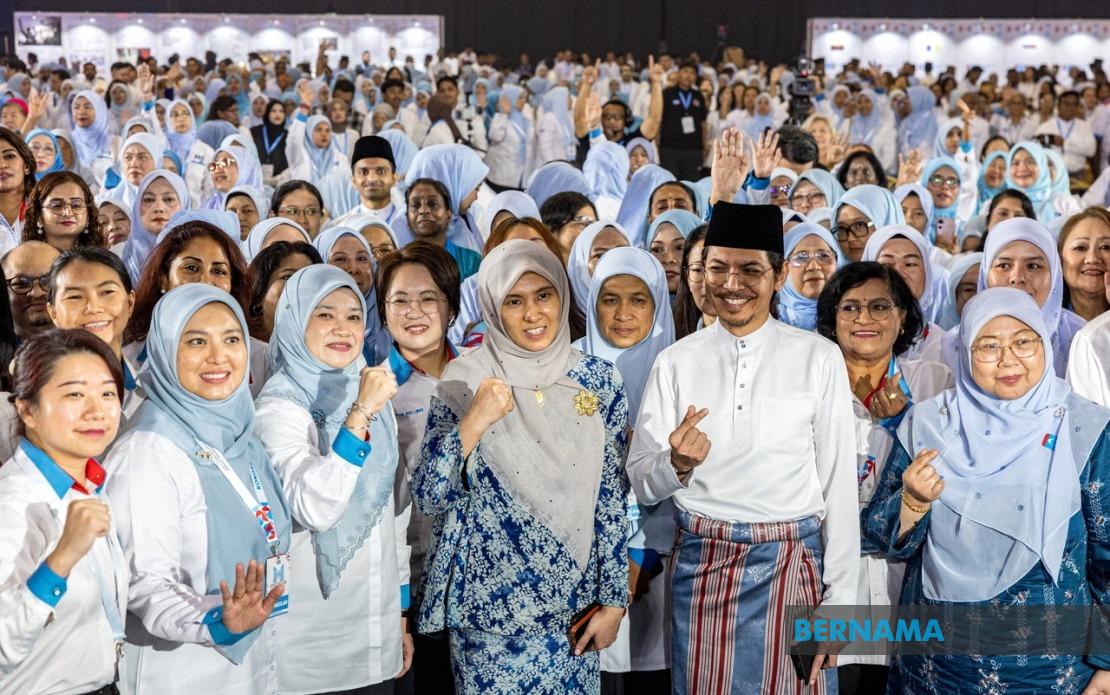
Political leaders must invest significantly in developing robust community networks at the grassroots level to preserve meaningful connections with voters and residents, according to Angkatan Muda Keadilan (AMK) chief Muhammad Kamil Abdul Munim. Speaking during the closing of debate on the AMK Chief's Policy Address at the 2026 AMK National Congress in Melaka on August 14, he articulated a vision where elected representatives remain embedded within their constituencies through sustained engagement and visible presence rather than relying solely on top-down communication strategies.
Muhammad Kamil underscored that maintaining proximity to communities serves multiple strategic purposes beyond simple relationship-building. He argued that strong local networks enable political parties to effectively disseminate their preferred narratives and counter negative perceptions that competing political forces may seek to establish. In the contemporary media landscape where information travels rapidly across multiple channels, controlling messaging at the grassroots becomes increasingly vital for parties seeking to frame debates and maintain voter loyalty. The AMK chief suggested that without this foundational community presence, even compelling national-level narratives risk losing resonance at the local level where voters experience governance most directly.
The emphasis on multi-layered engagement reflects recognition that successful politics in Malaysia requires simultaneous operation across different levels of communication and organisation. Muhammad Kamil enumerated the various components that contribute to effective political outreach: the physical presence of leaders in communities, the clarity and consistency of party messaging, the strength of party machinery in mobilising supporters, the sophistication of communication channels, and crucially, the depth of established networks at grassroots level. This comprehensive approach suggests that neglecting any single element creates vulnerabilities that opposition parties may exploit.
A particularly significant aspect of his remarks concerned the timing and nature of electoral preparation. He cautioned against concentrating exclusively on crafting national-level narratives and policy positions while neglecting the parochial concerns of local communities. This distinction carries particular weight in the Malaysian context, where voters often judge party performance based on immediate local impacts—quality of infrastructure, responsiveness to neighbourhood complaints, availability of employment opportunities—rather than abstract national policy frameworks. By directing attention to community-specific issues and needs, parties can demonstrate tangible relevance to constituents' daily lives.
Muhammad Kamil also addressed the internal challenge of party cohesion and ideological commitment, particularly regarding newer members who may lack deep understanding of organisational history and foundational principles. He urged local leaders to intensify programmes and activities designed to cultivate ideological consciousness among grassroots membership, especially those recently recruited. This concern reflects a broader anxiety within political movements about whether rapid expansion in membership creates a solid base of committed supporters or merely a shallow pool of individuals attracted by transient incentives or personality cults.
The AMK chief articulated a worry that without deliberate efforts to educate new members about party ideals, historical struggles, and underlying philosophical commitments, parties risk developing a membership that lacks comprehension of why particular platforms matter or what distinguishes one party from another. This vulnerability becomes particularly acute during competitive elections when opposing parties may attract disengaged members through superior material inducements or more compelling short-term appeals. He suggested that members who understand the reasons for their party affiliation and grasp the principles animating its struggle become far more resilient to such poaching attempts.
The emphasis on ideological clarity and institutional memory carries implications for Malaysian politics more broadly. In an environment where electoral competition has intensified and voter allegiances have become less predictable, parties that successfully instil commitment grounded in principle rather than patronage gain significant advantages. This approach contrasts with transactional politics where support flows toward whichever party offers the most attractive immediate benefits. By investing in member education about party values and historical context, AMK appears to be positioning itself as an organisation concerned with building durable political culture rather than merely accumulating votes.
Muhammad Kamil's warnings about the danger of gradually deviating from the party's original mission reflect concerns that resonate across Malaysia's political spectrum. Parties that grow rapidly without corresponding investment in ideological indoctrination often discover that institutional identity becomes diluted, internal cohesion deteriorates, and the organisation becomes vulnerable to capture by factions pursuing particularistic interests rather than collective purpose. His framing suggests that the struggle to maintain organisational integrity and ideological fidelity represents an ongoing challenge rather than a problem solved through initial establishment.
The practical implications of his remarks extend beyond internal party management to influence how Malaysian political parties approach the crucial 2026 election cycle. Rather than concentrating resources and strategic energy exclusively at federal level where major policy decisions occur, his analysis suggests that local-level organising provides essential foundation for sustained electoral competitiveness. This perspective potentially rebalances how parties allocate their considerable resources between national campaigns and grassroots infrastructure development.
Muhammad Kamil's address ultimately articulates a political philosophy emphasizing that sustained democratic engagement requires continuous cultivation of human relationships and institutional trust at the community level. In an era when digital communication and television advertising command enormous investment and attention, his emphasis on traditional grassroots organising through face-to-face interaction and genuine community programme participation suggests that Malaysia's most successful political movements will continue to blend modern communication technologies with the enduring effectiveness of localised networks and personal connections between elected representatives and constituents. This synthesis of traditional and contemporary political practice may prove decisive in determining which parties maintain relevance and electoral viability across successive election cycles.

