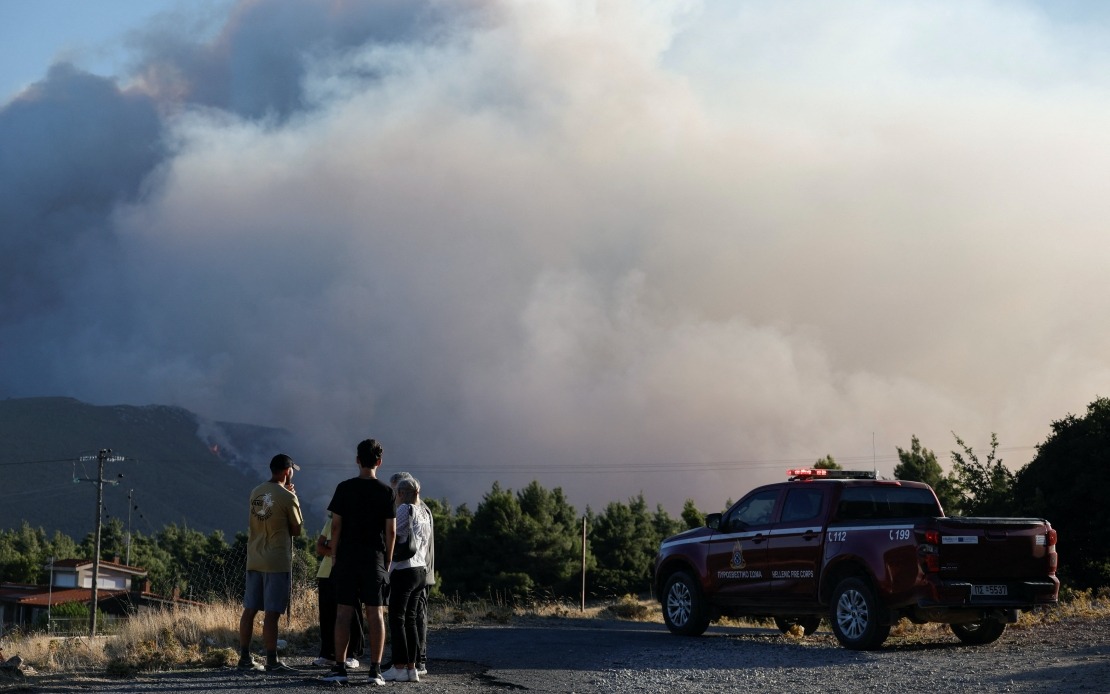
Firefighting efforts intensified across Greece on Sunday as a vast wildfire continued its destructive sweep through the Kithairon Mountains, west of the capital Athens. Throughout the night and into daybreak, hundreds of emergency personnel maintained continuous operations against the spreading flames, supported by an array of military vehicles, specialist equipment, and civilian volunteers. The scale of the response underscores the severity of the situation, with state broadcaster ERT confirming that aerial operations resumed at first light as firefighting planes and helicopters joined ground crews in their battle against the advancing inferno.
The fire's progression has been marked by sudden accelerations caused by strong wind conditions, transforming the rate at which flames consume vegetation and structures. The communities of Veniza and Psatha have emerged as particularly devastated areas, bearing the brunt of the fire's intensity as it sweeps eastward across the landscape. Meteorological conditions have proven a significant complicating factor, with wind-driven spread creating unpredictable patterns that challenge even experienced fire management personnel. This environmental factor explains the urgency with which authorities have mobilised resources and expanded the scale of deployment.
The threat level escalated considerably as the fire advanced towards Megara, a city situated approximately 50 kilometres west of Athens with a population that faced potential evacuation orders. Being within such proximity to a major urban centre, the wildfire poses risks not merely to peripheral communities but to infrastructure and population centres that form part of the Athens metropolitan area. The advancing flames now threaten the outer boundaries of this significant settlement, elevating public concern and prompting heightened alert status among local authorities and residents.
International cooperation has become central to Greece's firefighting response, with specialist personnel from both Romania and France deployed alongside Greek crews. The engagement of foreign resources reflects both the magnitude of the challenge and the established protocols for mutual assistance among European Union member states during environmental emergencies. Official figures indicate that at least 500 firefighters have been mobilised in coordinated operations, representing a substantial commitment of human resources to contain and suppress the spreading flames.
Investigative authorities have taken action against individuals suspected of contributing to the crisis, with 13 people arrested nationwide on charges of negligent arson. These arrests indicate that human negligence may have played a role in triggering the disaster, though specifics regarding individual circumstances have not been disclosed. The criminal element adds a layer of complexity to what would otherwise be understood primarily as a natural disaster, raising questions about fire prevention measures and public awareness campaigns regarding wildfire risk in vulnerable areas.
Multiple fire zones across Greek territory have demanded coordinated attention from authorities. The island of Cephalonia, located in the Ionian Sea, continues to experience significant wildfire activity, though current assessments suggest that populated areas remain outside the immediate danger zone at present. This assessment offers some relief, but the situation remains fluid as wind conditions and fire behaviour can change rapidly, necessitating continuous monitoring.
Conditions on Crete have shown relative improvement, with media reports indicating that wildfires across the island have largely been brought under control. However, the damage inflicted during the peak of the fires has been substantial, with several communities having been evacuated preventively. Unconfirmed reports suggest that up to 200 homes have been destroyed across affected Cretan localities, though official governmental confirmation of these figures has not yet been released. Such destruction represents significant economic loss and displacement for affected residents.
The cumulative environmental impact has been quantified in preliminary assessments by meteorological experts. Approximately 10,000 hectares of land in the north-western and western regions surrounding Athens have been consumed by the current fire outbreak, according to calculations published through news portal Protothema. This vast acreage represents not only immediate ecosystem damage but longer-term environmental consequences including soil degradation, habitat destruction, and altered landscape characteristics that will persist for years following suppression efforts.
For Southeast Asian observers, the Greek wildfire crisis offers instructive parallels to the regional phenomenon of transboundary haze and large-scale forest fires, which periodically afflict countries including Indonesia, Malaysia, and neighbouring nations. The organisational response demonstrated by Greek authorities—rapid mobilisation of international assistance, deployment of aerial resources, and coordination across multiple jurisdictions—reflects best practices that regional fire management agencies continue to develop and refine. The integration of military assets, civilian volunteers, and international personnel into unified command structures represents an operational model that has proven effective in European contexts and offers potential lessons for Southeast Asian disaster management frameworks.

