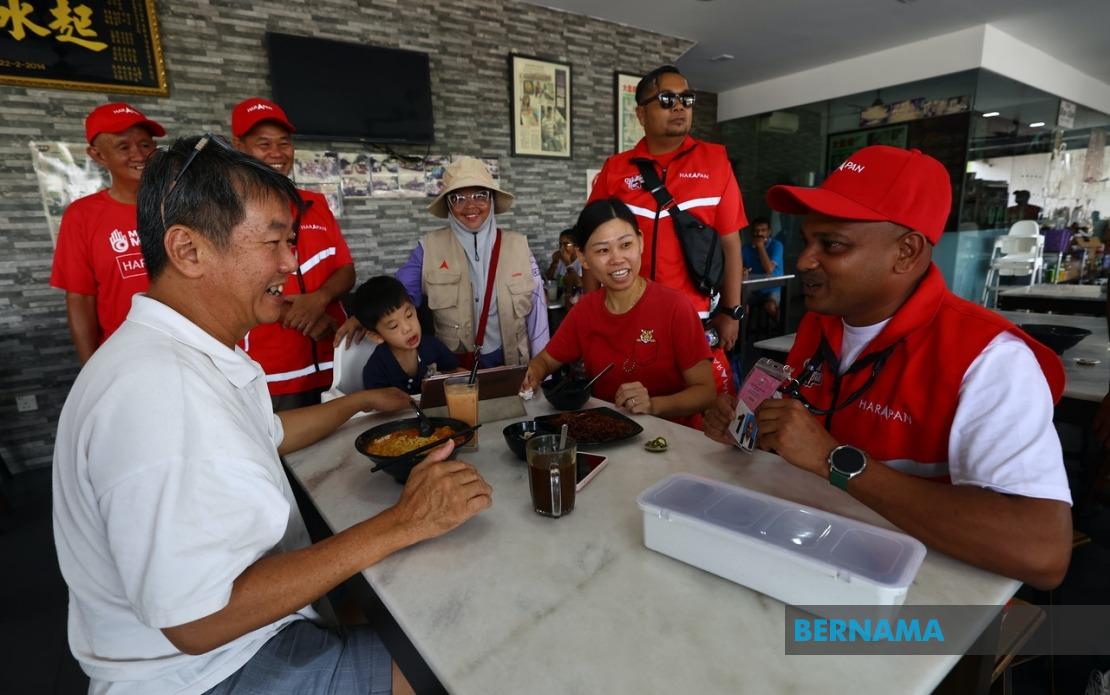
Pakatan Harapan candidate Guna Balakrishnan is pressing hard in his final days of campaigning for the Layang-Layang state seat in Johor, determined to connect with the remaining portion of voters he has not yet reached. Speaking from the coalition's operations centre in Kluang, Balakrishnan acknowledged that his campaign team has already canvassed nearly four-fifths of the constituency, but recognises the critical importance of maximising contact with every remaining household before polling day on July 11.
With just five days separating him from election day, Balakrishnan has adopted an ambitious stance towards the final campaign stretch. He declared his willingness to elevate his personal commitment beyond maximum effort, framing the challenge as one requiring exceptional dedication to ensure no voter is overlooked. This intensity reflects the competitive nature of the Layang-Layang contest, where the outcome could prove decisive given the constituency's 25,181 registered voters and a three-way battle between the main political coalitions.
At the heart of Balakrishnan's pitch to voters lies a manifesto centred on tangible solutions to persistent community problems. Infrastructure emerges as a primary concern, with flooding identified as a critical issue requiring immediate attention in this constituency. Beyond flood mitigation, he has committed to upgrading road networks and improving street lighting across Layang-Layang, addressing quality-of-life issues that directly affect daily accessibility and safety for residents. These pledges suggest that Balakrishnan has identified infrastructure deficiencies as a key vulnerability affecting incumbent governance.
Digital connectivity represents another significant plank in his platform, reflecting Malaysia's broader development challenges in rural areas. Balakrishnan has acknowledged the gaps in internet access that inhibit both educational advancement and economic opportunity for residents in less urbanised parts of the constituency. This focus aligns with national concerns about digital inequality and demonstrates recognition that competitive politics increasingly requires candidates to address the infrastructure necessary for participation in the modern economy.
Human capital development forms the forward-looking dimension of Balakrishnan's agenda. His manifesto emphasises women's entrepreneurship, recognising that female participation in business requires targeted support and mentoring. Simultaneously, he has positioned Technical and Vocational Education and Training expansion as essential for youth employment prospects, addressing concerns that conventional educational pathways may not suit all young Malaysians. These initiatives suggest a comprehensive approach to economic participation across demographic groups.
Senior citizen welfare receives explicit attention through Balakrishnan's proposed establishment of a senior citizen activity centre (PAWE), reflecting Pakatan Harapan's apparent recognition that ageing population dynamics require proactive social infrastructure. This commitment goes beyond tokenistic gestures, proposing institutional frameworks that embed care and engagement into community life. Such provisions resonate with constituencies where demographic ageing accelerates the need for purpose-driven activities for retirees.
Local reception to Balakrishnan's platform has proven encouraging, with residents articulating specific alignment between his proposals and their lived concerns. Trader Tan Ah Kiat emphasised that flood mitigation and drainage improvements address chronic vulnerabilities in flood-prone areas, suggesting these are not abstract policy points but responses to recurring community trauma. Tan further highlighted that digital connectivity carries particular significance for rural traders seeking to expand market reach and operational efficiency beyond geographical limitations.
Likewise, R. Kalaiselvan's endorsement of human capital initiatives indicates that growth-oriented policies resonate across demographic segments. His explicit mention of inclusive vision across all community segments suggests that voters increasingly evaluate candidates on their demonstrated understanding of diverse constituent needs rather than generic appeals. This fragmentation of electoral interests places pressure on all candidates to develop granular policy responses.
The three-cornered contest itself shapes campaign dynamics in ways distinct from bilateral competitions. Guna faces competition from Barisan Nasional's Chua Jian Boon and incumbent Abd Mutalip Abd Rahim representing Perikatan Nasional. This configuration allows Pakatan Harapan to potentially consolidate opposition to the incumbent while simultaneously defending against Barisan Nasional's appeal. The existence of three serious contenders reduces the likelihood of overwhelming mandates and heightens the strategic importance of narrowing margins.
Early voting scheduled for Tuesday, July 7, introduces another tactical consideration into the final campaign week. Candidates will compete intensively to mobilise supporters toward early ballots, particularly those unable to vote on election day. This extended voting window compresses the effective campaign period for undecided voters, making Balakrishnan's effort to reach the final 20 per cent increasingly time-sensitive as some voters make decisions before the official polling date.
For Malaysian political observers, the Johor election carries significance beyond a single state's governance. As Malaysia's most developed state economically and politically, Johor's electoral trajectory influences perceptions of national political momentum. A strong Pakatan Harapan performance would suggest the coalition maintains appeal beyond its 2018 peak, whilst losses would indicate sustained challenges in consolidating support. The Layang-Layang race exemplifies contests occurring across the state where local concerns intersect with national political narratives, requiring candidates to simultaneously address potholes and governance philosophy.

