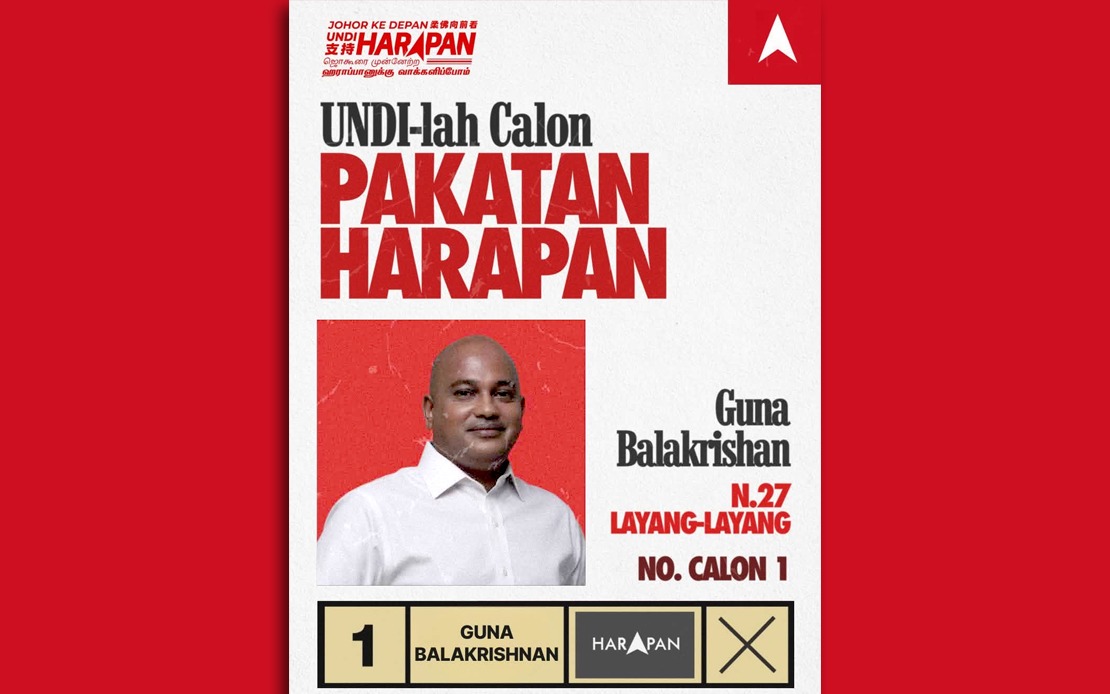
Guna Balakrishnan, the Pakatan Harapan candidate contesting the Layang-Layang state seat in Johor, has unveiled a six-point manifesto focused on bringing inclusive development to the constituency. His campaign emphasises positioning himself as a representative who will maintain close ties with residents, working to identify and address their specific needs while championing growth that extends across all segments of the community. The manifesto reflects a deliberate strategy to differentiate the PH campaign on the ground-level service delivery angle ahead of the July 11 state election.
Flooding remains one of the most pressing concerns for Layang-Layang residents, with multiple communities experiencing recurring inundation problems. Guna's pledges specifically target areas including Kampung Senda, Sungai Sayong, Kampung Tengah Renggam, Ulu Benut, Simpang Renggam and Kampung Chokro, where residents have long suffered from inadequate water management infrastructure. His commitment encompasses accelerating ongoing flood mitigation schemes, overhauling drainage systems to improve water flow, and implementing consistent upkeep programmes for local roads and public amenities. For a rural constituency where flooding directly threatens agricultural livelihoods and household stability, these promises address a fundamental quality-of-life issue that election campaigns cannot afford to overlook.
Beyond flood management, Guna's platform incorporates broader infrastructure modernisation that reflects the reality of rural Malaysia's digital divide. Improved street lighting across the constituency would enhance personal security and enable evening commercial activity in areas currently constrained by darkness. Equally important is expanding internet connectivity in remote zones, a gap that became particularly acute during the pandemic as rural communities sought to participate in online education and e-commerce. By framing digital access as an economic enabler rather than a luxury amenity, the PH campaign is positioning infrastructure investment as a driver of competitive advantage for rural entrepreneurs.
Local economic revitalisation forms another pillar of the manifesto, with particular emphasis on supporting small-scale traders who form the backbone of rural commerce. Guna has identified Renggam's tourism potential as an underutilised revenue stream, suggesting that heritage, cultural, or natural attractions could be packaged and promoted to generate income while creating employment opportunities. This approach reflects broader regional trends where state governments across Southeast Asia increasingly view tourism development as a diversification strategy for constituencies dependent on traditional agriculture or resource extraction.
Youth engagement represents a significant campaign theme, with pledges to expand access to Technical and Vocational Education and Training (TVET) programmes. The proposal to establish a motorsports track signals an interesting approach to youth development, offering a structured, supervised environment for an activity that otherwise occurs informally in rural areas. TVET expansion addresses a genuine gap in Malaysian education, where vocational pathways remain underfunded relative to academic routes, limiting opportunities for students whose talents and inclinations lie outside tertiary university education.
The manifesto additionally prioritises the welfare of women and senior citizens, demographic groups often marginalised in development planning. Proposals to strengthen women's entrepreneurship acknowledge that economic participation by female residents requires targeted support mechanisms, not merely general economic growth. The commitment to establish a Senior Citizens Activity Centre (PAWE) reflects recognition that Malaysia's ageing population requires proactive planning to maintain dignity, social connection, and purposeful engagement beyond retirement, particularly in rural areas where extended family structures may be weakening.
Guna has framed these commitments as realistic rather than aspirational, emphasising that they represent genuine intentions to drive tangible change rather than conventional election rhetoric. This framing is strategically important in contexts where voter cynicism about unfulfilled campaign promises remains high. By positioning himself as a bridge between constituents and government machinery, the candidate suggests that success depends not on extraordinary new resources but on effective coordination between existing agencies and the community itself.
The Layang-Layang contest represents a three-way race among Guna for Pakatan Harapan, Barisan Nasional's Chua Jian Boon, and incumbent Abd Mutalip Abd Rahim representing Perikatan Nasional. With 25,181 registered voters, the seat offers a meaningful slice of Johor's electoral map, and the outcome will reflect broader voter sentiments regarding federal coalition performance and local governance. The relatively tight voter population means that ground-level mobilisation and candidate-voter interaction remain decisive factors, making the PH campaign's emphasis on community accessibility potentially consequential.
Johor's state election will proceed on July 11, with advance polling scheduled for July 7, giving candidates approximately one week to consolidate support. For Malaysian observers monitoring coalition dynamics, the Johor contest provides a significant indicator of whether Pakatan Harapan has successfully recovered ground after the 2022 general election setbacks. Rural constituencies like Layang-Layang are particularly revealing, as they reflect whether opposition parties can compete on service delivery messaging or whether Barisan Nasional and Perikatan Nasional's incumbency advantages prove decisive.
The manifesto's emphasis on specific, localisable issues rather than national policy themes reflects a campaign strategy attuned to rural Malaysian voter priorities. While larger political narratives certainly matter, constituencies like Layang-Layang are ultimately decided by perceptions of candidate responsiveness and concrete commitments addressing tangible community challenges. Guna's approach suggests that Pakatan Harapan is attempting to compete not primarily on ideology but on demonstrable competence and constituent service, a strategic recalibration that may prove increasingly necessary as Malaysian voters across regions demand results-focused governance.

