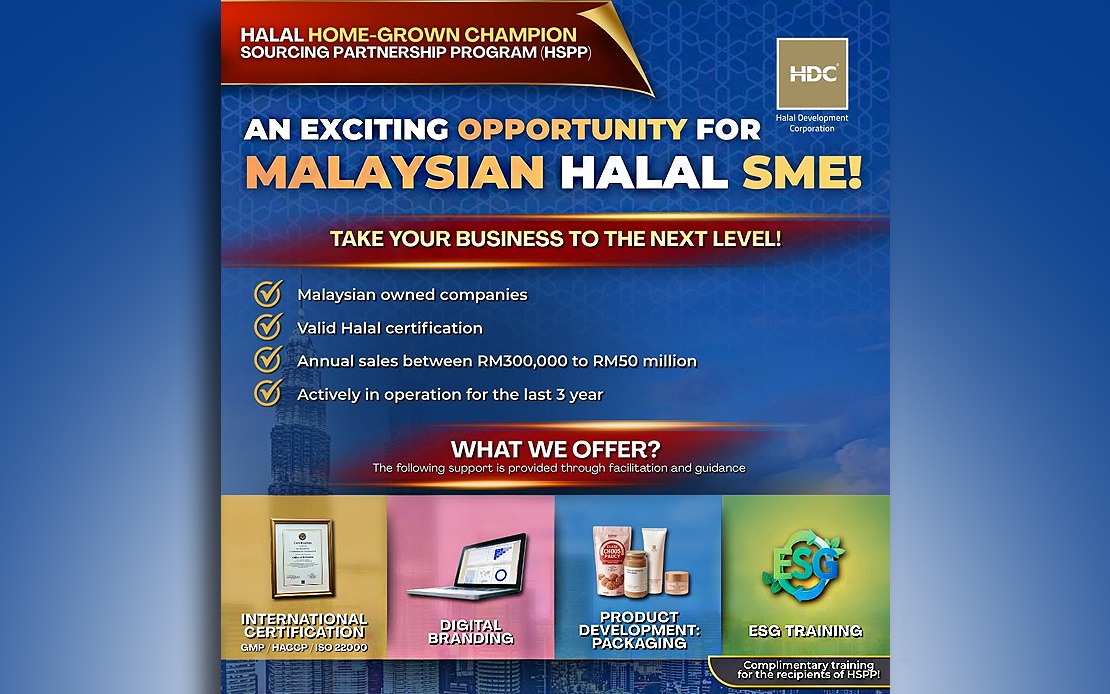
The Halal Home Grown Champion – Sourcing Partnership 2.0 initiative has become a significant driver of growth for Malaysia's small and medium-sized halal enterprises, channelling opportunities worth RM187.91 million to local businesses over a three-year period. Since its implementation in 2024, the programme has directly supported 313 halal companies while specifically targeting underrepresented entrepreneurs, including 158 Bumiputera-owned firms and 52 women-led businesses seeking to establish themselves in one of the world's fastest-growing sectors.
The Ministry of Investment, Trade and Industry characterises this intervention as a precision-targeted support mechanism designed to unlock growth potential among Malaysia's sprawling micro, small, and medium enterprise ecosystem. Rather than broad-based subsidies or generic business support, the Sourcing Partnership 2.0 model focuses on matching local halal producers with commercial opportunities and supply chain integration, recognising that many MSMEs possess strong production capabilities but lack access to larger buyer networks and export channels.
The timing of this initiative reflects Malaysia's strategic positioning within the global halal economy, a sector valued at hundreds of billions of dollars annually and projected to expand significantly over the coming decade. Malaysian policymakers recognise that while the nation enjoys a hard-won reputation for halal certification credibility—built over decades of rigorous standards enforcement—this advantage must be actively maintained and leveraged through continuous support for domestic producers seeking international markets.
The concentration of benefits among Bumiputera and women-owned enterprises signals deliberate policy prioritisation toward economic inclusion and broader wealth distribution across Malaysia's business community. These demographic categories historically face structural barriers including limited access to capital, restricted networks within established trading circles, and unequal opportunity to participate in high-value supply chains. By embedding this support within a larger halal sector development strategy, policymakers aim to achieve simultaneous objectives: expanding the halal industry's overall contribution to national GDP while ensuring benefits are distributed more equitably.
MATRADE's commitment to hosting the Malaysia International Halal Showcase in 2026 provides crucial complementary infrastructure to the broader Sourcing Partnership 2.0 programme. Scheduled from September 23 to 26 at the Malaysia International Trade and Exhibition Centre in Kuala Lumpur, MIHAS 2026 represents a concentrated opportunity for participating businesses to achieve international visibility and forge crucial trade relationships. The event's positioning as the world's largest halal trade show attracts buyers, distributors, and investors from across the Muslim world and beyond, creating genuine high-stakes commercial platforms where Malaysian producers can negotiate contracts and secure market commitments.
The allocation of 2,400 exhibition booths at MIHAS 2026 reflects confidence in Malaysia's MSME capacity to exhibit and compete on international stages. More significantly, projections that over 1,000 local MSMEs will benefit from business opportunities generated by the event suggest organisers expect the showcase to catalyse genuine commercial activity beyond mere networking. This could include securing distribution agreements in key halal markets across the Middle East, Southeast Asia, North Africa, and increasingly, non-Muslim-majority countries where halal certification carries premium positioning and appeals to health-conscious consumers.
Malaysia's existing institutional architecture supporting the halal sector—including established certification bodies, logistics infrastructure, and a demonstrated commitment to standards compliance—provides substantial advantages over competitor nations seeking to capture larger shares of the global halal market. However, this foundation alone proves insufficient. The conscious addition of targeted MSME support, coupled with flagship trade show participation, acknowledges that institutional advantages must be actively leveraged and transmitted to individual businesses to generate tangible economic impact.
The RM187.91 million potential sales figure warrants scrutiny beyond surface-level interpretation. This represents projected value across a three-year period for 313 participating firms, averaging roughly RM600,000 per company. For many genuine MSMEs, this scale of annual revenue expansion could represent transformational growth, potentially enabling business transitions from subsistence-level operations to sustainable commercial enterprises. Conversely, for some more-established participants, these figures may represent modest incremental growth rather than breakthrough expansion, suggesting the programme accommodates heterogeneous participant profiles with vastly different baseline capabilities and ambitions.
The parliamentary response to Tan Sri Mahiaddin Mohd Yassin's inquiry reflects broader governmental strategy regarding halal sector development within Malaysia's economic modernisation agenda. Rather than treating halal exclusively as a religious or cultural matter, policymakers increasingly frame halal commerce as serious economic infrastructure requiring strategic investment, targeted support, and international market development. This reframing carries significant implications for how resources are allocated across competing development priorities and how Malaysia positions itself within regional and global trade hierarchies.
For Malaysian MSMEs operating within the halal ecosystem, the convergence of targeted sourcing partnerships, trade show opportunities, and government endorsement creates an unusually supportive environment compared to non-halal sectors facing comparable development challenges. However, participating businesses must still navigate complex international regulatory frameworks, secure necessary certifications for specific target markets, and manage supply chain logistics—challenges that government support programmes can facilitate but cannot entirely eliminate.
The sustainability of these initiatives beyond 2026 remains a crucial consideration. Current programme parameters suggest defined endpoints for both the Sourcing Partnership 2.0 framework and the MIHAS showcase cycle. Long-term sector growth depends on whether successful participants graduate into self-sustaining commercial operations requiring minimal government intervention, or whether the ecosystem requires continuous policy support and intervention to maintain momentum. This distinction will ultimately determine whether the RM187.91 million potential sales figure represents a foundation for enduring halal sector expansion or a temporary boost dependent on continued government sponsorship.

