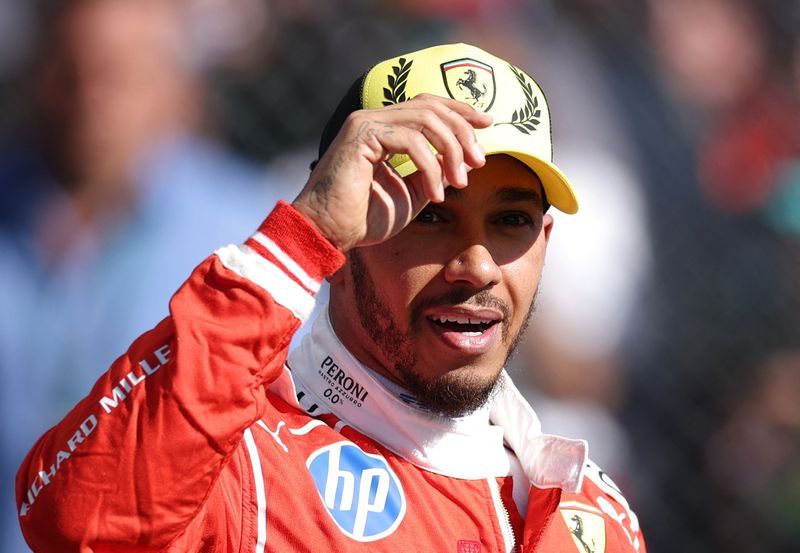
Lewis Hamilton has the opportunity to make a statement heading into Formula One's August break this weekend at Budapest's Hungaroring, a circuit where the Ferrari driver has enjoyed unparalleled success throughout his career. The seven-time world champion's arrival in Hungary comes at a pivotal moment in the championship battle, with the Italian teenager Kimi Antonelli commanding the standings and Mercedes wrestling with an alarming performance deficit affecting George Russell. For Hamilton, the Hungaroring represents familiar territory and the prospect of building momentum after claiming second place overall, though he trails Antonelli by 45 points following the British driver's struggles in Belgium.
Russell's predicament has become the dominant talking point across the paddock this week as the championship favourite confronts a crisis of confidence and machinery. The 26-year-old Briton, who began the campaign as the primary title contender and carried the reputation of 'Mr Consistency', now finds himself 50 points behind Antonelli after a costly spin into the gravel at Spa last Sunday. That incident marked Russell's third scoreless finish of the season, a devastating blow for a driver who was expected to challenge for the crown. The core issue plaguing the Mercedes car centres on significant time loss along the straights, a fundamental weakness that cannot be remedied through driver finesse alone and demands urgent technical intervention from the reigning champions' engineering department.
Antonelli's ascendance has been remarkable, the 19-year-old Italian accumulating six victories in the first ten races and establishing a commanding championship position that puts him on course for an extraordinary maiden season. His rapid development and consistency have contrasted sharply with Russell's inconsistency, raising uncomfortable questions about the relative capabilities of the two Mercedes drivers and whether the car's current configuration favours one driver over the other. The performance disparity between the two silverbacked machines suggests something more fundamental than driver error, pointing instead to a setup imbalance or aerodynamic issue that has eluded the Stuttgart-based team's analysis thus far.
Hamilton's record at the Hungaroring stands as perhaps the most dominant achievement any driver has accumulated at a single venue in modern Formula One. The 39-year-old has claimed eight victories at the Budapest circuit across his career, a tally unmatched by any other competitor at this track, and he remains just one win short of equalling his personal record of nine victories at Silverstone. Beyond recent success, Hamilton also secured pole position here in 2023, demonstrating that his prowess at this venue extends beyond race day performance. For a driver seeking to rebuild momentum and prove his continued competitiveness at Ferrari, the Hungaroring offers both psychological comfort and a genuine opportunity to harvest a significant points haul.
The nature of the Hungaroring track itself creates conditions that could benefit Ferrari's current package. Unlike Spa, where engine power and straight-line speed proved decisive and amplified Mercedes' structural advantage, Budapest's slower and more technical layout diminishes the importance of raw horsepower. The circuit demands precision through its numerous turns and complex corner sequences, rewarding setup nuance and tyre management rather than straightforward acceleration out of corners. Ferrari team principal Frédéric Vasseur struck a cautionary tone regarding expectations, emphasising that while the engine deficit should theoretically prove less consequential at Budapest, nothing was guaranteed and the team must approach the weekend with the same meticulous preparation applied to every race.
Charles Leclerc has emerged as Ferrari's stronger performer across the recent double-header, securing victory at Silverstone and finishing second at Spa, while Hamilton's performances have been more variable with a win in Barcelona but disappointing results at more recent venues. This form advantage for Leclerc could prove significant if Ferrari is able to maximise the circuit's characteristics, though Hamilton's historical mastery of the venue cannot be dismissed. The challenge for the Maranello team involves translating theoretical advantages into tangible race-day results, a transition that has proven elusive for Ferrari at various points this season.
Antonelli's assessment that the championship battle could develop into a four-team fight reflects the compressed nature of competition at the Hungaroring compared to power-dependent circuits. Red Bull and McLaren both harbour realistic podium aspirations at a venue where downforce and mechanical grip assume greater significance relative to aerodynamic advantage and engine performance. McLaren in particular arrives with confidence, introducing substantial upgrades including a new floor and revised aerodynamic components while continuing development of an experimental rear wing configuration. Team principal Andrea Stella will be monitoring how these modifications influence the papaya cars' competitiveness, with McLaren seeking to reclaim ground in both driver and constructor championship battles.
The competitive complexity intensifies when considering that four of the top seven championship contenders have previous Hungarian victories, though notably both Mercedes drivers and Charles Leclerc lack wins at this specific venue. Last year's race saw Leclerc claim pole position before Lando Norris converted that positioning advantage into victory for McLaren in a one-two finish alongside Oscar Piastri, highlighting how front-running pace can translate into decisive results at this track. The mixture of different winning drivers at Budapest across recent seasons underscores how varied conditions and setup choices create opportunities for different teams to triumph.
McLaren's driver rotation for Friday's opening practice session, with reserve Leonardo Fornaroli replacing Oscar Piastri while the Australian sits out the session, represents standard protocol for driver development and fresh perspective gathering. Fornaroli, last year's Formula Two champion, gains valuable experience in contemporary machinery that will inform his development pathway within the McLaren organisation. Meanwhile, Aston Martin arrives with a chassis upgrade that has been delayed in development, though the team must wait until the Dutch Grand Prix in late August before receiving the anticipated Honda power unit improvements that could represent a genuine leap forward in performance.
The championship dynamics entering the August break will be shaped considerably by how teams address their current shortcomings during this final race before the calendar's traditional summer pause. For Mercedes, the desperation to understand and rectify Russell's car difficulties has become acute, with the two-week break potentially offering respite but also extending the period in which Antonelli consolidates his advantage. Hamilton, conversely, would relish the psychological boost of a strong Hungarian result as evidence that his Ferrari transition is genuinely competitive rather than merely salvaging points from a difficult season. The Hungaroring represents more than simply another race weekend; it serves as a potential inflection point that could reshape championship momentum heading into the second half of the campaign.

