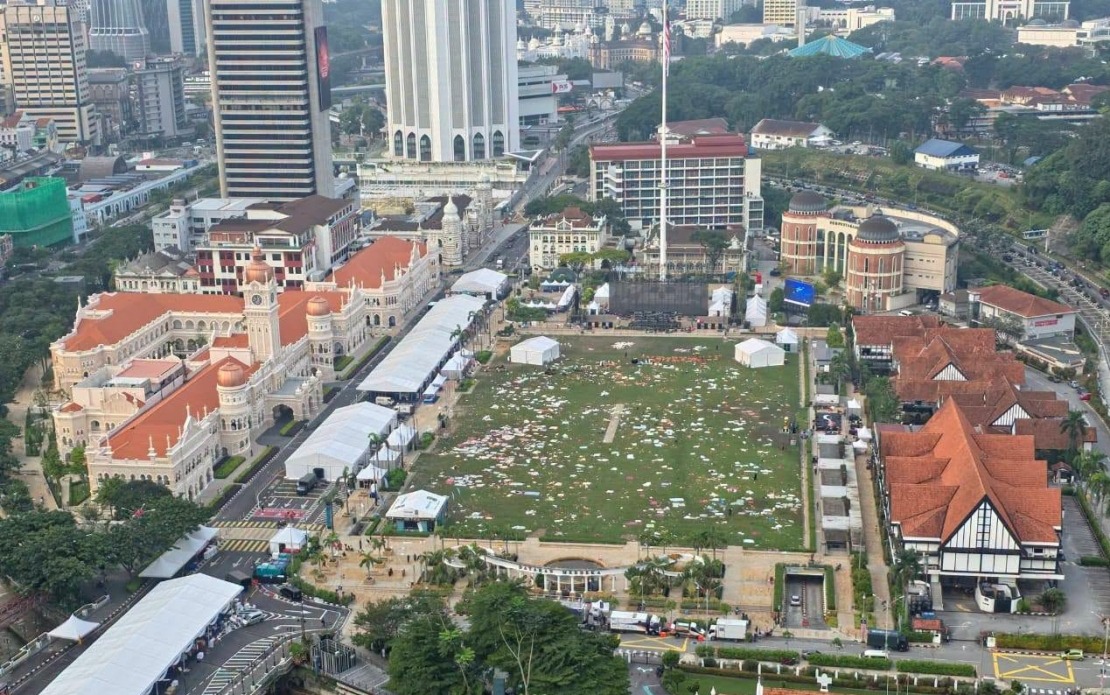
Federal Territories Minister Hannah Yeoh has acknowledged the dedicated efforts of Kuala Lumpur City Hall (DBKL) workers who worked to restore Dataran Merdeka after substantial littering occurred during a public screening of the 2026 FIFA World Cup final. Her remarks come as part of a broader push to reframe public cleanliness not merely as an administrative obligation, but as a reflection of national character and collective responsibility that extends beyond government agencies to ordinary citizens.
Yeoh's statement addresses a recurring tension in urban governance across Southeast Asia: the gap between citizen expectations of pristine public infrastructure and the behavioural patterns that undermine such spaces. While acknowledging that taxpayers rightly expect quality public services from their government, the minister drew a critical distinction between the legitimate demand for institutional competence and the notion that civic responsibility can be outsourced entirely to municipal workers. This nuance reflects growing frustration among policymakers across the region with the cultural disconnect between demanding government accountability and personal accountability for collective spaces.
The cleanup at Dataran Merdeka, Malaysia's most symbolically significant public square and the venue for major national commemorations, carries particular weight precisely because of its historical importance. The location itself—the heart of Malaysia's independence narrative—amplifies concerns about public behaviour. When such spaces are marred by carelessness, it raises questions not only about cleanliness logistics but about how Malaysians collectively value and treat the tangible symbols of their shared heritage. Yeoh's emphasis on Dataran Merdeka as more than an event venue but as a custodial responsibility underscores this deeper dimension.
Her statement aligns closely with Prime Minister Datuk Seri Anwar Ibrahim's philosophy on national development, which prioritises the moral and cultural dimensions of progress alongside economic and infrastructure metrics. This perspective challenges the conventional development narrative dominant across the region, which tends to equate national advancement primarily with construction, GDP growth, and technological adoption. By contrast, the Prime Minister and his minister are articulating a vision of Malaysia MADANI—a civilisational concept emphasising dignity, prosperity, and stewardship—that hinges on citizens internalising responsibility for collective wellbeing.
The incident reveals infrastructure management challenges that plague major cities throughout Southeast Asia. Event venues regularly experience significant waste accumulation following large gatherings, yet the root cause often lies not in inadequate cleaning systems but in insufficient pre-event planning, insufficient waste receptacles, or insufficient public education about segregation and disposal. DBKL's response demonstrates operational capacity, but the scale of cleanup required raises questions about whether current infrastructure and resource allocation can sustainably accommodate large public gatherings without incurring substantial costs.
Yeoh's framing of rubbish disposal as a "basic civic responsibility" attempts to reposition individual behaviour as a matter of personal dignity rather than regulatory compliance. This approach reflects emerging trends in public administration across Asia, where governments increasingly recognise that behavioural change—particularly around public space maintenance, recycling, and environmental stewardship—requires shifts in values and self-perception rather than merely enforcement mechanisms. The minister's appeal to personal ownership of the problem suggests an understanding that education and cultural messaging may prove more effective than penalties.
For Malaysian readers, this episode offers a broader lens on the state of civic culture in urban Malaysia. The tension between government service delivery and citizen participation reflects anxieties about rapid urbanisation, changing social norms, and the relationship between individual freedoms and collective obligations. Similar incidents have been documented at other major venues, from concert sites to sporting events, suggesting this is not an isolated problem but symptomatic of evolving attitudes toward public property among segments of the Malaysian population.
The statement also carries implicit recognition of workforce dignity. By praising DBKL workers explicitly, Yeoh is elevating the visibility and status of municipal labourers whose contributions often go unacknowledged in public discourse. This recognition matters because it reinforces the idea that those who perform essential service work deserve respect and appropriate working conditions—a message particularly resonant in a region where such workers often face social invisibility despite performing vital functions.
From a regional perspective, Malaysia's experience mirrors challenges facing rapidly developing cities across Southeast Asia, where urbanisation has outpaced the cultural and institutional adjustment necessary to maintain shared spaces. Countries from Thailand to the Philippines to Vietnam grapple with similar tensions between infrastructure investment and public behaviour. Hannah Yeoh's intervention suggests Malaysia is attempting to address this through values-based messaging rather than punitive approaches, a strategy with potential implications for regional urban governance.
Moving forward, this incident may catalyse conversations about event management standards, public space design that discourages littering, and community engagement strategies. Whether Malaysian society will genuinely absorb the civic responsibility message remains uncertain, but the minister's articulation of expectations represents an important marker of official values. The success of such appeals ultimately depends not on government communication but on whether enough Malaysians internalise the principle that shared spaces demand shared stewardship—a cultural shift far more challenging than any single cleanup operation.

