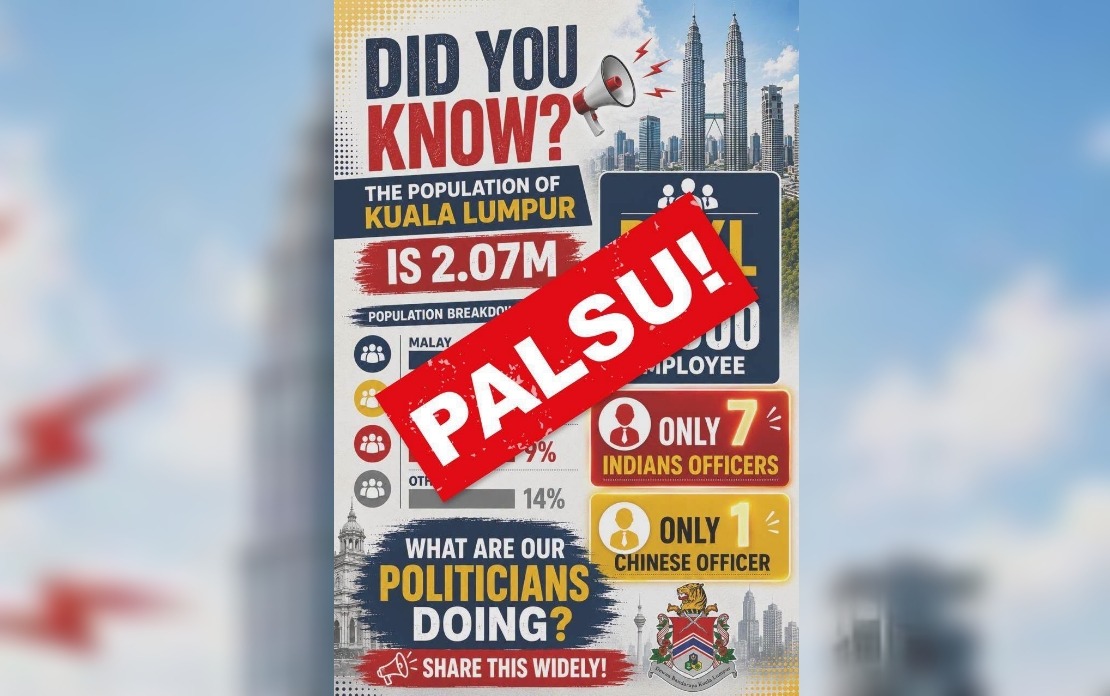
Minister in the Prime Minister's Department (Federal Territories) Hannah Yeoh has moved to dispel what she characterises as deliberate misinformation about the ethnic composition of Kuala Lumpur City Hall's workforce, which has circulated widely on social media amid the ongoing election campaign. The false narrative, spread via WhatsApp, alleged that the local authority employed an extraordinarily low number of Indian and Chinese staff members, a claim the minister has firmly rejected as inconsistent with official records.
Yeoh provided detailed workforce statistics to counter the misleading claims. As of July 1, 2026, DBKL maintains a staff complement of 9,131 employees, among whom 490 are of Indian ethnicity and 22 are Chinese. These figures are substantially higher than the inflammatory claims that had circulated online, which suggested only seven Indian and one Chinese staff member held positions within the organisation. Within the more senior Management and Professional Group, the authority currently has ten Indian officers and two Chinese officers, indicating some representation at decision-making levels, though Yeoh acknowledged scope for improvement.
The minister's statement carries particular significance given the timing and apparent coordination of the misinformation campaign. Election periods across Malaysia have historically witnessed the weaponisation of sensitive racial and religious issues, often through rapid online dissemination of unverified claims designed to stoke communal tensions. The emergence of these false DBKL staffing narratives during active campaigning suggests a calculated attempt to exploit perceptions of institutional bias and minority marginalisation, themes that resonate emotionally but require factual scrutiny.
Yeoh has instructed DBKL leadership to undertake a comprehensive internal review of its human resources practices. This directive encompasses recruitment methodologies, hiring decision-making processes, mechanisms for staff promotion, and the channels through which vacant positions are advertised to the public. The objective is to identify any systemic gaps or barriers that might inadvertently disadvantage candidates from particular communities, and to implement corrective measures grounded in transparency, impartiality, and merit-based selection criteria. Such institutional self-examination is valuable regardless of current staffing demographics.
The minister's acknowledgement that representation within DBKL can be improved represents a measured approach that neither dismisses legitimate concerns about diversity nor validates the false claims circulating online. Public institutions, particularly those serving diverse urban populations like Kuala Lumpur, benefit from workforces that reflect the communities they serve. This principle operates both on grounds of democratic legitimacy and because diverse teams bring varied perspectives to problem-solving and service delivery.
Yeoh has also made a broader appeal to all stakeholders to resist the temptation to weaponise such issues for political advantage. She called on political parties, social media influencers, and the general public to prioritise factual accuracy over inflammatory narratives, and to distinguish between correcting genuine misinformation and amplifying existing community grievances. The distinction is critical: addressing real institutional imbalances requires honest data and sincere engagement, while spreading false claims corrodes public trust and deepens communal divisions.
The DBKL workforce diversity question touches on broader patterns within Malaysian public administration. Federal Territories institutions, including those based in Kuala Lumpur, have long been scrutinised regarding the representation of various ethnic communities, particularly in professional and managerial ranks. While progress has been made toward more inclusive practices in recent years, historical employment patterns and evolving recruitment standards continue to shape organisational demographics. Examining and improving these systems remains an ongoing responsibility for government agencies.
The circulation of the false WhatsApp poster also highlights the challenge that Malaysian public institutions face in combating coordinated disinformation campaigns, particularly those designed to inflame intercommunal sentiment. Social media's speed and reach mean that false claims can achieve significant circulation before fact-checking mechanisms mobilise. The minister's public rebuttal, while necessary, may reach only a fraction of those who encountered the original misleading post, underscoring the asymmetry between spreading falsehoods and correcting them.
For Malaysian readers, particularly those in Kuala Lumpur, the incident offers a timely reminder of the importance of verifying claims about public institutions before sharing them. Election periods inevitably see increased political messaging and contestation, and claims about government bias or discrimination resonate emotionally. However, emotional resonance does not substitute for factual accuracy. Citizens and voters benefit from developing stronger filters for evaluating such claims, checking official sources, and considering whether particular narratives align with incentive structures that might motivate their fabrication.
The commitment to transparency and merit-based selection that Yeoh articulated also has implications for how DBKL and other federal territory agencies operate going forward. Publishing recruitment data disaggregated by ethnicity, documenting promotion criteria and outcomes, and explaining hiring rationales can all help counteract both misinformation and legitimate concerns about systemic bias. Openness, paradoxically, often proves more effective than defensiveness at building public confidence in institutional fairness.
Looking ahead, the success of DBKL's promised review will depend on implementation rigour and willingness to make substantive changes if genuine gaps are identified. The minister's framing of this exercise—transparency, fairness, and merit—sets appropriate expectations. Whether the local authority translates this commitment into measurable outcomes will shape public perception of both DBKL's actual diversity practices and the government's broader sincerity regarding inclusive public administration.

