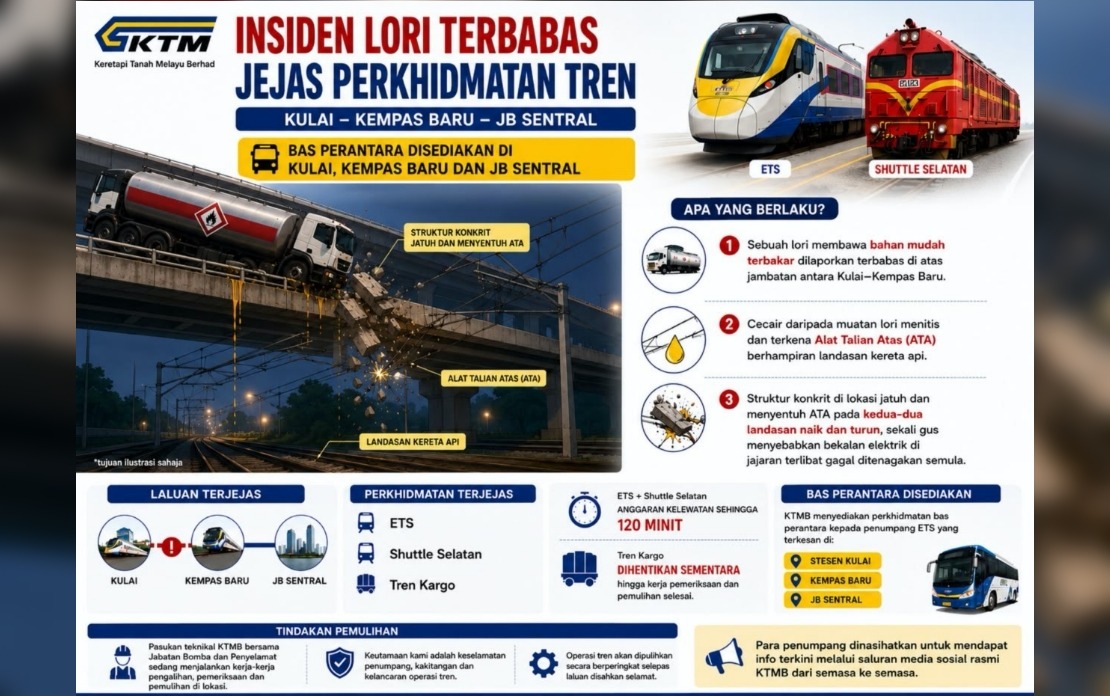
A hazardous cargo incident in Johor Bahru has disrupted rail transport across a key commuter corridor, with authorities scrambling to restore services and manage passenger flows on August 5. The disruption occurred when a lorry carrying flammable liquid veered off course near the railway tracks serving the Kulai–Kempas route, triggering an electrical outage that cascaded across both the Shuttle Selatan coach service and the Electric Train Service (ETS) network in the region.
Keretapi Tanah Melayu Berhad (KTMB), the national rail operator, confirmed the incident through a Facebook announcement, explaining that the power supply failure was a direct consequence of the lorry's collision with infrastructure adjacent to the tracks. The operator did not provide specific details regarding the cause of the skid or whether there were any injuries, but indicated that both mechanical repairs and electrical restoration work commenced immediately at the scene.
The operational impact was substantial and immediate. Multiple train services experienced significant scheduling disruptions, with ETS9449 running 32 minutes behind schedule and ETS9533 delayed by 55 minutes as of 10:37 pm local time. KTMB cautioned that these figures remained fluid and subject to further changes depending on how quickly restoration efforts could be completed, leaving passengers uncertain about travel times throughout the evening.
To mitigate the impact on commuters, KTMB activated contingency measures across three major stations in the affected corridor. Shuttle bus services were deployed at Kulai, Kempas Baru, and JB Sentral stations to accommodate ETS passengers unable to use their regular train services. This arrangement allows travellers to continue their journeys, albeit with longer transit times and the inconvenience of transferring between modes of transport.
Passengers using the Shuttle Selatan coach service faced more limited options. Rather than offering direct alternative transport, KTMB advised these customers to seek out independent alternatives—taxis, ride-hailing services, or personal vehicles—to complete their journeys. The distinction in response between the two services suggests differing contractual arrangements and operational capacities between the ETS and Shuttle Selatan divisions.
To address the financial burden on affected travellers, KTMB announced that fare adjustments would be provided to passengers whose journeys were disrupted. The specific mechanics of these adjustments—whether they would be automatic refunds, credits on future journeys, or compensation claims processed at customer service counters—were not detailed in the operator's statement. For commuters dependent on these services for daily work travel, such administrative processes often prove slow and cumbersome.
The incident underscores the vulnerability of Malaysia's rail infrastructure to external hazards, particularly in the densely populated Johor Bahru metropolitan area where major transport corridors run in close proximity to industrial zones and freight routes. The presence of hazardous materials on roads adjacent to electrified rail lines creates compounding risks that extend beyond typical traffic incidents. A collision in such circumstances can trigger cascading failures affecting thousands of daily commuters.
For the broader Southeast Asian region, this incident reflects recurring challenges with transport safety in rapidly urbanising areas. As cities expand and logistics networks intensify, the geographic overlap between dangerous cargo routes and critical public infrastructure increases. Few countries in the region have invested heavily in physical separation or redundancy in these networks, making disruptions like this inevitable without significant infrastructure investment.
The timing of such incidents also highlights gaps in emergency response coordination. While KTMB mobilised shuttle services relatively swiftly, the lack of transparency regarding incident causes, timeline for full restoration, and specific compensation mechanisms suggests room for improvement in crisis communication. Passengers left in the dark about when services might normalise tend to lose confidence in operators and explore permanent alternative commuting options.
From a regulatory perspective, this incident may prompt questions about hazmat transport permits and routing protocols in Johor Bahru. Whether the lorry was authorised to travel on roads adjacent to the Kulai-Kempas rail corridor, what safety standards govern such operations, and whether warning systems existed to prevent such collisions remain unanswered. Malaysian transport authorities may need to review whether current guidelines adequately protect rail infrastructure from external threats.
The restoration timeline remains uncertain. KTMB indicated that cleanup and electrical repairs were underway but provided no estimated completion time. For regular commuters, this ambiguity creates genuine hardship. Evening rush-hour disruptions affecting homebound workers can cascade into family schedules, childcare arrangements, and wider social impacts that extend far beyond railway operations themselves.
As Malaysian cities continue expanding southwards into Johor Bahru's hinterland, transport planners face the challenge of designing systems resilient to such incidents. The incident serves as a reminder that modern urban mobility depends not just on trains and coaches themselves, but on the entire ecosystem of roads, utilities, and safety protocols surrounding them. Until these systemic vulnerabilities are addressed, commuters will continue experiencing such disruptions.

