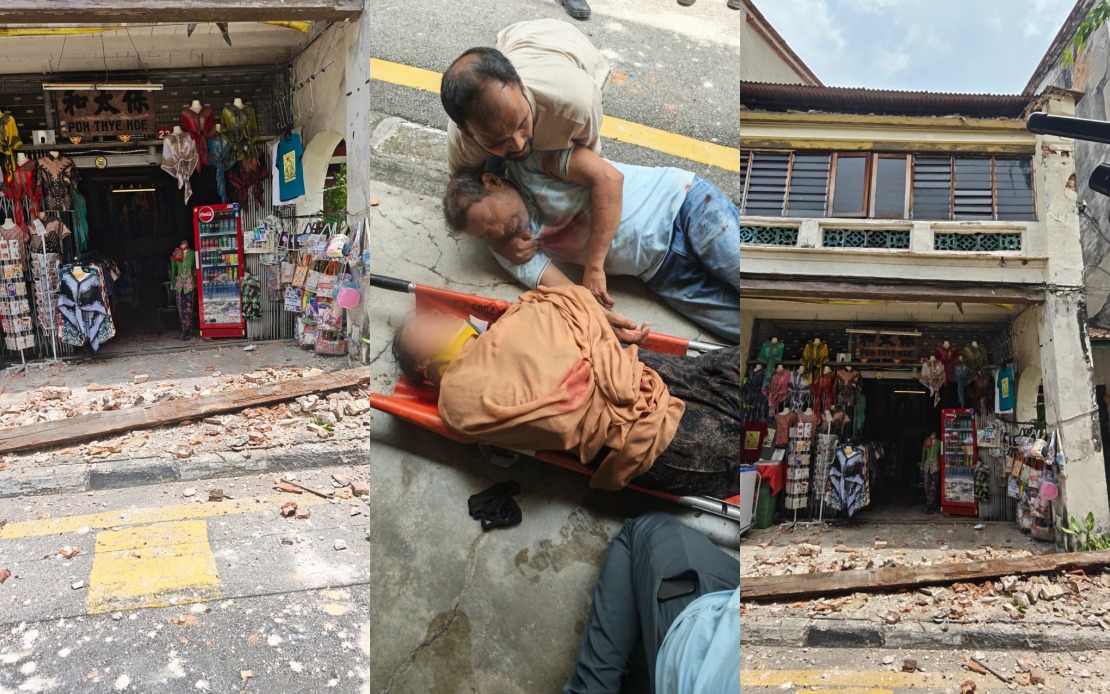
A heritage building on Armenian Street in George Town claimed two victims on August 4 when structural debris unexpectedly gave way, leaving the incident to prompt urgent questions about preservation standards in Malaysia's most celebrated historic district. The injured visitors, identified as Mohamad Ammtar, 66, and Fatimah, 55, both from Sri Lanka, were struck by falling stones and timber from a first-floor beam as they navigated the UNESCO-listed precinct, one of Asia's most densely concentrated collections of shophouses and colonial-era structures.
Emergency responders arrived swiftly after the Penang Fire and Rescue Department received a distress call at 1.11 pm. According to John Sagun Francis, the department's assistant director of operations, firefighters from the Lebuh Pantai station administered immediate care before transferring the couple to Penang Hospital. While both sustained injuries serious enough to require hospital treatment, neither victim's condition was reported as life-threatening. The building involved in the incident functioned as a mixed-use property, with a grocery operation occupying the ground floor and the upper storey appearing dormant at the time of the collapse.
The timing of the incident compounded its seriousness—the tourists had planned to depart for Sri Lanka the following day, transforming what should have been a final memory of Malaysian hospitality into a medical emergency. This reality brought into sharp focus the safety vulnerabilities that persist within George Town despite its global heritage designation. The incident exposed a systemic gap: while the physical architecture of these centuries-old buildings commands admiration from visitors worldwide, the structural integrity that keeps them standing has clearly not kept pace with the rigorous maintenance standards expected in a major tourism hub.
State authorities responded decisively to the accident, with Wong Hon Wai, chairman of Penang's Tourism and Creative Economy Committee, visiting the scene and immediately escalating safety concerns to the highest levels of government. Wong directed both George Town World Heritage Incorporated and Majlis Bandaraya Pulau Pinang to distribute formal advisories requiring all heritage building proprietors to conduct thorough structural inspections. The directive reflects an acknowledgment that the incident was not isolated but rather a symptom of deferred maintenance across the entire historic quarter.
Wong's public statements emphasised that authorities would not treat the collapse as an anomaly confined to a single structure. Instead, he positioned the accident as a catalyst for comprehensive reassessment of heritage building safety throughout Penang state. His insistence that every old structure require inspection—not merely those showing obvious distress—signals a significant shift toward proactive rather than reactive preservation management. For property owners across George Town, this represents a tightening of expectations and likely increased compliance obligations.
The Penang government extended immediate assistance to the injured Sri Lankan couple, moving beyond routine medical provision to coordinate support through diplomatic channels. State officials initiated contact with the Sri Lankan High Commission in Kuala Lumpur, recognising that managing the incident's international dimensions required more than local intervention. This diplomatic approach reflects sensitivity to how such accidents affect tourism perception and Malaysia's reputation as a safe destination for regional travellers.
The incident carries particular symbolic weight because it occurred at the intersection of heritage preservation and public safety—two domains that should reinforce rather than contradict each other. George Town's status as a World Heritage Site rests partly on the authenticity and original character of its built environment, yet that very authenticity, when combined with age and insufficient maintenance investment, creates hazardous conditions for the thousands of daily visitors who navigate its narrow streets and alleyways. The collapse thus highlights a growing tension in heritage tourism management across Southeast Asia, where balancing conservation ideals against practical safety requirements remains contested.
From a Malaysian perspective, the incident underscores challenges faced by other heritage-designated areas competing for tourism revenue while managing aging infrastructure. Penang's situation mirrors conditions in heritage zones across the region—from Bangkok's old quarter to Vietnam's Hoi An—where property economics, preservation philosophy, and visitor safety sometimes operate at cross-purposes. Owners of heritage buildings often face substantial costs to upgrade structural systems while meeting heritage guidelines that restrict modern interventions, creating disincentives for the proactive maintenance that prevents accidents.
Authorities confirmed they were awaiting detailed investigation findings to establish how and why the first-floor beam failed. Understanding the mechanical cause—whether through material degradation, inadequate repairs, water damage, or structural design flaws—will inform the scope and nature of inspections mandated across the state. The investigation's conclusions may reshape building code enforcement and establish new precedents for heritage property liability and owner responsibilities.
Wong's characterisation of the incident as serious specifically because it involved tourists rather than residents reveals governmental understanding of how such accidents affect external perceptions of Malaysian destinations. Tourist safety incidents generate international media coverage disproportionate to their local impact, potentially influencing travel decisions among source markets like Sri Lanka, India, and other regional countries that have increasingly contributed to Penang's visitor numbers. For the state government, managing this incident involved not only addressing immediate welfare concerns but also protecting George Town's carefully cultivated global brand.
The accident arrives amid broader Southeast Asian conversations about sustainable tourism and the tension between preservation and accessibility. As heritage sites face mounting visitor numbers, the infrastructure supporting these flows—including the physical buildings themselves—requires commensurate investment. Penang's current episode suggests that the economic benefits of heritage tourism must translate into concrete maintenance funding if destinations are to remain both attractive and genuinely safe.
Moving forward, how Penang implements the directed inspections and translates findings into enforceable standards will signal whether the incident prompts temporary administrative activity or genuine structural change in heritage building oversight. The state government's willingness to coordinate internationally through the Sri Lankan High Commission also establishes precedent for how future accidents involving foreign visitors will be managed, positioning Malaysia as a destination taking tourist welfare seriously despite the complexities inherent in preserving aging structures in high-traffic urban environments.

