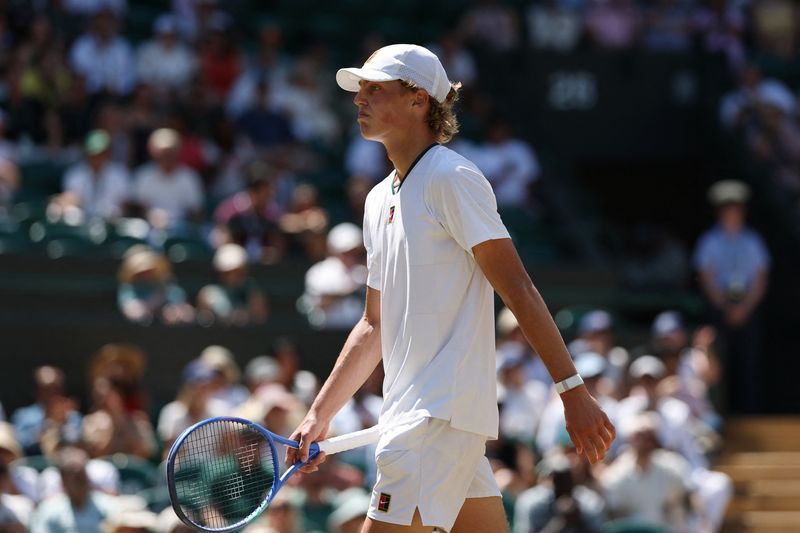
Lleyton Hewitt's teenage son Cruz has announced himself on professional tennis's biggest stage with an impressive debut victory at the Washington Open on Tuesday, defeating American Marcos Giron 6-3 6-4 in the first round. The 17-year-old Australian qualifier, ranked 612 in the world, claimed his maiden ATP Tour-level win in commanding fashion, marking another significant milestone in what has already been a remarkable summer for the young player.
The first-round triumph capped an extraordinary month for Cruz, who had recently finished as runner-up in the Wimbledon boys' championship to American Jordan Lee. That near-victory at the prestigious All England Club came nearly 25 years after his legendary father claimed the men's singles title at the same venue, placing the younger Hewitt's achievement in fascinating context. The timing of Cruz's emergence as a competitive force in junior and junior-to-senior tournaments has drawn considerable attention within tennis circles, particularly given the illustrious shadow cast by his father's career.
Washington holds profound personal significance for the Hewitt family. Lleyton won the ATP 500 title at the Washington Open in 2004, and Cruz spoke emotionally about playing in the same venue where he has watched his father compete. "It's pretty surreal to win here," the teenager reflected after his victory. "Obviously I saw my dad play here. I came to his last tournament I remember. There are so many memories of that. To make it to round two, it's very special." His words reveal how deeply the venue resonates with his family identity and motivation.
The significance of Cruz's achievement extends beyond the moment itself. At 17, he became the youngest player to claim victory at the Washington tournament since Japan's Kei Nishikori accomplished the feat in 2007, a distinction that underscores the rarity of such junior success at ATP events. This victory also places Cruz within an exclusive cohort of players born in 2008 or later who have already registered ATP-level wins. Only three others—Diego Dedura, Thijs Boogaard, and Moise Kouame—had achieved this milestone before Tuesday, suggesting that Cruz is part of a new generation beginning to make its mark on professional tennis.
The influence of his father's guidance proved instrumental in Cruz's approach to the match. Rather than offering tactical complexities, Lleyton advised his son to maintain perspective and enjoyment throughout the contest. "He told me just to enjoy it and take every point one-by-one, really enjoy the atmosphere and the crowd," Cruz explained. This philosophy of present-moment focus reflects the mental approach that characterized his father's own career, particularly in high-pressure situations. The teenager's ability to absorb and implement such counsel speaks to his maturity and willingness to draw upon the accumulated wisdom of one of Australia's greatest sporting figures.
Cruz demonstrated commendable composure in managing the emotional weight of his circumstances. As a qualifier who had never before competed in an ATP Tour main draw, the situation carried inherent pressure. Yet he articulated a sophisticated understanding of psychological management, acknowledging the nerves while actively working to channel them productively. "I just see there's a little pressure, but I try and take the positive and come with it as well. I'm happy with how I'm dealing with it so far," he noted, suggesting a mental resilience that will prove essential if his career trajectory continues upward.
Cruz's second-round opponent will emerge from a match between top-seeded Stefanos Tsitsipas and fellow Australian Alex de Minaur, both established figures on the ATP Tour. The possibility of facing de Minaur held particular appeal for the teenager, revealing yet another dimension of his connection to Australian tennis. De Minaur, who is significantly older and already established as a major tournament player, has maintained a close relationship with the Hewitt family spanning years. "If I play Alex, that would be a dream to share the court with him," Cruz said. "He's like my older brother. I've known him basically my whole life. He's stayed with us and we have Christmas together, also. He's taught me so much, I think that would be a pretty cool memory for us."
The broader implications of Cruz's emergence merit consideration within the context of Australian tennis development. Australia has historically produced world-class players, but the pathway from junior success to ATP relevance remains challenging and unpredictable. Cruz's qualifier status and ranking of 612 underscore that he remains a prospect rather than an established presence. However, his performance at Washington suggests he possesses the technical ability, mental fortitude, and family support structure that top-level professionals require. The question now becomes whether this breakthrough can translate into sustained progress through the professional ranks.
For Malaysian and Southeast Asian tennis followers, Cruz Hewitt's emergence carries particular interest as an example of how early professional exposure at the ATP level can accelerate player development. Regional players pursuing ATP careers closely monitor breakthrough performances by juniors and young professionals, seeking patterns that signal sustainable progress. Cruz's victory, achieved through disciplined play and evident composure, provides a template worth observing as the tennis world watches whether the son of a former champion can establish his own legacy in the sport.

