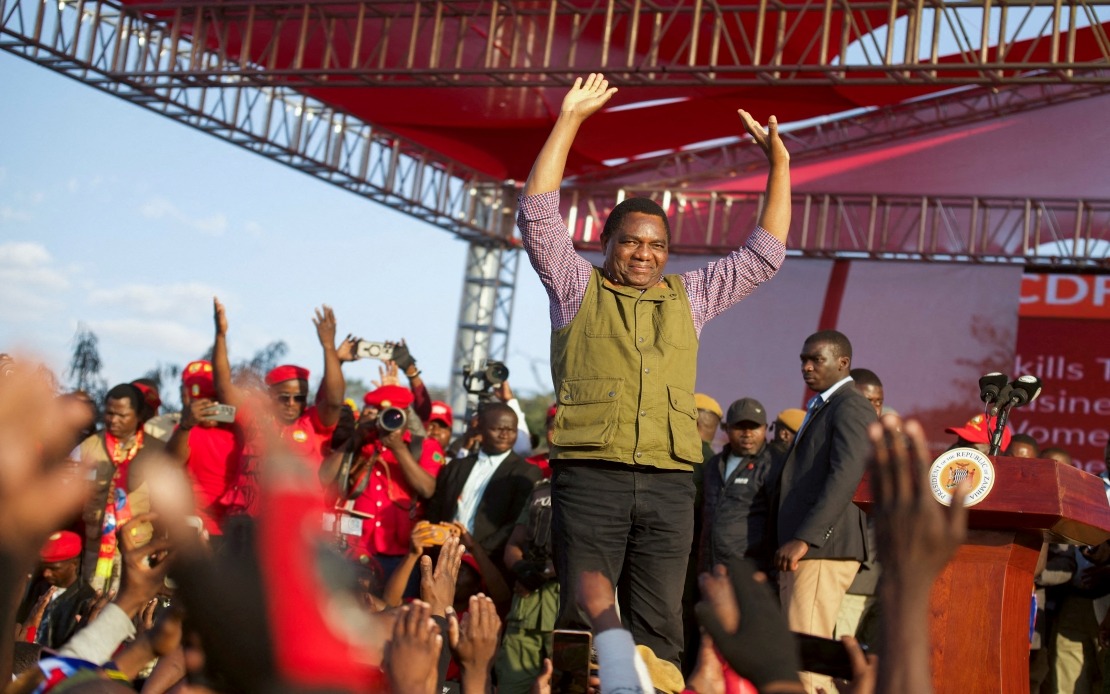
Zambian President Hakainde Hichilema appeared poised for re-election on Sunday, building a commanding advantage in the country's presidential contest with over 1.5 million votes counted from more than half the electoral constituencies. The 64-year-old economist and livestock rancher secured 1,544,140 votes from 135 of the 226 constituencies tallied by Sunday evening, a substantial margin that positioned him well ahead of his nearest rival as counting continued across the Southern African nation.
Running under the banner of the ruling United Party for National Development (UPND), Hichilema's lead extended significantly over the opposition field. His closest competitor, Brian Mundubile, a 55-year-old lawyer contesting for the National Reconciliation Party for Unity and Prosperity (NRPUP), had accumulated 1,030,662 votes—a gap exceeding half a million ballots at that stage. The Electoral Commission of Zambia announced the consolidated results from the National Election Results Centre in the capital Lusaka late Sunday evening, providing the first comprehensive snapshot of voter preference across multiple regions.
The electoral landscape reflected Zambia's political geography, with Mundubile's opposition alliance demonstrating particular strength in urbanized areas. His campaign gained traction across constituencies within Lusaka and the Copperbelt region, the country's industrial and economic heartland where mining operations concentrate. This geographic split mirrors broader patterns in African elections, where urban and rural constituencies often diverge significantly in their electoral preferences. The concentration of opposition support in developed urban corridors suggested that while Hichilema commanded national momentum, pockets of resistance remained among urban professionals and workers concerned with cost-of-living pressures.
Under Zambia's constitutional framework, a presidential candidate must capture more than 50 percent of all valid votes cast to secure outright election. With results from approximately 60 percent of constituencies counted, Hichilema's accumulating margin suggested he was well positioned to clear this threshold without requiring a second-round runoff, which would only occur between the top two candidates if no frontrunner achieved the required majority. The math appeared increasingly favorable to the incumbent, though the final outcome remained formally subject to completion of the tally across remaining constituencies.
For Hichilema personally, a successful re-election would validate his first five years in office and provide the extended runway he has argued is necessary to complete his development agenda. His 2021 election victory represented a dramatic turnaround—he had mounted unsuccessful presidential campaigns three times previously before finally breaking through with a landslide that defeated then-incumbent Edgar Lungu by more than one million votes. That decisive result gave Hichilema and the UPND an unmistakable mandate and positioned them to reshape national policy after years in opposition.
The incumbent has framed his first term as one of significant economic stabilization and sector revival. His administration credits itself with addressing Zambia's substantial debt burden, a legacy issue that had constrained public finances and limited investment capacity. The debt restructuring efforts, negotiated with both bilateral creditors and international institutions, aimed to restore fiscal sustainability. Additionally, Hichilema's government promoted revitalization of the mining sector, traditionally Zambia's economic backbone, through enhanced operational frameworks and investment incentives designed to attract capital and expand production from copper deposits.
On the social policy front, Hichilema highlighted his administration's expansion of education access, particularly through implementing free tuition at public primary and secondary schools. This flagship programme addressed one of the population's most pressing concerns—the cost barriers preventing children in lower-income families from completing schooling. Educational access has long represented a fundamental development challenge across Southern Africa, where poverty and geographic dispersion limit traditional school attendance. By eliminating direct educational costs, the UPND government sought to expand opportunity and reduce generational inequality.
The election took place within a regional context where economic stability and effective governance have become differentiating factors for Southern African leaders. Zambia, having previously endured debt distress and fiscal mismanagement, occupied a position where voters could assess tangible improvements in living standards and institutional function. Hichilema's message emphasized continuity with his institutional reforms and consolidation of economic gains, contrasting with opposition appeals for alternative approaches to development challenges.
The presence of 13 candidates in the presidential race, rather than a two-candidate contest, reflected Zambia's multiparty democratic framework. However, the concentration of votes between Hichilema and Mundubile demonstrated that despite formal multiparty competition, electoral outcomes typically cluster around the two leading contenders. This pattern, common throughout African democracies, suggests that smaller opposition parties and independent candidates serve primarily to expand choice within elections already shaped by dominant political forces.
With results continuing to arrive across the counting process, the substantive question transitioned from whether Hichilema would return to office—his lead suggested that outcome was highly probable—to the specific margin of his victory and the composition of the newly elected parliament. Opposition performance in parliamentary races would substantially shape the political dynamics of his second term, determining whether Hichilema would enjoy a cooperative legislature or face a more combative assembly inclined toward scrutiny and obstruction of executive initiatives.
For Malaysia and broader Southeast Asian observers, Zambia's election offered insights into democratic competition and leadership transitions in developing economies. The region's own experience with re-election contests, coalition politics, and the role of incumbency advantage resonates with patterns visible in the Zambian contest. Questions about economic management, social provision, and the relationship between electoral performance and policy delivery transcend geographic boundaries, connecting governance challenges in Southern Africa with Southeast Asian contexts.

