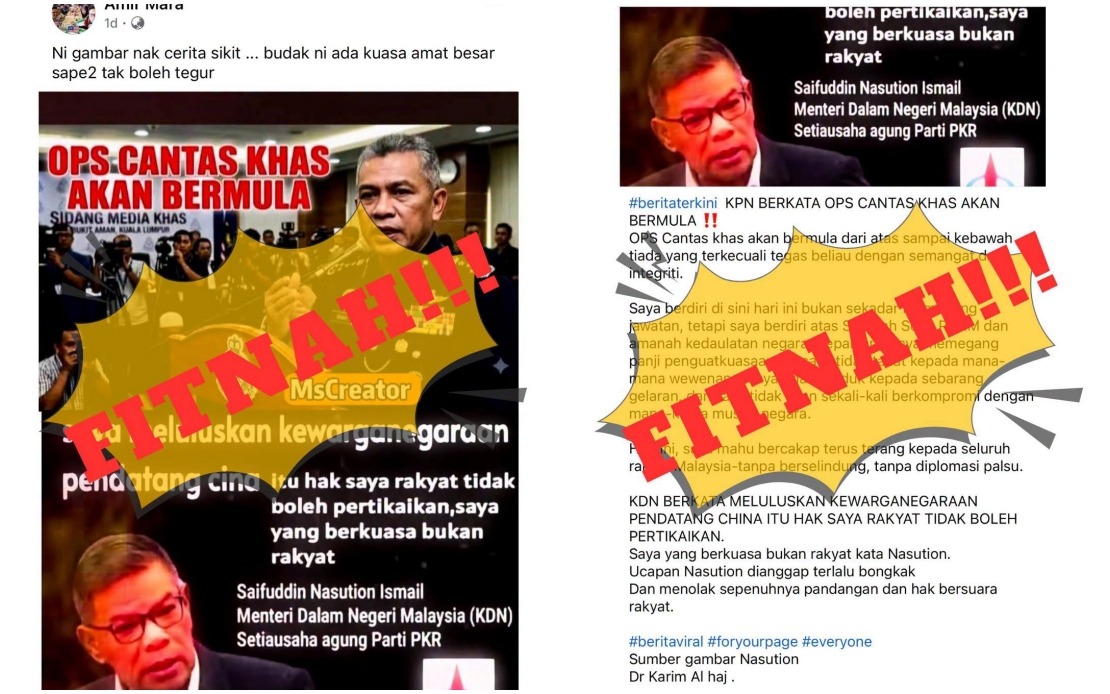
Home Minister Datuk Seri Saifuddin Nasution Ismail has firmly rejected persistent allegations that the Ministry of Home Affairs (KDN) granted citizenship to large numbers of foreign nationals, particularly claims involving 1.2 million Chinese nationals remaining in Malaysia. Speaking through his official social media channels on August 19, Saifuddin Nasution stressed that he has repeatedly addressed these claims with factual evidence and official data, yet misinformation continues to circulate widely across digital platforms.
The minister expressed frustration at the recurring nature of the controversy, noting that despite multiple official denials and clarifications, certain groups deliberately recycle discredited videos, posters, and narratives to mislead the public. This pattern of persistent misinformation represents a troubling trend in Malaysia's digital information landscape, where false claims gain traction faster than official corrections can counter them. The deliberate recycling of debunked content suggests a coordinated effort rather than isolated misunderstandings, raising questions about the motivations behind such sustained misinformation campaigns.
Saifuddin Nasution emphasised that the allegations have already been thoroughly addressed through official statements and media reports, with documented facts available for public review. Yet the continued spread of these claims indicates that official clarifications alone have proven insufficient to stem the tide of misinformation. This gap between official truth and public perception represents a significant governance challenge, particularly when sensitive citizenship and national identity matters are involved.
The minister warned of the broader consequences of tolerating such false claims, extending beyond individual or institutional reputational damage. According to Saifuddin Nasution, the dissemination of defamatory allegations threatens to undermine public confidence in state institutions themselves, a concern of particular gravity in a diverse, multi-ethnic nation like Malaysia. When citizens lose trust in government institutions' integrity, the very foundations of social cohesion become vulnerable to exploitation.
Beyond institutional damage, Saifuddin Nasution highlighted the social dangers inherent in spreading unverified claims about citizenship and national composition. Misinformation touching on sensitive identity, ethnicity, and belonging issues carries the potential to stir racial tensions, foster intercommunal hatred, and disrupt public order. In Malaysia's context, where interethnic harmony requires constant nurturing and where historical sensitivities remain relevant, such claims represent a genuine threat to national security and social stability.
The minister's statement underscores a growing challenge facing governments across Southeast Asia: the difficulty of combating digital misinformation in an age of widespread social media access. Unlike traditional media, where editorial gatekeeping could filter false claims, social media platforms enable rapid, decentralised distribution of unverified information. Individuals with no verification responsibilities can reach millions instantly, and by the time official corrections emerge, the false narrative may already have deeply penetrated public consciousness.
Saifuddin Nasution called on all citizens to cease spreading such claims and warned against exploiting sensitive national issues for political gain or social media engagement. This appeal represents an indirect acknowledgment that some actors may be leveraging citizenship misinformation for partisan advantage, whether to undermine the government's credibility or to mobilise particular constituencies through fear and resentment. The use of sensitive identity issues as political fodder threatens the delicate balance Malaysia has maintained among its diverse communities.
The minister urged the public to verify information through official sources before accepting or sharing it, a reasonable request that nonetheless highlights the challenge of combating misinformation in practice. Citizens often lack the time, expertise, or inclination to independently verify complex claims about government immigration policies, and social media algorithms typically promote emotionally engaging content regardless of accuracy. Encouraging individual responsibility for fact-checking, while necessary, cannot alone solve systemic misinformation problems.
Saifuddin Nasution's statement emphasised the distinction between facts and false claims, asserting that objective data should supersede unsubstantiated narratives. This framing reflects a rational, evidence-based approach to governance, yet it implicitly acknowledges that many citizens may prioritise emotional resonance or ideological alignment over empirical truth. The persistence of citizenship misinformation despite official denials suggests that some segments of the population find the false narrative more compelling or psychologically satisfying than the documented facts.
The ongoing controversy surrounding mass citizenship grants reveals vulnerabilities in Malaysia's information ecosystem and highlights the challenge of maintaining institutional credibility amid digital-age misinformation. The government faces the dual task of effectively communicating factual information while simultaneously addressing the underlying anxieties and suspicions that make false narratives appealing to segments of the population. Saifuddin Nasution's repeated denials, while formally correct, may require supplementation with proactive communication strategies that address public concerns about immigration and citizenship more comprehensively. The stakes remain high, as sustained misinformation on identity-related topics threatens both institutional legitimacy and social harmony across Southeast Asia's most ethnically diverse major economy.

