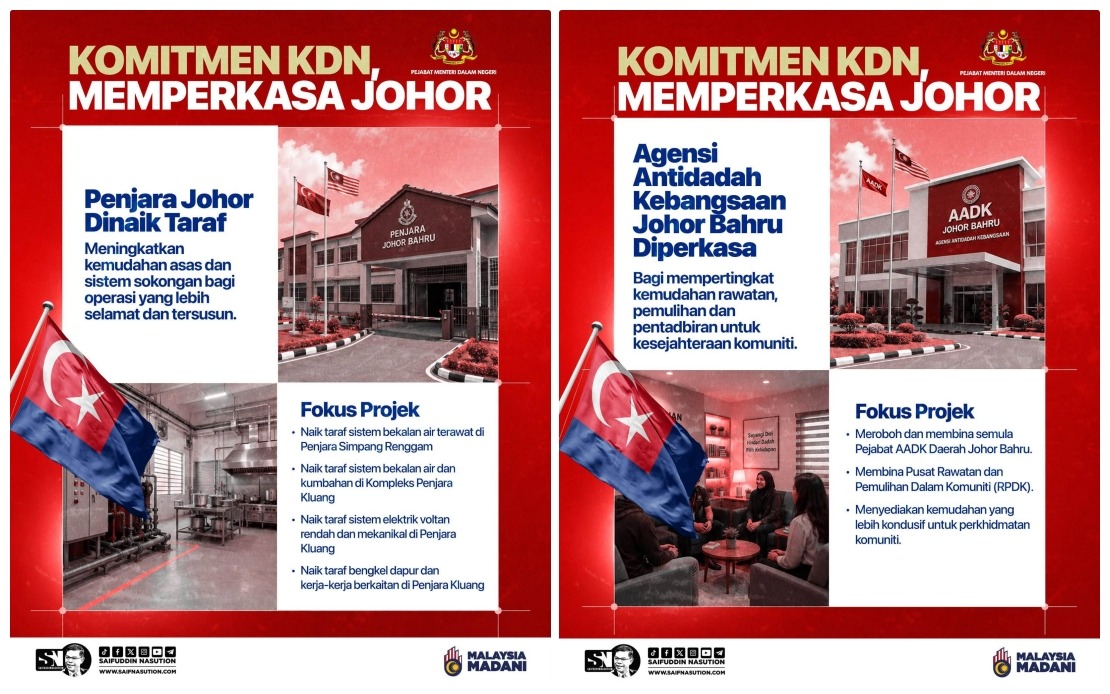
Home Minister Datuk Seri Saifuddin Nasution Ismail has announced an expansive programme of development initiatives designed to strengthen Johor's security apparatus and modernise government service delivery across multiple agencies operating in the state. The announcement, made in Johor Bahru on July 10, underscores the federal government's recognition of Johor's critical strategic importance as a southern anchor point for national security, border administration and international connectivity. Given Johor's geographical position adjacent to Singapore and its role as a primary gateway for travellers and commerce entering Malaysia, the state's operational efficiency carries implications extending well beyond its borders.
The initiatives span seven major agencies operating under the Home Ministry's umbrella, reflecting a coordinated approach to addressing infrastructure deficits that have accumulated across the security and public administration sectors. The Royal Malaysia Police will see the most visible improvements, with plans advancing for construction of a new district police headquarters in Segamat and secured funding for land acquisition needed to establish district headquarters in Pengerang. These facilities represent investments in institutional capacity at the district level, where frontline officers engage directly with communities and investigate crimes. Beyond new construction, the police force will benefit from renovation work targeting residential quarters and lift systems at existing stations, projects addressing the day-to-day working conditions of personnel stationed throughout the state.
Immigration and border administration form a second pillar of the announced improvements, reflecting the government's focus on managing flows across the country's most utilised land border crossing at Johor Bahru. The Immigration Department will receive funding to upgrade facilities at the Sultan Iskandar Building and the Sultan Abu Bakar Complex, installations that process thousands of travellers daily. Saifuddin Nasution characterised these upgrades as essential to ensuring that border operations function with greater organisational effectiveness and maintain the integrity standards essential to national security. For Malaysia's tourism industry and business community, the modernisation of these facilities carries practical significance, as processing efficiency at major entry points directly influences the travel experience and investment decisions of regional visitors.
The National Registration Department will establish a new district office in Batu Pahat, expanding the physical footprint of a critical institution responsible for issuing identity documents and managing the citizen registry. This expansion speaks to demographic growth patterns in Johor and reflects government recognition that infrastructure investment must keep pace with population distribution. The department operates as the foundational institution underpinning social services, voting systems and official identification throughout Malaysia's administrative apparatus.
Correctional facilities comprise another focus area, with the ministry directing resources toward basic systems upgrades at both Kluang Prison and Simpang Renggam Prison. These improvements to infrastructure and operational systems reflect broader commitments to improving conditions within Malaysia's detention facilities, a matter subject to regular international scrutiny. The redevelopment of National Anti-Drugs Agency offices and treatment centres across Johor represents the government's sustained emphasis on narcotics enforcement and rehabilitation, areas where Johor's position as a trafficking transit point makes these resources particularly critical.
Maritime security receives attention through planned upgrades to the Abu Bakar Maritime Base, including jetty improvements and building renovations. The Malaysian Maritime Enforcement Agency operates from this installation to patrol waters off Johor, conducting operations against smuggling, illegal fishing and maritime incursions. The upgrades signal government investment in the capabilities of an agency tasked with securing Malaysia's sovereignty over territorial waters and exclusive economic zones along the southern coast.
The announcement arrives on the eve of the 16th Johor state election, scheduled for July 11, when approximately 2.7 million registered voters will select 56 state assemblymen. The timing carries unmistakable political dimensions, as Home Ministry infrastructure commitments typically feature prominently in federal government messaging during state-level electoral campaigns. Such announcements demonstrate the central government's engagement in state-level development and implicitly highlight the federal resources available to states aligned with federal government priorities.
From a governance perspective, the coordinated announcement across multiple agencies reflects institutional planning structures within the Home Ministry, suggesting that these projects exist within longer-term strategic frameworks rather than representing ad-hoc allocations. However, the sequential delivery of these projects remains subject to budgetary cycles, procurement processes and operational capacity constraints that frequently extend implementation timelines beyond initial projections. Malaysian readers accustomed to infrastructure project announcements understand that the interval between ministerial declarations and completion typically spans years rather than months.
The minister's emphasis on ensuring that allocations deliver direct benefits to residents and strengthen security agency preparedness articulates the government's strategic rationale for these investments. Beyond the immediate operational improvements these projects will generate, the announcements signal to Johor's population that the federal government maintains active engagement with the state's development needs and recognises the state's particular significance to national interests. For Southeast Asia's broader security architecture, investments strengthening Malaysia's border administration and maritime enforcement capabilities carry implications for regional cooperation frameworks and transnational crime prevention efforts.

