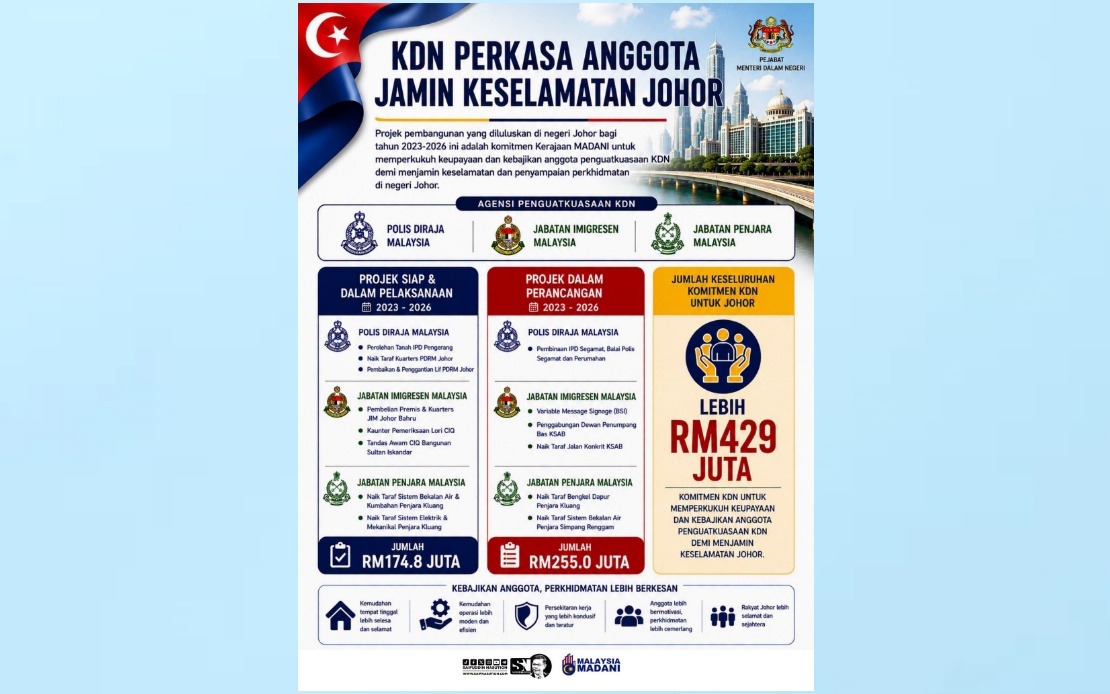
The Home Ministry has committed substantial resources to bolster its enforcement infrastructure and personnel support systems in Johor, unveiling an investment exceeding RM429 million channelled since 2023 across three cornerstone agencies. Home Minister Datuk Seri Saifuddin Nasution Ismail revealed the funding breakdown in a recent statement, emphasizing that the expenditure represents far more than routine budget allocation—it constitutes a fundamental shift toward recognising personnel welfare as integral to national security outcomes.
The three principal beneficiaries of this injection are the Royal Malaysia Police, the Malaysian Immigration Department, and the Malaysian Prisons Department. Each institution has received targeted support designed to address operational constraints and modernise working conditions. For Malaysian observers accustomed to discussions centring purely on enforcement statistics and crime prevention metrics, the prioritisation of officer welfare signals a policy recalibration toward understanding that institutional effectiveness depends directly upon human capital investment.
Saifuddin Nasution framed the initiative within a broader strategic narrative, arguing that investment in personnel conditions transcends conventional notions of employee benefit schemes. Rather, he positioned workplace improvements—encompassing physical infrastructure, residential accommodation, and operational equipment—as enabling factors for more efficient and safer law enforcement delivery. This conceptual linkage between staff welfare and public safety outcomes reflects emerging international best practice in police and corrections administration, where officer satisfaction metrics correlate demonstrably with service quality and community trust.
The minister articulated the government's foundational assumption that when enforcement personnel operate from well-maintained facilities with appropriate living quarters and contemporary tools, downstream benefits accrue to the broader public through enhanced service delivery and elevated security conditions. The reasoning extends beyond welfare philosophy into operational pragmatism: officers working within resource constraints and substandard conditions inevitably experience reduced effectiveness and heightened stress, creating systemic inefficiencies that ultimately compromise public protection mandates.
Financial allocation distribution reveals implementation prioritisation, with RM174.8 million designated for projects either completed or currently progressing through execution phases. The remaining RM255 million targets developmental initiatives still in preliminary planning or design stages, indicating the ministry's multi-year approach to infrastructure transformation. This bifurcation between immediate-term and pipeline projects acknowledges both the necessity of addressing urgent operational gaps and the reality that comprehensive institutional modernisation requires sustained temporal commitment.
Among projects actively advancing are the land acquisition for Pengerang District Police Headquarters, procurement of office and residential space for Johor Bahru Immigration Department operations, and foundational facility upgrades at Kluang Prison. These initiatives represent foundational infrastructure needs that previous budgeting cycles apparently left unaddressed, suggesting that the current allocation partly corrects cumulative maintenance and expansion deficiencies accumulated across multiple fiscal years.
Future-phase investments reveal more ambitious institutional restructuring ambitions. The Segamat District Police Headquarters initiative encompasses both operational police stations and officer residential quarters, addressing simultaneous capacity and accommodation pressures. The consolidation project affecting the bus terminal at Sultan Abu Bakar Complex indicates coordination between security and transportation infrastructure planning. Complementary improvements to Kluang Prison's kitchen facilities and water systems at Simpang Renggam Prison address fundamental service delivery requirements that proper institutional functioning demands.
Saifuddin Nasution positioned the expenditure sequence within broader MADANI Government developmental philosophy, asserting that resource distribution reflects state-specific needs assessment rather than standardised nationwide templates. He referenced recent clarifications by Prime Minister Datuk Seri Anwar Ibrahim regarding Johor's significantly enhanced development allocation, which has increased to approximately RM14.6 billion compared with the preceding RM10.2 billion figure. This contextualisation suggests the enforcement agency investment forms part of comprehensive state development prioritisation rather than isolated sectoral spending.
The timing and magnitude of this announcement carry particular significance for Johor, Malaysia's southernmost peninsula state and second-largest by population. Enhanced enforcement capacity directly impacts cross-border security dynamics given Johor's geographical proximity to Singapore and its role as a critical economic corridor. Strengthened police, immigration, and corrections infrastructure throughout the state therefore carries implications extending beyond local administration into regional security architectures and bilateral relations.
For Malaysian readers navigating increasingly complex domestic security challenges, the announcement signals governmental acknowledgment that enforcement effectiveness depends upon systematic investment in personnel conditions and institutional infrastructure rather than rhetorical commitments alone. The substantive financial commitment—exceeding RM429 million over a three-year span—demonstrates concrete resource mobilisation behind stated security priorities, though implementation efficiency will ultimately determine whether budgeted allocations translate into tangible operational improvements.
The emphasis on personnel welfare as strategic rather than merely humanitarian further indicates evolving governmental thinking about enforcement institution management. Rather than treating officer benefits as expendable during fiscal constraints, current policy frameworks increasingly position welfare investment as foundational to achieving measurable security outcomes. This conceptual evolution, reflected in concrete budget lines, may gradually transform how Malaysia's enforcement agencies approach human resource management and institutional development across coming years.

