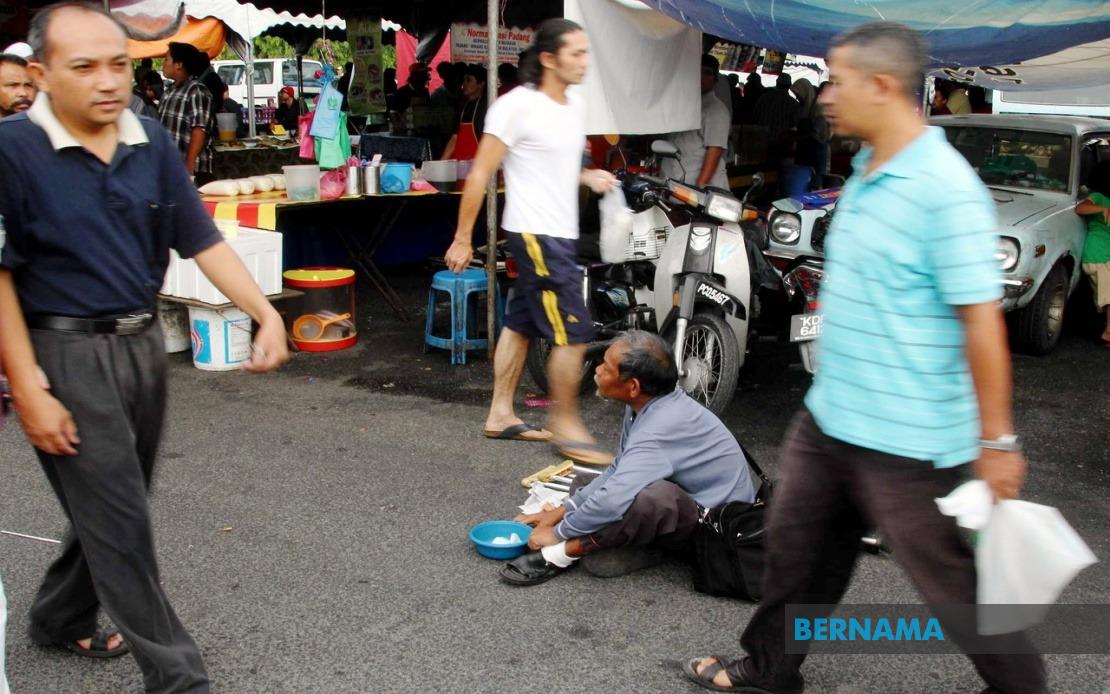
The Ministry of Home Affairs has raised alarm bells over what it describes as a coordinated criminal enterprise centred on the exploitation of foreign nationals through street begging, with particular concern directed at cases involving minors. In a parliamentary response this week, authorities outlined their assessment that these activities transcend opportunistic street-level panhandling and instead point to the involvement of organised networks with clear hierarchical structures and defined profit-sharing arrangements.
Data disclosed by the ministry paints a picture of intensive enforcement activity over the past five months. Between the start of 2025 and the end of May, immigration officers conducted 836 separate operations concentrated in the Kuala Lumpur metropolitan area. These sweeps resulted in the inspection of 10,609 individuals, with nearly half that number—5,411 people—detained for breaching immigration regulations. Among those apprehended, 42 were specifically involved in begging-related offences, though the ministry has intimated that the identified figure likely represents only the visible tip of a larger problem.
The parliamentary question, raised by Fong Kui Lun from the Bukit Bintang constituency, drew particular attention to the persistence of begging operations in high-visibility tourist precincts including Bukit Bintang itself, the Jalan Alor precinct, and Changkat Bukit Bintang. These locations—magnets for both domestic and international visitors—present both the opportunity and the visibility that make them attractive to organised operators. The concentration of foot traffic and transient populations in these zones creates ideal conditions for syndicates to deploy their operatives and extract revenue from passing crowds.
What distinguishes the government's framing of this issue from conventional law enforcement concerns is the explicit acknowledgement of domestic complicity in the scheme. The ministry has indicated that investigators are pursuing leads against Malaysian nationals suspected of functioning as enablers within these networks—individuals positioned as protectors, organisers, or money collectors who facilitate the exploitation of foreign nationals. This dimension underscores a sobering reality: the syndicates cannot function without domestic infrastructure and cooperation from Malaysian citizens occupying key operational roles.
The ministry's response emphasised an integrated approach to tackling the problem, reflecting recognition that no single agency possesses sufficient reach to dismantle these networks unilaterally. Immigration authorities have deepened their collaborative mechanisms with the Royal Malaysia Police and Kuala Lumpur City Hall, seeking to leverage each organisation's distinct enforcement powers and intelligence capabilities. The Immigration Department has simultaneously upgraded its analytical apparatus for identifying syndicate structures, tracking operational patterns, and mapping hotspot geography—the foundational intelligence work necessary to move beyond reactive enforcement toward preventive dismantling of criminal infrastructure.
A particularly significant institutional development has been the expansion of the KL Strike Force, a multi-agency task force that now coordinates activity among the Immigration Department, police, city authorities, and the Department of Social Welfare. This mechanism serves multiple functions simultaneously: it identifies and maintains surveillance of locations where begging concentrates, executes both planned and surprise joint operations, accelerates the circulation of intelligence among participating agencies, and maintains follow-up monitoring to prevent the rapid re-emergence of operations at previously targeted sites. The inclusion of the Department of Social Welfare signals recognition that effective responses must incorporate social welfare considerations, not purely enforcement.
The escalation from isolated enforcement actions to institutionalised inter-agency coordination suggests the ministry has concluded that syndicate-driven begging represents a strategic challenge to public order and national image management rather than a collection of discrete immigration violations. The language employed—references to preservation of public safety and the nation's reputation—indicates that officials view these operations through the lens of Malaysia's international standing, particularly given their concentration in areas frequented by tourists and their potential to generate negative international media coverage.
The foreign worker quota matter addressed in a separate parliamentary response, while administratively distinct from the begging syndicate issue, intersects with the broader question of irregular and exploitative foreign labour practices in Malaysia. The special application window that operated from January 19 to March 31 yielded 314 quota recommendations from 1,919 applications, a 16.4 percent approval rate. Those approved are now proceeding through deliberation by the Department of Labour Peninsular Malaysia under the framework of the Employment Act 1955. The creation of such special application windows, while intended to provide administrative flexibility, potentially reflects the scale of irregular foreign labour dynamics in the Malaysian economy and the persistent gap between formalised quota arrangements and ground-level labour realities.
For Malaysian readers, these developments carry implications across multiple dimensions. Consumer-facing implications include heightened scrutiny of tourist zones and surrounding commercial areas, where enforcement operations may disrupt normal activity and commerce. The acknowledgement of domestic syndicate participation raises questions about accountability for Malaysian citizens involved in these exploitation networks and signals intensified investigation into local enablers. The broader framing of foreign worker management—encompassing both exploitative street-level begging and formal labour quotas—suggests the government perceives foreign labour dynamics as a domain requiring more sophisticated governance architecture than currently exists.
Regionally, Malaysia's struggle with organised begging syndicates reflects patterns seen across Southeast Asia, where porous borders, differential wage levels, and established smuggling infrastructure create conditions enabling the trafficking of vulnerable populations for exploitation in street-level income-generation schemes. Thailand, Indonesia, and Cambodia have all confronted similar challenges, and comparative experience suggests that durable solutions require not only downstream enforcement against begging operations but upstream interventions addressing demand-side factors—tourist economies' tolerance for street-level poverty visibility—and cross-border cooperation with source countries to interrupt supply chains of vulnerable individuals.
The sustainability of the government's enforcement approach remains an open question. Previous crackdowns in various jurisdictions have achieved temporary suppression of visible begging without dismantling underlying syndicate structures, which simply relocate or adapt operational patterns. The ministry's emphasis on intelligence analysis and hotspot mapping suggests awareness of this challenge, yet the ultimate effectiveness will depend on whether the resources and political commitment allocated to these operations can be sustained beyond headline-generating enforcement surges.

