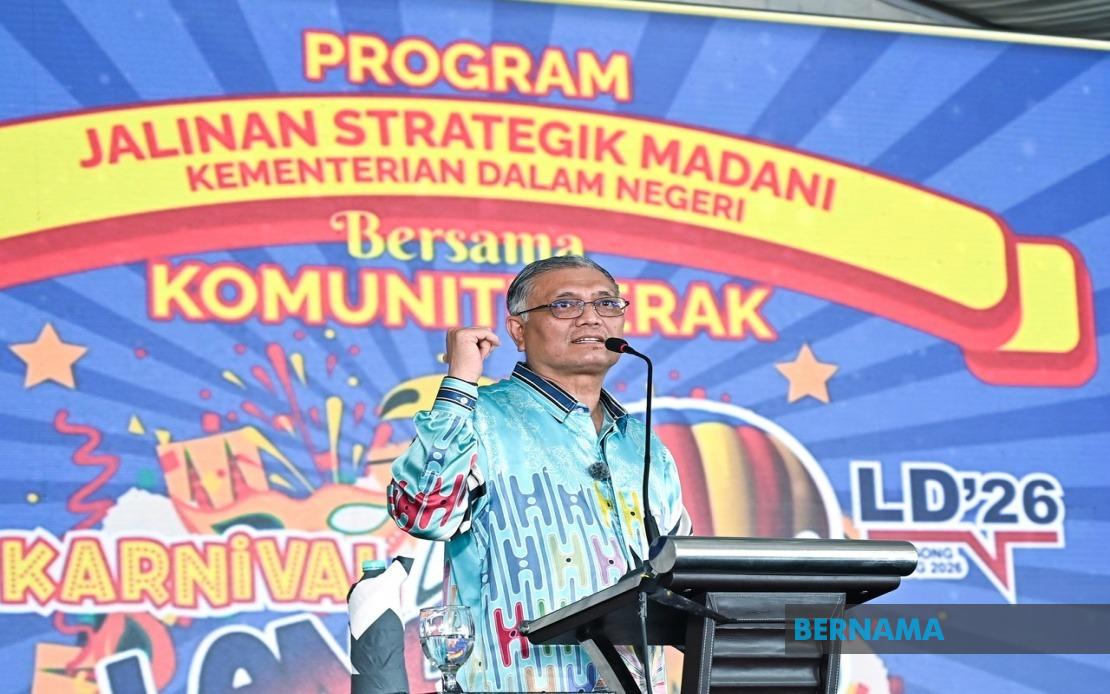
The Home Ministry launched its MADANI Strategic Partnership Programme this week in Lenggong, Perak, marking another step in the government's broader initiative to decentralise access to public services and strengthen ties between security agencies and local populations. The two-day event at Dataran Lenggong positioned government service delivery as a collaborative rather than purely transactional exercise, reflecting a strategic shift towards embedding state institutions more deeply within community structures across the country.
Deputy Home Minister Datuk Seri Dr Shamsul Anuar Nasarah, who also represents Lenggong as its Member of Parliament, articulated the programme's core rationale during the official launch. He emphasised that the initiative aims to dismantle geographical and bureaucratic barriers that often prevent citizens from accessing essential government facilities and information. By creating a physical space where multiple Home Ministry agencies operate simultaneously, the programme eliminates the need for residents to navigate the complex system of visiting separate offices in urban centres, a particular advantage for rural communities where mobility and time constraints present genuine obstacles to civic engagement.
The event attracted participation from several major government bodies operating under the Home Ministry's purview. The Royal Malaysia Police, Immigration Department of Malaysia, and the National Anti-Drugs Agency each established service counters staffed with officials prepared to process applications, provide guidance, and receive grievances. This integrated approach allows residents to address multiple administrative needs in a single visit, while simultaneously presenting an opportunity for security agencies to conduct outreach and build public familiarity with their operations and services.
Beyond administrative functionality, Dr Shamsul Anuar positioned the MADANI programme as a forum for genuine two-way dialogue between state security apparatus and grassroots communities. He invited visitors to leverage the occasion for direct engagement on crime prevention, drug trafficking, and neighbourhood security challenges that affect their daily lives. This emphasis on dialogue acknowledges a growing recognition within government circles that effective security policy requires input from communities who experience its consequences most directly, rather than remaining the exclusive domain of centralised bureaucracies.
The programme incorporated substantial recreational and cultural elements designed to broaden appeal beyond administrative transactions. Religious talks catered to the spiritual interests of participants, while children's creative performances and colouring competitions ensured youth engagement and family-oriented participation. These activities served a dual purpose: they generated goodwill and positive public sentiment towards government institutions, while simultaneously allowing security agencies to interact with younger demographics in non-coercive contexts that may foster long-term trust and cooperation.
Approximately 1,190 participants engaged in a Fun Ride and Fun Run organised jointly by the People's Volunteer Corps and the National Anti-Drugs Agency, traversing villages surrounding Lenggong to experience the region's natural landscape. This element cleverly integrated health promotion with tourism marketing, positioning Lenggong Valley's UNESCO World Heritage Site designation as an asset for community pride while physically demonstrating the government's commitment to supporting local development priorities. The activity reinforced messaging that state institutions operate in service of communal wellbeing beyond narrow security functions.
Lenggong Valley's UNESCO World Heritage status provides particular context for this programme's siting. The region's archaeological significance and tourism potential create natural constituencies of residents and business operators invested in stability and good governance. By anchoring the MADANI programme in this location, the Home Ministry associated its security and administrative functions with broader narratives of heritage preservation, economic development, and community advancement. This geographic strategy enhances the programme's resonance within the local political economy.
The service counter operations reportedly received encouraging engagement from residents, suggesting practical demand for decentralised government service delivery exists at community level. Record updates, information requests, and formal complaints lodged during the event represent tangible administrative outcomes, while the volume of enquiries provides valuable feedback to agencies regarding service accessibility gaps and community priorities. This data-gathering dimension transforms what appears as outreach into systematic intelligence collection about public service gaps.
For Malaysian policymakers observing the MADANI programme's implementation, the approach offers lessons regarding rural service delivery in an era of constrained public resources. Rather than establishing permanent satellite offices requiring ongoing staffing and maintenance, mobile or periodic service delivery models allow greater geographic coverage with flexible resource deployment. The programme's success in Lenggong may inform future Home Ministry planning regarding how to maintain service accessibility across peninsular Malaysia's diverse and dispersed population centres.
The MADANI initiative also reflects international trends in community-centred governance that have gained prominence across Southeast Asia. Governments throughout the region increasingly recognise that security outcomes depend substantially on public cooperation and trust, making visible government presence in localities and responsive engagement mechanisms strategic imperatives rather than optional enhancements. Malaysia's approach positions community engagement as fundamentally linked to security effectiveness.
Looking forward, the programme's sustainability and expansion will depend on several factors including budget allocation, agency coordination capacity, and genuine responsiveness to community input received during these events. The initial reception in Lenggong suggests appetite exists for enhanced government-community interaction, but translating positive sentiment from discrete events into sustained institutional change requires systematic follow-up mechanisms and evidence that government acted on feedback received. Residents' willingness to engage genuinely depends on perception that participation produces tangible results rather than performative consultation.
The MADANI programme ultimately represents an investment in public confidence in state institutions at a moment when such confidence faces various pressures. By demonstrating responsiveness to community needs, creating spaces for dialogue, and reducing friction in accessing government services, the Home Ministry advances both administrative efficiency and political legitimacy. For residents in communities like Lenggong, the programme offers concrete value through improved service accessibility while reinforcing the principle that government institutions exist to serve rather than merely regulate their constituents.

