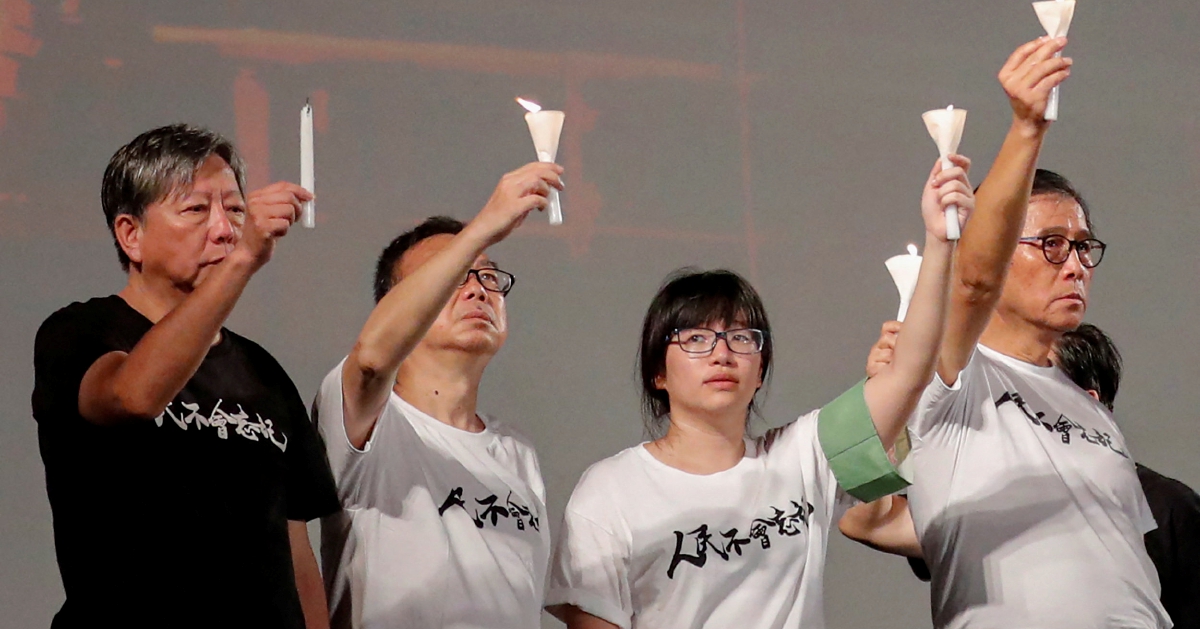
A Hong Kong court has found two prominent activists guilty of incitement to subversion for their role in organising yearly candlelit vigils commemorating the 1989 Tiananmen Square military crackdown in Beijing. The Friday verdict represents a significant escalation in prosecutions against those who have sought to preserve memory of the event, which the Chinese government has heavily censored on the mainland for more than three decades.
The two individuals organised the Tiananmen candlelight vigils, which historically drew tens of thousands of Hong Kong residents to Victoria Park each June 4th to remember those killed during the 1989 military operation. These gatherings became emblematic of Hong Kong's distinctive space for free expression and political activism, starkly contrasting with mainland China's enforced silence on the subject. The annual event served as a rare commemorative moment in Chinese-speaking regions where discussion of Tiananmen remained openly possible.
The conviction under the subversion clause represents a marked tightening of the legal boundaries within which Hong Kong activists can operate. Subversion charges, particularly those related to inciting action against state authority, carry severe penalties and have become a preferred prosecutorial tool in recent years. This development reflects broader concerns among international observers regarding the transformation of Hong Kong's legal and political landscape since 2020, when the National Security Law fundamentally altered the framework governing expression and assembly.
For Malaysian observers, this case underscores important distinctions between Hong Kong's historical autonomy and the tighter integration now occurring with mainland Chinese governance structures. While Malaysia maintains its own national security provisions and restrictions on political speech, Hong Kong's trajectory demonstrates how external security frameworks can be imposed upon a previously separate jurisdiction, reshaping the terrain of what constitutes permissible political activity overnight.
The vigils themselves had become increasingly restricted in recent years, with authorities blocking access to Victoria Park and deploying police presence. Yet the decision to prosecute the organisers criminally represents an entirely different threshold—one that criminalises the very act of seeking to commemorate a historical event. This distinction matters considerably for understanding how jurisdictions gradually convert administrative constraints into legal prohibitions, establishing precedents that can be weaponised against various forms of dissent.
The case also demonstrates how security laws, once enacted with stated intentions to address terrorism or sedition, frequently expand to encompass broader categories of political behaviour. The National Security Law introduced in Hong Kong in 2020 contained provisions permitting interpretation that extended well beyond traditionally understood security threats. Activists and legal observers had warned such language would permit authorities to prosecute ordinary civic participation as subversive, warnings that now appear prescient.
International human rights organisations have expressed concern that Hong Kong's trajectory signals reduced protection for freedom of expression and assembly—rights that were previously safeguarded under the Basic Law and international commitments. The conviction sends a chilling message to other potential organisers of commemorative or protest events. When criminal penalties attach to memorialisation itself, rather than to specific illegal acts or violence, the enforcement mechanism becomes capable of suppressing historical consciousness and collective memory as political tools.
For Southeast Asia more broadly, the Hong Kong precedent matters because it illustrates how security legislation can be deployed to prosecute political dissent. Malaysia, with its own sedition laws and increasing use of security provisions, occupies a position where these developments merit careful attention. The question of what constitutes impermissible political expression versus legitimate commemoration remains contested in multiple regional contexts.
The verdicts also illuminate how courts function within transformed political systems. Hong Kong courts retain formal independence in structure, yet the National Security Law imposed external accountability requirements that arguably constrain judicial discretion in sensitive cases. This creates a situation where legal processes may appear formally proper while substantively reflecting constraints imposed from outside the judicial system itself—a distinction that complicates traditional rule-of-law assessments.
The conviction of these activists marks another chapter in Hong Kong's transformation from a jurisdiction where political opposition could be openly expressed to one where commemorating contested historical events carries criminal consequences. As the city continues its integration with mainland governance mechanisms, the space for oppositional voices continues contracting. For other Asian democracies and semi-democracies, Hong Kong's example provides a cautionary account of how rapidly such transformations can occur when institutional safeguards are dismantled or subjected to external authority.
Looking ahead, the cases are likely to deter future organisers of similar commemorative gatherings, effectively suppressing public memory of Tiananmen within Hong Kong itself. This practical suppression of collective remembrance through criminalization represents a form of governance quite distinct from older models of political repression, relying on legal procedure rather than overt force to achieve similar outcomes. Understanding such mechanisms becomes essential for citizens and policymakers across Asia seeking to maintain and protect spaces for genuine political expression.

