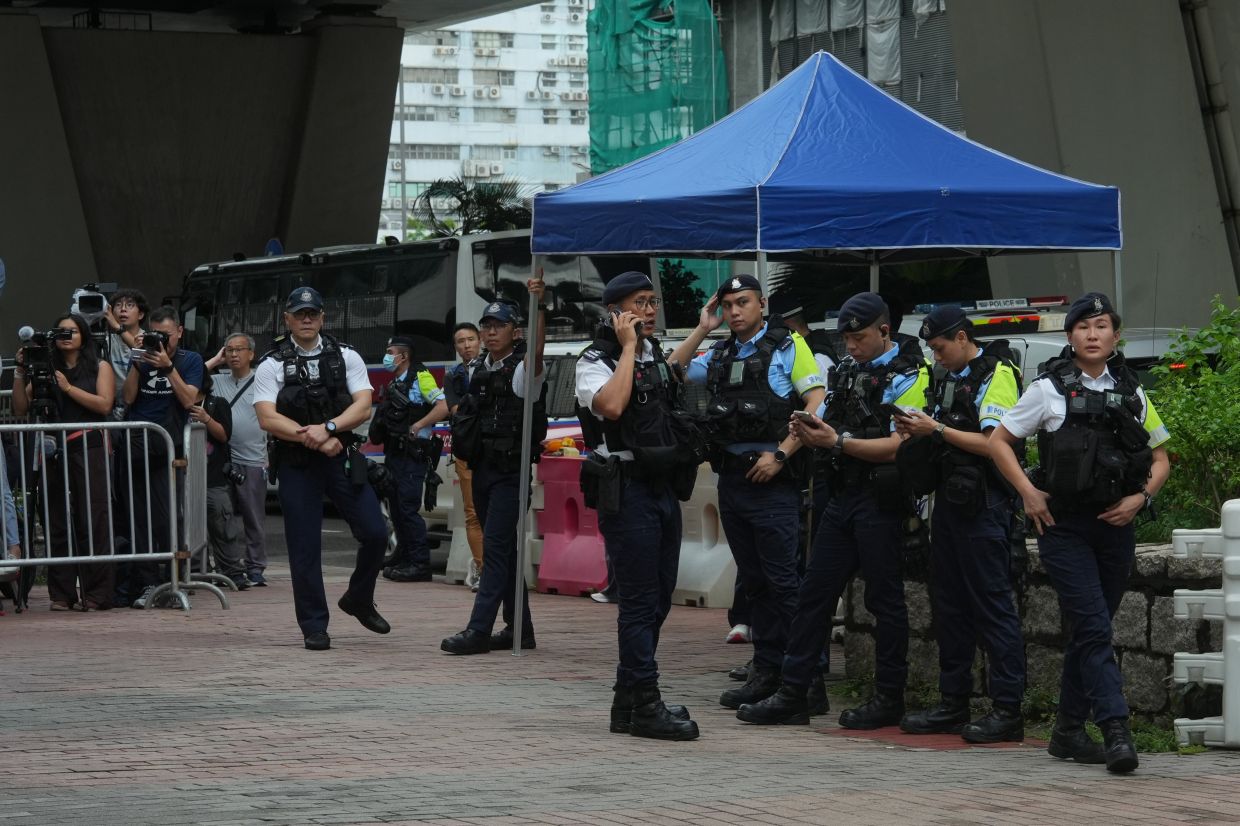
Hong Kong authorities have detained a woman on suspicion of public disorder and seditious intent after she wore a T-shirt with a message deemed controversial by police outside West Kowloon Court. The arrest, announced by the police force on Monday night, adds another dimension to Hong Kong's increasingly stringent security environment under national security legislation introduced in 2020. Officers in plain clothes identified the woman during Friday morning proceedings and took her into custody, an incident captured by media cameras stationed at the courthouse.
The timing of the arrest proved significant, occurring just hours before three High Court judges delivered guilty verdicts against Lee Cheuk‑yan, a former lawmaker, and Chow Hang‑tung, a practising barrister, both former leaders of the Hong Kong Alliance in Support of Patriotic Democratic Movements of China. The alliance, which had organised Hong Kong's annual Tiananmen Square vigil for decades, was disbanded in 2021 following police pressure. The pair were found guilty of inciting subversion under the national security law after being accused of calling for an end to "one‑party dictatorship" in mainland China, charges that underscore how broadly Beijing and Hong Kong authorities now interpret subversion offences.
Police justified their operation by citing public safety concerns, with a spokesman stating that "the purpose of the security operation was to ensure public safety and order," though he declined to provide specifics about the detention or the alleged seditious message on the T-shirt. Witnesses reported the woman was wearing a black garment printed with Japanese characters, though the precise wording or meaning remained unclear in public statements. This opacity reflects a broader pattern in Hong Kong where authorities invoke security concerns to limit disclosure about arrests and investigations, creating a chilling effect on public information access.
The arrest came after more than 50 people had assembled outside the courthouse from early Friday morning to either demonstrate support or observe the highly anticipated judgment. The gathering demonstrated that despite mounting pressure on activists and restrictions on public expression, Hong Kong citizens continue attempting to show solidarity with those facing national security charges. The police presence and visible enforcement action, however, sent a clear message about the consequences of public dissent, even non-verbal forms expressed through clothing.
Lee and Chow's conviction represents a watershed moment in Hong Kong's legal landscape. The 216-page High Court ruling established that any attempt to overthrow or undermine the Communist Party of China's leadership constitutes subversion under the national security law. More significantly, the judges held that the Hong Kong constitution does not permit Western-style democracy, a pronouncement with profound implications for how future cases will be adjudicated. This interpretation effectively closes off arguments based on democratic principles and suggests that activism promoting pluralism could face similar legal jeopardy.
Both men have endured prolonged detention ahead of sentencing. Lee, formerly a democratic-aligned legislator who spent decades in Hong Kong's political arena, has been held in custody for nearly five years. Chow, who maintains a legal practice as a barrister, has similarly languished in detention for an extended period. A fourth defendant, former vice-chairman Albert Ho Chun‑yan, has been detained for more than four years and awaits sentencing after entering a guilty plea in January, indicating that the prosecution's case against the alliance's leadership was formidable.
For Malaysia and other Southeast Asian democracies, Hong Kong's trajectory offers cautionary lessons about how national security legislation can be weaponised against political opposition and civil society activism. The case demonstrates the vulnerability of institutions—including the judiciary—when faced with pressure from authoritarian governance frameworks. The treatment of the unnamed woman arrested for her T-shirt further illustrates how enforcement of security laws often targets symbolic or expressive conduct rather than overt violence or direct threats, expanding the scope of criminal liability beyond traditional boundaries.
The incident also highlights tensions between international human rights standards and increasingly restrictive interpretations of national security. Hong Kong's trajectory from relative freedom of expression to prosecution of activists for their words and symbols within just a few years represents one of the most rapid transformations in contemporary Asia. The deployment of plainclothes officers to identify and arrest individuals based on clothing messages suggests an intelligence and enforcement apparatus calibrated to detect and suppress dissent at granular levels.
The broader context of the Tiananmen Square vigil's suppression is equally significant. For thirty years, Hong Kong residents commemorated the 1989 military crackdown through annual gatherings that had become emblematic of the territory's distinct political culture and historical consciousness. The alliance's disbandment and the prosecution of its leaders effectively severed this institutional mechanism for remembrance, while simultaneously signalling that organising collective commemoration of politically sensitive events now carries severe legal consequences.
As Malaysia navigates its own relationship with national security legislation and civil liberties, the Hong Kong precedent warrants close examination. The case suggests that security laws, once enacted, tend toward expansive interpretation and that courts operating under pressure may abandon their traditional role as guardians of fundamental freedoms. The conviction of Lee, Chow, and the alliance based on calling for political change in mainland China—conduct that would typically be protected speech in democratic jurisdictions—underscores how security frameworks can fundamentally restructure what constitutes a crime.
The woman arrested for her T-shirt may represent one of many individuals facing similar charges across Hong Kong as authorities intensify enforcement of national security provisions. Her identity remaining largely anonymous in public reporting itself reflects the climate of fear and restriction now pervading Hong Kong society, where even naming individuals facing such charges might invite unwanted official attention.

