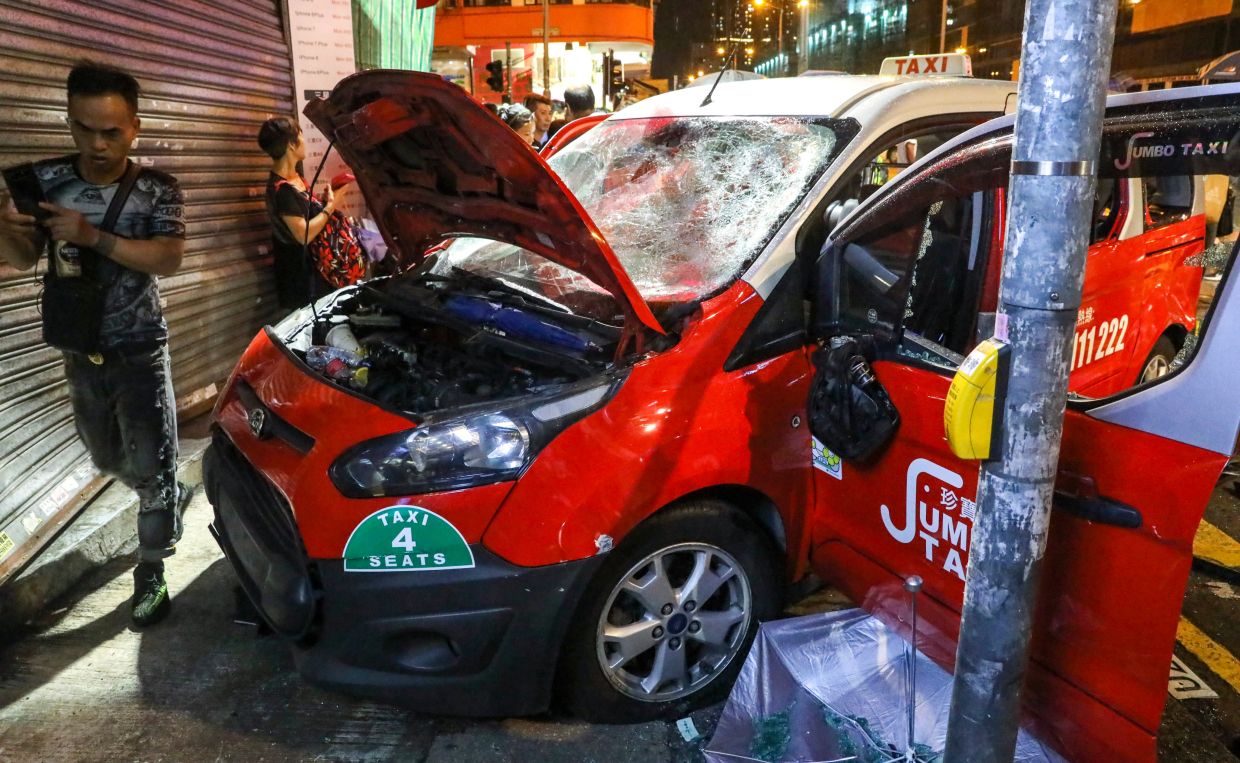
A Hong Kong kindergarten clerk whose life was fundamentally altered by a traffic collision during the 2019 pro-democracy demonstrations is pressing her claim for HK$8.4 million in damages against the taxi driver involved in the incident. Park Hoi-lam was severely injured when taxi driver Henry Cheng Kwok-chuen's vehicle mounted a pavement and hit her on Yen Chow Street in Sham Shui Po on October 6, 2019, during civil unrest that gripped the territory for months.
The lawsuit, initiated in 2022, hinges on a fundamental dispute about responsibility and causation. Park's legal team, led by counsel Susanna Leong, contends that the collision itself demonstrates clear negligence by Cheng, arguing he failed to exercise basic care in driving. The legal arguments centre on whether the driver had the opportunity to prevent the accident through defensive actions—the defence claims Cheng sounded no horn and made no attempt to brake before impact. For Park's side, these omissions constitute culpable negligence regardless of what happened afterwards.
The defence takes a starkly different view of events and their significance. Cheng's lawyers maintain he was himself victimised by the demonstration, subjected to attacks from protesters who wielded metal rods and hard objects. From this perspective, Cheng emerges as an innocent victim of the violence, and holding him financially responsible for Park's injuries compounds rather than corrects injustice. The defence asserts that "however serious the injuries sustained by the plaintiff were, seeking recompense through the courts from another victim of the violence does not, with respect, deliver justice."
This framing attempts to redirect focus away from the mechanics of the collision itself and onto the broader context of civil disorder. The defence strategy suggests that attributing liability to Cheng essentially punishes him for being caught in a chaotic situation beyond his control, a position that resonates with concerns about victim-blaming in protest-related incidents. Yet the plaintiff's counsel countered that the subsequent violence against the driver remains irrelevant to how and why the collision occurred—a distinction that matters enormously for legal liability.
Park's account of that afternoon paints a picture of someone caught in an unfolding emergency. She was travelling with friends towards Tsim Sha Tsui by bus when road closures forced the group to disembark in Sham Shui Po. Upon discovering that MTR services were suspended, they decided to walk toward Mong Kok. Separated from her companions, Park found herself in an increasingly crowded area as the situation deteriorated. She described the gathering as initially peaceful, but when commotion erupted near the taxi, she attempted to flee. The vehicle struck her at, in her words, "very high speed."
The consequences of those few seconds have rippled through nearly five years of her life. Park underwent seven surgical procedures within three months of the accident, and when discharged on January 18, 2020, she remained dependent on outpatient therapies. Medical professionals have informed her that further improvement is unlikely, and she faces the prospect of eventual knee replacement surgery—a sobering prognosis for someone in her working-age years. The injuries restrict her current employment as a kindergarten clerk near her home in Tuen Mun; she cannot lift heavy objects or comfort distressed children by carrying them, fundamental aspects of childcare work.
The financial toll extends beyond her career limitations. Park sought reconstructive surgery to address scarring on her legs, a procedure her cosmetic doctor recommended, but she lacks the funds to pursue it. This detail underscores how personal injury litigation in Hong Kong serves as a mechanism for victims to recover not just lost wages but the broader costs of medical care and rehabilitation. The inability to afford cosmetic treatment, while perhaps medically minor compared to her orthopedic injuries, speaks to how accidents fragment lives in multiple dimensions.
Pain management has become a permanent feature of Park's existence. She experiences chronic knee discomfort that prevents her from walking for more than an hour without rest—a significant restriction for someone who needs to manage a kindergarten classroom. When testifying before Justice Simon Leung Chun-man, she pushed back against the defence's characterisation of her condition by highlighting the gap between appearing functional and actually living meaningfully. Surveillance footage obtained by a private detective showed her shopping and dining after work, but Park's response was pointed: such activities, she argued, represent only the superficial continuity of daily life, not genuine recovery or the restoration of her former capabilities.
The defence's deployment of covert surveillance reflects a common litigation tactic in personal injury cases—using video evidence to suggest plaintiffs exaggerate their disabilities. Yet Park's response exposes the limitation of this approach: video snippets capture discrete moments that may not reveal the broader texture of disability. Walking to restaurants on good days does not erase the chronic pain or the lost hours she cannot be mobile. This evidentiary struggle underscores how difficult courts find it to quantify the subjective experience of permanent injury and diminished capacity.
Park's reluctance to attend her 2020 police interview alone, bringing barristers and lawyers, prompted the defence to suggest she was party to protest activity or concerned about legal consequences. She denied both assertions, framing legal representation as simple self-protection. This exchange reflects lingering sensitivities surrounding the 2019 protests; even five years later, questions about involvement carry implications. For Malaysian observers, the case illustrates how protest-related incidents in Hong Kong created tangled liability situations where determining fault requires distinguishing between accident causation and the political context in which accidents occur.
The six-day trial will ultimately require Justice Leung to weigh competing narratives about responsibility, causation, and proportionality. Is Cheng liable for negligent driving that occurred before the violence, or should the violent aftermath reframe how courts assess his culpability? Does Park deserve full compensation from someone who was himself attacked, or does his victimisation not diminish his responsibility for how he operated his vehicle? These questions extend beyond the immediate parties, touching on how Hong Kong's legal system allocates responsibility when individuals become entangled in civil unrest.
The case reflects broader tensions in post-2019 Hong Kong society, where the distinction between victims and perpetrators, between innocent bystanders and participants, has become increasingly contested. For Park, the resolution will determine whether the law recognises her injuries as compensable wrongs or as regrettable casualties of political disorder. The outcome may also signal how Hong Kong courts navigate the complicated intersection of traffic accidents and protest-related violence, a question with potential significance for similar disputes that may yet emerge across the region.

