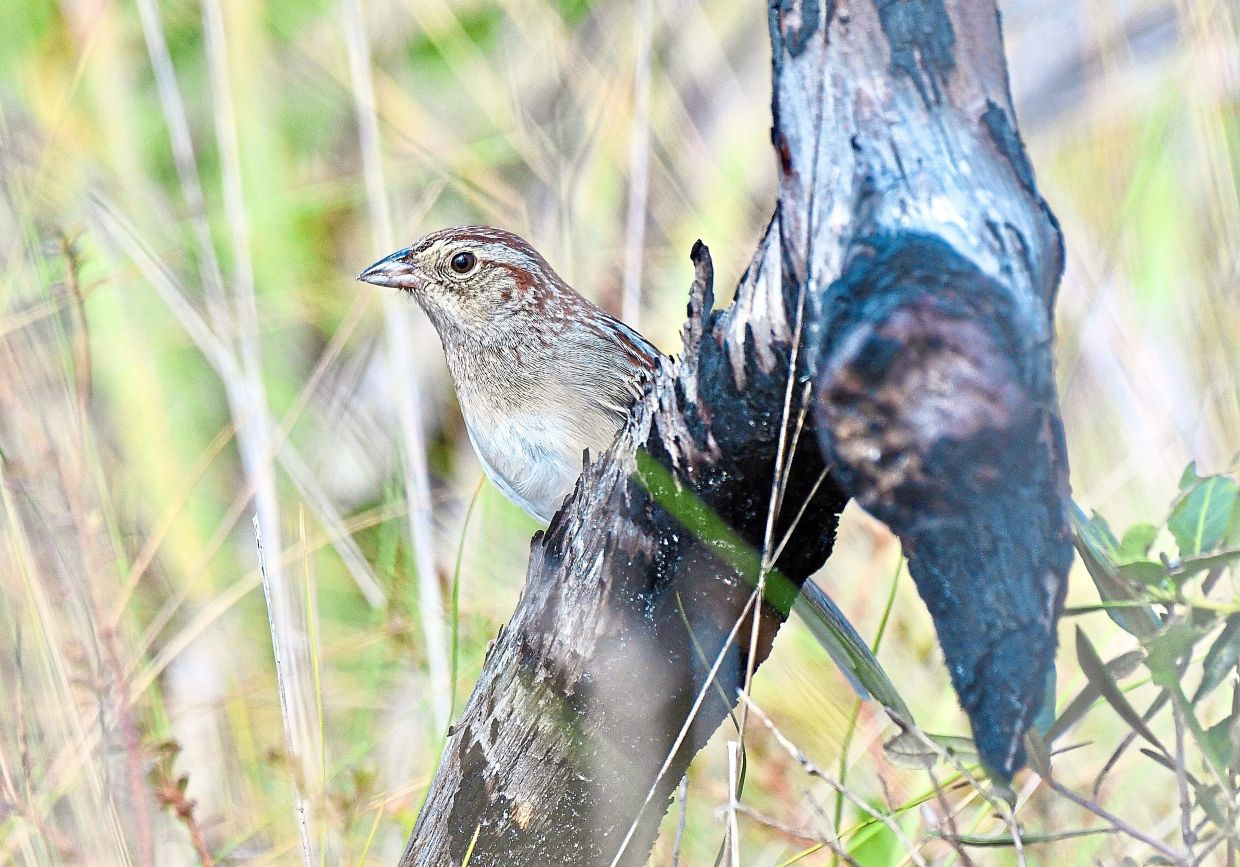
Researchers observing Bachman's sparrows in South Florida's flatwoods have uncovered a previously underappreciated mechanism shaping how these small brown birds select and preserve their vocal repertoires. The sparrows maintain a surprisingly complex communication system comprising up to 120 distinct song types within any given population, yet individual birds learn only a fraction of this collective catalogue during their formative years. This selective transmission has long puzzled ornithologists seeking to understand the forces guiding cultural inheritance in avian populations, with previous investigations emphasising the role of social status and physical attractiveness in song adoption.
The latest research, conducted by behavioural ecologist Rindy Anderson at Florida Atlantic University and published on March 24, introduces an environmental dimension to this puzzle. Rather than relying solely on social cues, young sparrows appear to unconsciously filter their song learning through acoustic properties of their physical surroundings. Trees, undergrowth density, wind patterns, and topography all scatter or obstruct sound waves in ways that degraded certain song frequencies whilst preserving others. This subtle environmental filtering mechanism may systematically favour the preservation of acoustically robust songs whilst allowing less acoustically efficient versions to fade from the population's collective memory.
The research methodology involved recording both common and rare Bachman's sparrow song variants before recreating these recordings in multiple natural environments frequented by the species. When researchers replayed these songs through dense forests, open windy areas, and other habitats where the birds typically forage and communicate, a clear pattern emerged: less common song types propagated poorly across distances, becoming increasingly degraded as they travelled through the acoustic landscape. By contrast, the more prevalent songs maintained their fidelity across greater distances, suggesting that young sparrows encountering these variants during their critical learning window would encounter cleaner, more recognisable versions worthy of imitation.
This finding aligns with the acoustic adaptation hypothesis, a theoretical framework proposing that habitat characteristics fundamentally shape vocalisation strategies across animal species. Tropical rainforest-dwelling monkeys, for instance, have evolved lower-frequency bellows because such sounds penetrate dense vegetation more effectively than higher pitches. Similarly, frogs inhabiting noisy stream environments produce shrill croaks that cut through water noise more efficiently than deeper calls. The sparrow research suggests that such habitat-driven vocal evolution operates through a learning mechanism rather than purely through natural selection pressure on individual physiology.
Anderson emphasises that environmental acoustic clarity represents only one component within a multifaceted system governing song transmission. Social factors—including the reproductive success of individual males and their physical ornamentation—retain considerable influence over which songs gain cultural prominence within sparrow communities. The interaction between these competing mechanisms remains incompletely understood, with Anderson cautious against overstating environmental factors' relative importance. The research therefore positions acoustic adaptation as a complementary rather than dominant force shaping avian cultural evolution.
This nuanced interpretation gains credibility from broader research trends in songbird biology. A comprehensive analysis of 5,085 songbird species worldwide suggested that sexual selection—wherein females preferentially mate with males exhibiting attractive vocal characteristics—may represent the primary driver of song variation across diverse species and ecosystems. Such findings complicate simplistic environmental determinism whilst acknowledging habitat's substantive but limited role in vocal transmission patterns. For Bachman's sparrows specifically, teasing apart these competing influences requires sustained longitudinal observation and carefully controlled experimental manipulation.
The acoustic properties of Bachman's sparrow songs themselves warrant consideration. All song types follow a characteristic architecture featuring an initial buzzing or whistling note followed by a trill section, with variations occurring in trill speed, complexity, and frequency composition. This standardised structure may itself reflect ancestral acoustic adaptation to flatwoods environments, with subsequent diversification occurring within acoustically viable parameters. The 120-song repertoire thus represents not random vocalisations but variations on a theme shaped by millenia of environmental selection.
David Wheatcroft, an ornithologist at Stockholm University not involved in the original research, identifies both the intuitive logic and surprising empirical demonstration within Anderson's findings. From a learning perspective, degraded songs become inherently less learnable—birds cannot faithfully reproduce songs they cannot clearly perceive. Yet documenting this mechanism in wild populations proves challenging given numerous competing variables influencing song rarity and transmission. Distinguishing acoustic degradation effects from social preference, individual variation, and random drift requires methodological sophistication that the Florida Atlantic team's field experiments provide.
The implications for understanding animal cultural evolution extend beyond ornithology toward broader questions concerning how environments shape behavioural transmission. If Bachman's sparrows unconsciously select song variants based on acoustic transmission properties, similar mechanisms may operate across diverse animal communication systems. Marine mammals navigating underwater soundscapes, insects producing vibrational signals through vegetation, and primates vocalising in varied forest densities may all experience comparable environmental filtering of cultural information. This perspective reframes habitat not merely as a constraint on animal behaviour but as an active force sculpting the transmission and evolution of learned behaviour across generations.
For Southeast Asian contexts, this research resonates particularly given the region's extraordinary avian diversity and ongoing habitat transformation. As deforestation, agricultural intensification, and urbanisation progressively alter acoustic environments throughout Malaysia, Thailand, Indonesia, and neighbouring countries, wild bird populations face potential disruption of their learned vocal traditions. Understory species, in particular, evolved to communicate effectively through dense vegetation may find their acoustic landscapes fundamentally altered by habitat conversion. Understanding how environmental acoustics mediate cultural transmission becomes increasingly relevant for conservation planning and species management strategies addressing habitat loss.
The Bachman's sparrow research ultimately illuminates a mechanism through which environment shapes culture without requiring explicit selection or conscious choice. Young sparrows learning which songs to adopt respond to the acoustic reality of their surroundings, naturally gravitating toward vocalisations that propagate clearly whilst filtering out degraded variants. This elegant mechanism demonstrates how evolutionary processes operate at cultural rather than purely genetic levels, with habitat serving as an invisible hand guiding the transmission of learned behaviour across generations. As environmental conditions worldwide continue shifting at unprecedented rates, such transmission mechanisms may increasingly determine which aspects of animal culture survive and which fade into silence.

