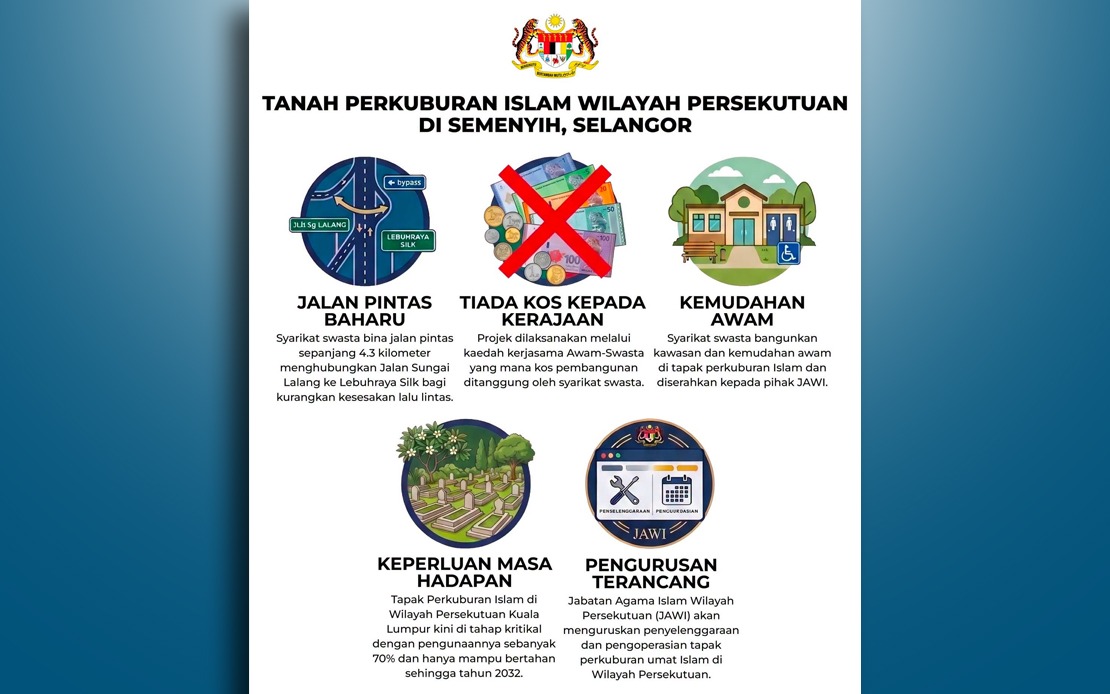
The government has moved to settle mounting public confusion about the Federal Territory Muslim Cemetery Development Project in Hulu Semenyih, Selangor, emphasising that planners have been studying the initiative for nearly two decades. Minister in the Prime Minister's Department (Federal Territories) Hannah Yeoh took to social media to explain the project's long gestation period, noting that it originated in 2005 as a response to the foreseeable depletion of Islamic burial grounds serving Kuala Lumpur's Muslim residents. The clarification became necessary after viral misinformation on social platforms raised questions about the scheme's legitimacy and planning timeline.
The burial capacity crisis facing Kuala Lumpur has reached a critical juncture. Existing Islamic cemeteries throughout the Federal Territory have consumed more than 70 per cent of their available space, leaving only around 29 per cent of plots still available. As of June 2023, approximately 34,496 burial plots remained open across all current facilities serving the capital. At the current rate of demand, cemetery managers project these remaining plots will be exhausted by 2032, creating an acute shortage that could force Muslim families to travel extensive distances or face unavoidable delays during periods of high mortality. This arithmetic underscores why officials view the Hulu Semenyih venture as strategically urgent rather than speculative.
The 332.6-acre development will operate through a public-private partnership model that attempts to balance private sector efficiency with public oversight. A developer will shoulder full responsibility for infrastructure costs, constructing facilities including prayer spaces, administrative offices, staff quarters, and amenities such as cafeterias and security posts. The developer will also prepare the earthworks necessary to accommodate 104,470 burial plots dedicated to Federal Territory residents. Critically, the Federal Lands Commissioner retains ownership of the underlying land, ensuring public control over a sensitive community resource.
Management authority remains vested in the Federal Territories Islamic Religious Department (JAWI), establishing a clear boundary between private capital investment and religious administration. This arrangement attempts to address concerns that profit-driven entities might compromise the sanctity or accessibility of Islamic burial grounds. By keeping operations under JAWI's purview, the government maintains theological and administrative authority while leveraging private funding and development expertise. The 10 per cent allocation for surrounding Selangor residents acknowledges that burial grounds serve broader regional populations rather than municipal boundaries alone.
The transportation infrastructure component forms an essential justification for the project's social utility. A 4.3-kilometre link road connecting Jalan Sungai Lalang to the SILK Highway will be constructed at a total cost of RM93.89 million, entirely financed by the developer as a condition imposed by Selangor's state government. Rather than burdening taxpayers, this arrangement channels development costs toward alleviating traffic congestion that currently affects Semenyih's local communities. The improved connectivity should provide residents with a more direct route to major thoroughfares while reducing pressure on existing road networks during peak periods.
The project has navigated an extensive approval process involving multiple government entities and technical evaluations. Officials highlight that the scheme has undergone formal technical assessments, undergone a Value Management Lab evaluation, and secured sign-off from both Selangor state authorities and Federal Government bodies. This multi-layered review process suggests the proposal has satisfied both environmental and administrative standards required for major infrastructure developments. The involvement of state-level oversight demonstrates that despite Kuala Lumpur's federal status, the project recognises Selangor's legitimate interest in regional land-use planning.
The timing of Hannah Yeoh's clarification reveals the political sensitivity surrounding cemetery development in Malaysia's urbanised regions. Misinformation spreading through social media platforms can quickly mobilise community anxiety when projects affect religious sites or involve private developers. By emphasising the 2005 origins of planning efforts, officials attempt to demonstrate methodical deliberation rather than reactive or opportunistic decision-making. The lengthy planning period also suggests that responsible government foresees demographic trends and infrastructure needs years in advance, rather than improvising responses to crises.
For Kuala Lumpur's Muslim population, the Hulu Semenyih project offers essential planning certainty in an area traditionally marked by neglect until crisis becomes imminent. The 2032 exhaustion date for existing plots represents not a distant future threat but a deadline affecting people who may purchase burial plots within the next five to seven years. Families wishing to secure burial spaces within reasonable proximity to their homes and communities face diminishing options without this expansion. The project thus addresses a fundamental aspect of Islamic practice that communities across Malaysia increasingly recognise as requiring strategic investment comparable to any other essential service.
Southeast Asian cities facing similar demographic pressures and urbanisation challenges may find Malaysia's partnership model instructive. As religious and secular burial practices intersect with property values, environmental regulations, and traffic management in metropolitan regions, balancing community needs against space constraints demands innovations that neither pure public provision nor entirely private enterprise can achieve alone. The Hulu Semenyih structure—combining public land tenure with private infrastructure investment, developer funding for associated traffic infrastructure, and public religious administration—offers a template that other nations grappling with cemetery shortages might examine.
The project also reflects how Malaysian governance increasingly requires explanation of long-standing plans to publics increasingly sceptical of government intentions. Hannah Yeoh's social media statement, though primarily defensive in tone, acknowledges that contemporary politics demands transparency about planning processes that earlier administrations might have pursued with minimal public communication. The willingness to document the 2005 origins demonstrates recognition that credibility depends on demonstrating foresight, methodical process, and consideration of community welfare. Whether social media clarifications sufficiently address underlying concerns about cemetery development in Selangor's landscape remains to be seen as construction approaches.

