The number of individuals rescued from human trafficking and forced labour situations in Malaysia has fallen significantly over the past two years, signalling that enforcement strategies are beginning to yield measurable results. Deputy Human Resources Minister Datuk Khairul Firdaus Akbar Khan attributed the downward trajectory to comprehensive government interventions spanning detection, investigation, and prevention activities rolled out across the country's various regions and sectors.
Data compiled by the Peninsular Malaysia Manpower Department reveals that rescue figures have fluctuated unevenly. In 2023, authorities assisted 70 victims, a number that contracted sharply to just 10 in 2024. The trend reversed partially in 2025, when 17 victims were identified and rescued. However, the year-to-date total through May 2026 stands at only four recorded cases, suggesting either continued suppression of trafficking networks or a methodological shift in how cases are being documented and reported across enforcement agencies.
Despite welcoming the reduction in reported cases, Khairul Firdaus offered a crucial caveat that reflects law enforcement's sophisticated understanding of the hidden nature of trafficking crimes. He acknowledged that official statistics may understate the genuine prevalence of human trafficking and labour exploitation, as many victims remain unreported due to fear, isolation, language barriers, or lack of awareness of support mechanisms. This dual reality—celebrating enforcement success while remaining vigilant about undetected cases—underscores the challenge facing authorities across Southeast Asia, where clandestine networks frequently operate in plain sight within informal economies and remote areas.
Government enforcement operations have intensified substantially during the first five months of 2026. Nationwide, 386 labour-related enforcement operations were executed, generating 311 formal investigation papers. These figures demonstrate that while individual victim rescues may be declining, the underlying investigative apparatus continues operating at high capacity, potentially dismantling trafficking infrastructure and supplier networks rather than simply identifying individual victims. This shift in enforcement approach suggests authorities are moving beyond reactive victim identification toward proactive network disruption.
Malaysia's commitment to combating trafficking aligns with international standards established under the International Labour Organisation. By ratifying ILO protocols addressing forced labour elimination, the government has embedded itself within a broader regional and global framework designed to harmonise anti-trafficking methodologies. Such alignment proves particularly significant for Malaysian businesses operating across supply chains that span Southeast Asia, as international protocols create standardised compliance expectations that filter down through commerce and manufacturing sectors where trafficking vulnerabilities frequently concentrate.
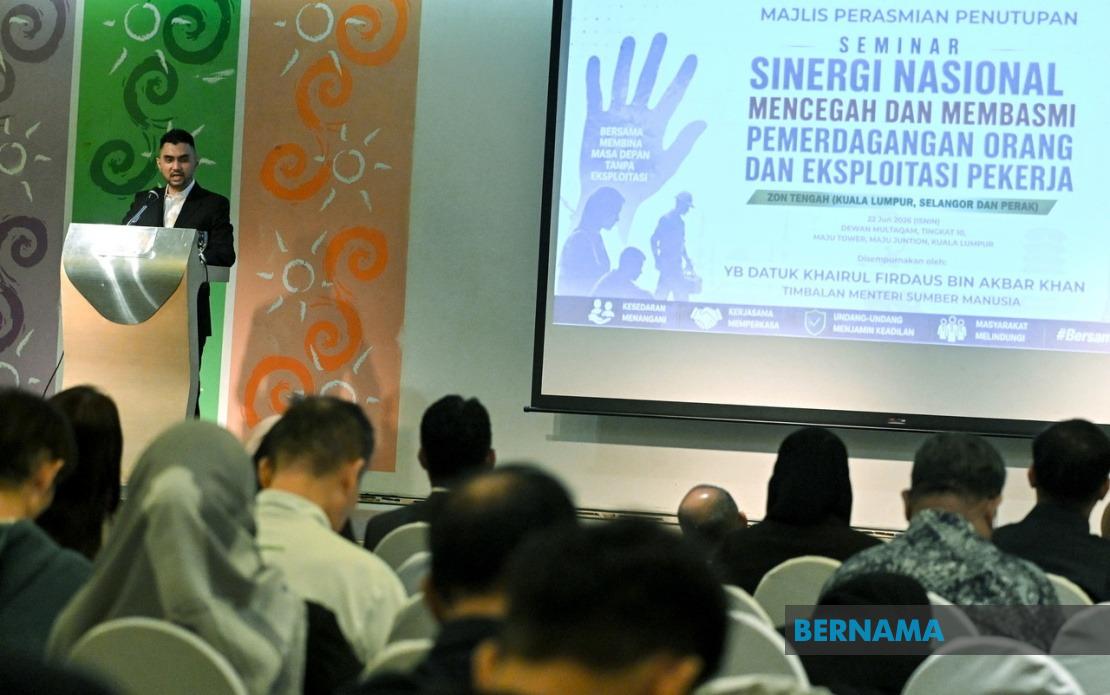
The National Synergy Seminar on Preventing and Eradicating Human Trafficking and Labour Exploitation represents a critical awareness-building initiative that extends beyond law enforcement into public consciousness. The Central Zone seminar, which prompted Khairul Firdaus's remarks, formed part of a scheduled national tour designed to saturate different regions with educational content about trafficking indicators, victim support pathways, and reporting mechanisms. Prior seminars had been held in the North Zone at Sungai Petani, Kedah in May and the South Zone at Kluang, Johor in June, establishing a structured approach to grassroots awareness.
Participation in these seminars has been substantial, with nearly 1,000 attendees across the regional events contributing perspectives and suggestions. The high turnout suggests receptiveness among local government officials, NGOs, community leaders, and business representatives toward traffick prevention. This participatory model recognises that sustainable anti-trafficking progress emerges when enforcement agencies collaborate with frontline stakeholders who encounter potential victims during their professional duties—social workers, labour inspectors, healthcare providers, and business compliance officers.
For Malaysian readers and businesses, the declining rescue statistics carry ambiguous implications. On one hand, they suggest that trafficking networks may be contracting or relocating operations to less-monitored jurisdictions. On the other hand, the persistence of enforcement activity and the government's proactive awareness campaigns indicate that authorities regard the problem as requiring sustained vigilance. Companies operating labour-intensive sectors, particularly in agriculture, domestic service, and construction, must recognise that external validation from government bodies does not absolve private sector responsibility for supply chain audits and worker protection protocols.
The regional context amplifies Malaysia's anti-trafficking narrative. Throughout Southeast Asia, trafficking remains a persistent challenge, with victims frequently transiting across borders for exploitation in destination countries. Malaysia's position as both a transit point and destination nation for trafficked labour necessitates sophisticated coordination with neighbouring jurisdictions and international law enforcement bodies. The seminar series and enforcement operations represent Malaysian contributions to a collective regional effort, though effectiveness ultimately depends on synchronisation across national borders where trafficking networks operate fluidly.
Looking forward, the government's messaging contains inherent tension worth examining. Officials celebrate declining rescue numbers while simultaneously warning that invisible cases may dwarf recorded statistics. This paradox reflects honest acknowledgment of enforcement limitations rather than complacency. For Malaysia to further reduce actual trafficking prevalence—rather than simply documented cases—attention must shift toward addressing root causes: poverty in source communities, demand from exploitative employers, and the bureaucratic vulnerabilities that permit informal labour systems to flourish beyond regulatory oversight.
Stakeholder engagement through seminars addresses the awareness dimension, but structural reform affecting business practices, labour law enforcement, and international cooperation will determine whether declining figures reflect genuine progress or merely gaps in detection. Malaysian policymakers and business leaders should view current statistics as a baseline prompting deeper examination rather than an endpoint validating satisfaction with current arrangements.