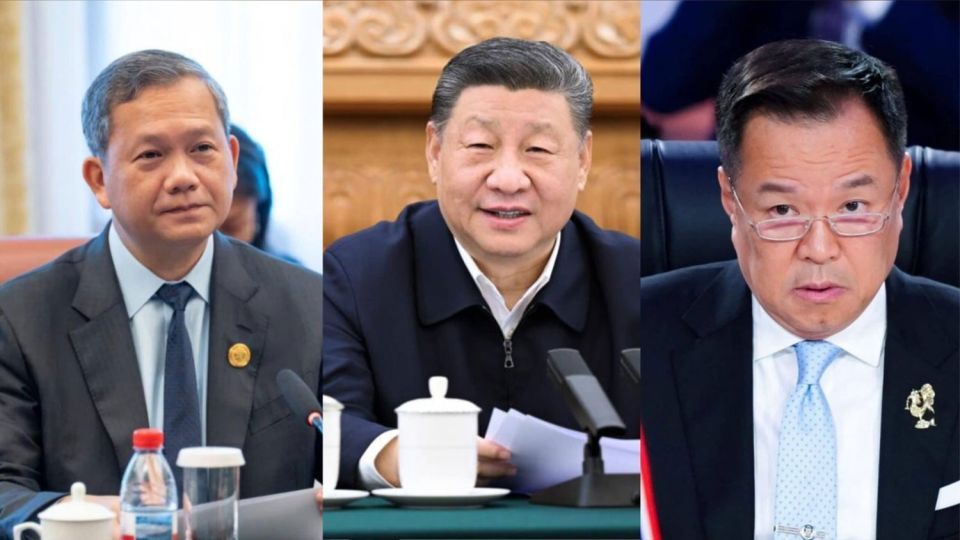
Cambodian Prime Minister Hun Manet and his Thai counterpart Anutin Chanvirakul are preparing for a high-level visit to Shanghai next month, where they will participate in the opening ceremony of the World AI Conference 2026 following a direct invitation from Chinese President Xi Jinping. The attendance of both Southeast Asian leaders at the same Chinese-hosted event creates a rare diplomatic opportunity that observers believe could potentially unlock progress on the contentious land border dispute that has haunted bilateral relations for decades. The gathering brings to the fore a larger question about Beijing's willingness to leverage its economic and political influence to broker peace between two nations where territorial tensions remain fundamentally unresolved.
Hun Manet's delegation, scheduled to travel from July 15 to 17, will include a roster of senior officials tasked with managing Cambodia's most pressing strategic relationships. Foreign Minister Prak Sokhonn, Defence Minister Tea Seiha, and Sun Chanthol, the first vice-chairman of the Council for the Development of Cambodia, will accompany the premier to underscore the visit's importance across multiple policy domains. The composition of the Cambodian entourage suggests that discussions will extend well beyond artificial intelligence technology and into the substantive realm of regional security cooperation. Thailand's delegation will similarly reflect high-level engagement, with Foreign Minister Sihasak Phuangketkeow expected to join Anutin. Both prime ministers have scheduled separate bilateral meetings with President Xi and Chinese Premier Li Qiang, indicating that Shanghai will serve as more than a ceremonial gathering.
Cambodia's Foreign Ministry emphasised the visit's strategic significance in a formal statement, framing the Shanghai trip as an opportunity to deepen the country's relationship with its most powerful neighbour and economic lifeline. The ministry referenced Cambodia's Comprehensive Strategic Partnership with China and highlighted the importance of the Diamond Cooperation Framework, which has become central to Phnom Penh's foreign policy architecture. Officials explicitly noted that the visit aims to construct what they describe as an all-weather Cambodia-China Community with a Shared Future, language that mirrors Xi Jinping's signature diplomatic formulations. Thailand's Foreign Ministry issued comparable rhetoric, emphasising the visit's role in strengthening Bangkok's own Comprehensive Strategic Cooperative Partnership with Beijing. These carefully calibrated statements reveal how both Cambodian and Thai governments view their relationships with China as foundational to their respective regional strategies.
The timing of the Shanghai conference assumes particular importance given that the two Southeast Asian neighbours have not engaged in substantive border negotiations since December 2025, when they reached the Chinese-brokered Fuxian Consensus. That agreement theoretically laid groundwork for resolving disputes centred on disputed maritime boundaries and overlapping territorial claims, yet implementation has stalled dramatically in the intervening months. The last visible interaction between Hun Manet and Anutin occurred in early June during the 3rd ASEAN Future Forum in Hanoi, where the two leaders staged a handshake for photographers but conducted no meaningful discussions on the border question. Shanghai thus represents a crucial juncture: either Beijing will deploy its considerable leverage to restart negotiations, or the two nations will continue their pattern of diplomatic theatre without substantive progress.
Policymakers and regional analysts have increasingly speculated that China will use the Shanghai platform to nudge both nations toward renewed dialogue. As the primary trading partner for both Cambodia and Thailand, and as a nation with demonstrated capacity to mediate regional conflicts, Beijing possesses significant carrots and sticks to incentivise cooperation. However, experts suggest that the mechanics of power within Thailand present formidable obstacles to any breakthrough. Kin Phea, director of the International Relations Institute at Cambodia's Royal Academy, has articulated a compelling analysis of why previous peace efforts have faltered, pointing to institutional tensions within Thailand's government structure that have repeatedly undermined progress.
Phea's assessment identifies a fundamental problem: Thailand's civilian government negotiators may reach agreements with their Cambodian counterparts, but Thailand's military establishment refuses to implement those commitments. The military apparatus, according to analysts, retains sufficient autonomous authority to pursue actions that contradict civilian policy directives, including incursions onto Cambodian territory that violate the spirit and letter of bilateral agreements. This dynamic represents not merely a disagreement between two governments but rather a structural inability on the Thai side to enforce compliance with diplomatic settlements. The Cambodian expert has urged China to assume a more assertive arbitration role, moving beyond passive witness to active enforcement mechanism.
The human cost of the border dispute remains stark and largely absent from diplomatic communiqués. Approximately 20,000 Cambodian civilians remain unable to return to their homes in areas currently under Thai control. These individuals represent families displaced by territorial occupation, their plight extending for years without resolution. The Fuxian Consensus ostensibly addressed this humanitarian dimension, yet enforcement mechanisms remain vague and unenforced. Phea has explicitly demanded that Thailand withdraw its troops from occupied areas, return to the Joint Boundary Commission negotiating table, and cease indefinite postponement of boundary demarcation work. These demands reflect not merely nationalist sentiment but straightforward application of international law principles regarding territorial integrity and the peaceful resolution of disputes.
China's historical role in brokering the Fuxian Consensus positioned Beijing as a potential guarantor of implementation, yet questions persist about whether Shanghai will mark a turning point toward active enforcement or continued diplomatic passivity. Beijing's economic leverage over both nations is immense, given China's status as Cambodia's largest foreign investor and a dominant player in Thailand's economy. The artificial intelligence conference provides a contemporary framing device for discussions about technological cooperation and innovation, yet underneath this veneer lies the fundamental geopolitical calculation about whether Beijing will translate economic influence into diplomatic pressure on the border question. The Shanghai gathering will reveal much about China's priorities: whether it prefers stability achieved through aggressive mediation or continued ambiguity that allows it to maintain leverage over both smaller neighbours simultaneously.
For Malaysia and broader Southeast Asia, the Cambodia-Thailand border dispute carries implications extending far beyond bilateral relations. Unresolved territorial tensions create vulnerability to great power competition and can prevent regional institutions like ASEAN from functioning coherently. A breakthrough at Shanghai could demonstrate that Beijing possesses capacity and willingness to solve regional disputes through diplomatic means, potentially establishing a model for addressing other contested boundaries across Asia. Conversely, continued stalemate would reinforce perceptions that despite bilateral partnerships with China, smaller states face structural constraints in achieving peaceful resolution of disputes without external arbitration. The conference will thus serve as a barometer of whether Chinese diplomacy extends beyond economic statecraft to active peacemaking in an era of rising tensions throughout the Indo-Pacific region.

