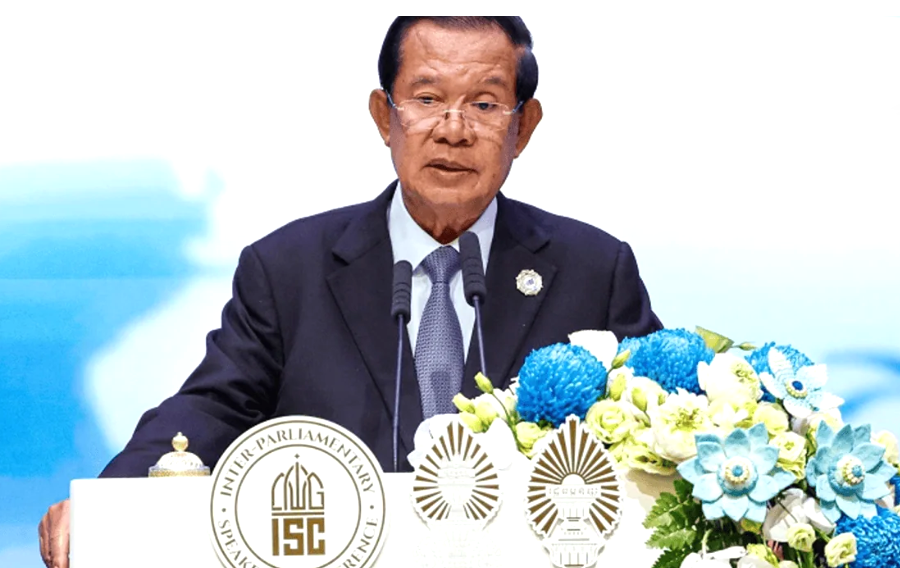
At the 2nd Inter-Parliamentary Speakers' Conference in Phnom Penh on Thursday, Cambodia's Senate president Hun Sen lodged a pointed accusation against Thailand, alleging the neighbouring nation had weaponised concerns over cross-border online scam operations to justify military occupation of Cambodian territory. Speaking before parliamentary leaders from countries including Pakistan, Malaysia, Myanmar, Australia and Russia, Hun Sen framed the Cambodia-Thailand border dispute as a troubling symptom of how international relations have deteriorated in the modern era, where convenient pretexts now mask territorial ambitions and the rules-based system continues to unravel.
Hun Sen characterised the situation as emblematic of "extra-territorial jurisdiction" deployed under false humanitarian or security guises. According to his remarks, Thailand has invoked the need to combat online scam networks operating from Cambodian soil as justification for crossing into sovereign Cambodian territory and maintaining a military presence there. Rather than treating this as an isolated bilateral dispute, Hun Sen positioned it within a larger global pattern in which powerful actors routinely violate international agreements and international law, citing security concerns or crime-fighting imperatives as cover. He stopped short of naming a specific ceasefire agreement that Thailand had breached, but suggested the country regarded such accords as mere formalities rather than binding commitments.
The Senate president's critique extended well beyond the immediate border row, encompassing a broader philosophical challenge to the post-World War II international order. He warned that modern conflict has assumed multiple forms—trade wars employing tariffs and the withdrawal of preferential market access, technology competition centred on semiconductor dominance and cyber-security capabilities, and resource protectionism over energy and rare earth minerals. Each of these represents a departure from conventional military confrontation, yet each destabilises vulnerable nations by exploiting the architecture of globalised economic systems against them. For Southeast Asian nations already grappling with development challenges and regional tensions, Hun Sen's assessment suggests an international environment increasingly hostile to smaller or less industrialised powers.
Central to Hun Sen's argument was the contention that powerful countries have fundamentally undermined the collective security framework they themselves established. He highlighted the phenomenon of wealthy nations exercising what he termed "exclusive rights of self-defence" to launch "unjustified pre-emptive strikes" without consequence, thereby destroying the premise of mutual protection that underpins the United Nations system. This asymmetry has triggered what he described as a "dangerous global arms race," as vulnerable nations lose faith in treaties and international institutions, recognising that formal agreements offer little protection against determined aggression from stronger neighbours or external powers.
Hun Sen drew particular attention to the double standards applied to developing nations in matters of human rights, environmental compliance and cross-border criminal justice. His core grievance is that international criticism and sanctions targeting Cambodia and similar countries often neglect the structural disadvantages and limited institutional capacity these nations face. Wealthy democracies, he argued, apply their own high standards to poorer or less developed states, disregarding the reality that many remain in recovery from decades of conflict, poverty, and weak governance. When Thailand or other nations exploit such issues as pretexts for intervention, they exploit precisely this asymmetry—knowing that developing countries lack the diplomatic and economic muscle to resist.
The broader implications of Hun Sen's speech resonate throughout Southeast Asia, where territorial disputes, foreign interference, and the weaponisation of transnational issues remain persistent concerns. Countries like Malaysia, which has long navigated complicated borders and geopolitical pressures, will recognise the underlying tension Hun Sen articulates: the rules that ostensibly govern international behaviour appear increasingly malleable when invoked by powerful actors, yet rigidly enforced when applied to weaker ones. The online scam phenomenon, whilst undoubtedly a serious transnational crime problem affecting multiple countries in the region, has indeed been seized upon by various governments—sometimes as a genuine security concern, sometimes as a cover for other agendas.
Hun Sen's warning about the potential collapse of the international non-proliferation framework carries particular significance for Southeast Asia. If faith in international treaties and collective security mechanisms erodes further, smaller nations may feel compelled to pursue independent military capabilities or nuclear weapons programmes as a means of self-protection, accelerating regional arms competition and instability. This dynamic, Hun Sen implied, represents a civilisational regression from the post-Cold War vision of a rules-based international order toward an older, more anarchic model of international relations based on military strength and territorial consolidation.
The speech also reflects Cambodia's own precarious position within regional power dynamics. Caught between Thai territorial pressures to the west and Vietnamese strategic influence to the east, Cambodia has limited options for resisting external pressure through conventional means. Hun Sen's resort to public denunciation at an international parliamentary forum suggests frustration with bilateral and multilateral diplomatic channels, and perhaps an effort to build international consensus around the principle that military occupation cannot be justified through invocations of cross-border crime or security concerns. By invoking the examples of other modern conflicts—trade wars, technology competition, resource protectionism—he attempted to universalise Cambodia's grievance, framing it as part of a systemic crisis affecting developing nations globally.
Crucially, Hun Sen called for a restoration of the rules-based order, invoking the UN Charter and ASEAN Charter as foundational documents that must guide international conduct. Yet his speech simultaneously acknowledged that these instruments have already been compromised by powerful states acting with impunity. This tension—between normative appeals to existing international law and the practical reality that such law is selectively enforced—captures the central dilemma facing Southeast Asian nations as they navigate an increasingly contested regional and global environment where conventional military force and economic coercion appear to have returned as primary instruments of statecraft.

