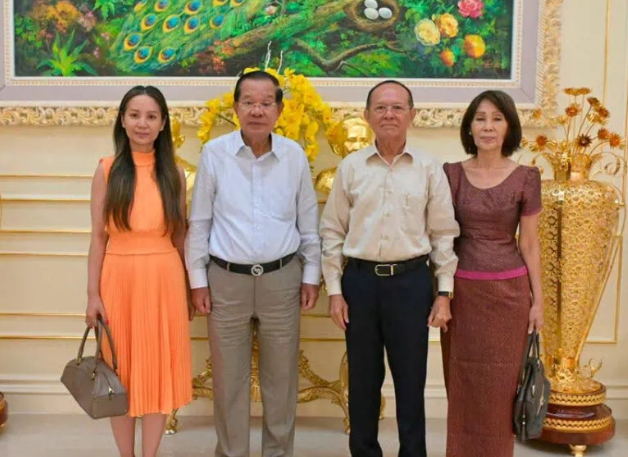
Senate President Hun Sen received former opposition leader Kem Sokha at his residence on Sunday morning, marking another step in the two veteran politicians' gradual rapprochement after years of intense rivalry. The three-hour meeting, which lasted from 9am to noon, included Sokha's wife and daughter, and Hun Sen subsequently posted about the encounter on social media, indicating its significance beyond a purely private affair. The willingness of Cambodia's current political leadership to conduct such visible engagement with a figure once regarded as its principal challenger reflects the dramatically altered political landscape of the kingdom.
Hun Sen's public commentary on the meeting centred notably on Kem Monovithya, Sokha's daughter, whom he described as an excellent human resource for the nation. This praise carries particular weight given Monovithya's prominent association with her father's Cambodia National Rescue Party, which served as the country's main opposition force before the Supreme Court dissolved it in 2017. The Senate president spent considerable time conversing with Sokha's daughter during the gathering, a detail he chose to emphasise, suggesting he views her as a figure of potential significance in Cambodia's political future. Yet Hun Sen offered no clarity on whether his remarks signalled plans for a formal political or public role for Monovithya, leaving observers to assess the intention behind the praise.
Sokha's trajectory from imprisoned opposition chief to tolerated public figure has unfolded through a carefully calibrated series of legal and administrative gestures. In 2023, he received a 27-year prison sentence on charges of conspiracy with a foreign power, a conviction upheld by the Phnom Penh Appeal Court on April 30, 2026, which also imposed a five-year overseas travel restriction. The royal pardon on May 25 that followed ended his imprisonment and house arrest, yet maintained prohibitions on his political activities. A subsequent royal decree issued on July 24 lifted his international travel ban, further easing the constraints surrounding the former CNRP co-founder, though restrictions on direct political engagement remained intact.
These graduated steps in Sokha's liberation have coincided with his re-emergence into public view. On July 28, just days after his travel restrictions were lifted, he travelled to Banteay Meanchey province to meet Cambodian families displaced by border tensions with Thailand. During that visit, Sokha deliberately characterised himself as a private citizen rather than a political representative, a framing that allowed him to engage with the displaced population without openly violating his political activity ban. He also indicated he had raised the displaced civilians' situation with international contacts, suggesting he retains channels of communication beyond Cambodia's borders.
Hun Sen's earlier mention that Sokha had visited his residence several weeks prior to that border trip indicates a pattern of private contact between the two figures that extends beyond the recent Sunday gathering. This earlier meeting occurred before Sokha's public humanitarian mission, implying that Hun Sen's residence has become an informal venue for dialogue between the former adversaries. The accumulation of these interactions suggests a deliberate process of normalisation rather than isolated incidents, though neither side has publicly articulated what political, personal, or strategic considerations underpin these developments.
The historical context of Hun Sen and Sokha's rivalry underscores the significance of their current engagement. For over a decade, the Cambodia National Rescue Party emerged as a genuine electoral threat to Hun Sen's ruling Cambodian People's Party, achieving substantial gains in the 2013 national election and the 2017 commune elections. This electoral momentum positioned the CNRP as the country's primary opposition force, challenging Hun Sen's grip on power in ways previous opposition movements had failed to achieve. The party's dissolution in 2017, followed by Sokha's arrest and subsequent conviction, represented a comprehensive elimination of organised opposition to CPP rule.
The timing and context of Hun Sen's public praise for Monovithya merit scrutiny, particularly regarding what it may portend for Cambodia's political future. By describing the younger generation of the former opposition in positive terms whilst maintaining that no political arrangements have been announced, Hun Sen may be signalling either a genuine shift toward political inclusivity or positioning himself as the arbiter of acceptable political participation. For Malaysian observers monitoring regional political developments, these signals from Cambodia carry implications for how Southeast Asian ruling parties increasingly manage and integrate former rivals, a pattern that extends beyond Cambodia's borders.
Sokha's emergence from legal restrictions follows a pattern familiar in Southeast Asian politics: the gradual rehabilitation of opposition figures through controlled steps that preserve the ruling order's essential interests whilst creating space for political reconciliation or cooptation. His characterisation of himself as a private citizen during his border relief mission indicates the narrow channels through which he may operate publicly without formally breaching his political activity restrictions. This carefully bounded space suggests that whilst Hun Sen may tolerate Sokha's public presence, genuine political rehabilitation remains conditional and limited.
The absence of any official announcement regarding political agreements or reconciliation processes demonstrates how these developments unfold through signals and private meetings rather than formal mechanisms. Neither Hun Sen nor Sokha's camp has indicated that the recent encounters constitute part of a structured dialogue, suggesting plausible deniability about their implications. This ambiguity serves multiple purposes: it allows Hun Sen to demonstrate magnanimity toward a former rival without formally conceding political space, whilst enabling Sokha to rebuild his public presence without overtly violating restrictions that technically remain in effect.
For the broader Southeast Asian region, Cambodia's management of opposition figures offers insights into how established ruling parties navigate the challenge of legitimacy when electoral competition has been substantially constrained. Hun Sen's willingness to engage Sokha privately and praise his daughter publicly may reflect confidence that the institutional structures preventing opposition resurgence remain intact, making occasional displays of magnanimity politically costless. Alternatively, it may signal genuine movement toward a more pluralistic political environment, though the maintenance of Sokha's activity restrictions suggests such movement remains carefully controlled.
The evolving relationship between these two figures carries implications for Cambodia's international standing and regional relationships. Sokha's interactions with international contacts regarding displaced border communities, conducted with apparent approval from the Cambodian government, suggest a recalibration of how external engagement by opposition figures is tolerated. This shift contrasts sharply with the period when Sokha faced imprisonment partly on charges of foreign contact, indicating evolution in how Hun Sen's government perceives the political risks associated with opposition figures maintaining international connections.
Moving forward, the trajectory of Sokha's further rehabilitation will likely depend on his demonstrated willingness to operate within boundaries set by Hun Sen and the ruling party. The praise directed toward Monovithya may ultimately prove significant if it presages opportunities for the next generation of opposition-aligned figures to participate in Cambodia's public life, albeit within carefully circumscribed limits. Whether these developments represent genuine reconciliation or sophisticated management of a neutralised threat remains a question that will unfold through continued observation of private meetings, public gestures, and the gradual expansion or contraction of the space afforded to Sokha and his family.

