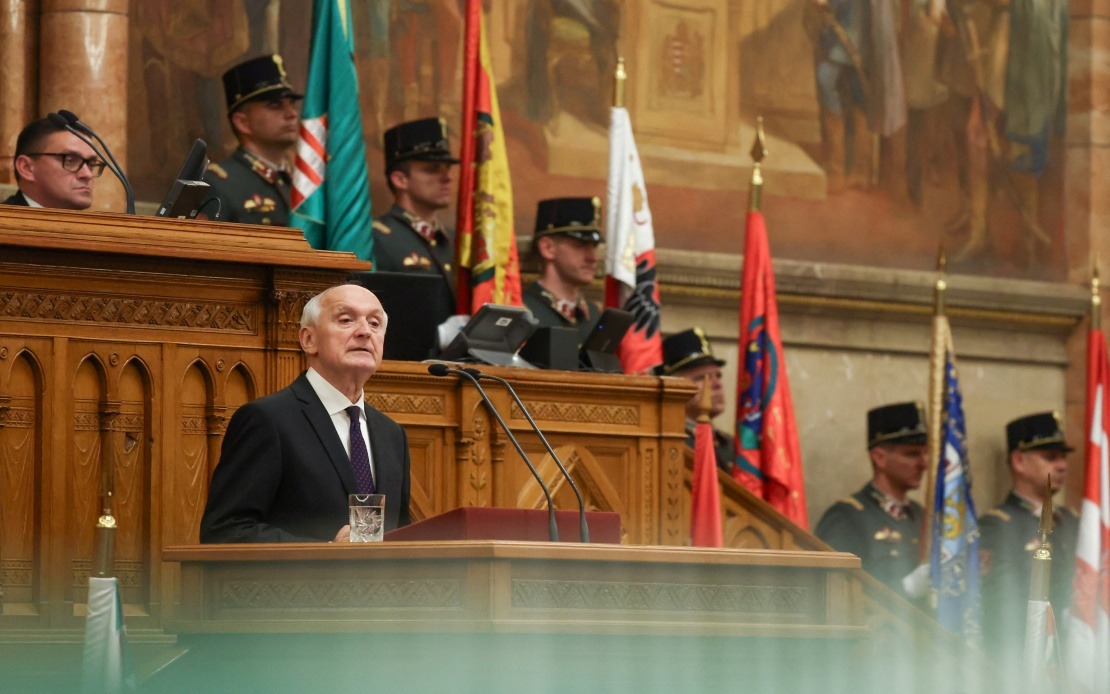
Andras Baka officially became Hungary's president on August 19, 2026, following his election by the Hungarian Parliament two weeks earlier. Prime Minister Peter Magyar announced the transition on social media, extending wishes for the new president's success and calling for him to demonstrate humanity in his leadership role. The inauguration marks a significant institutional change in a country where presidential transitions have become increasingly fraught with political tension and constitutional controversy.
Baka's ascent to the nation's highest ceremonial office represents the culmination of a career spanning multiple judicial institutions across Hungary and Europe. He served as president of Hungary's Supreme Court between 2009 and 2011, a period that coincided with significant transformations to the country's judicial architecture. When the government of then-Prime Minister Viktor Orban initiated comprehensive reforms to the Supreme Court during his tenure, Baka chose to resign rather than continue under the restructured arrangements, signalling his principled disagreement with the direction of judicial reform.
Before leading Hungary's Supreme Court, Baka gained international legal experience through his work at the European Court of Human Rights in Strasbourg, where he developed expertise in human rights jurisprudence and comparative European law. This background positioned him as someone familiar with continental judicial standards and protective mechanisms for individual rights. Following his resignation from the Supreme Court presidency, he transitioned to leadership of the Hungarian Curia from 2012 to 2020. The Curia itself was the institutional successor created following Orban's Supreme Court reform, effectively replacing the previous Supreme Court structure with a new apex court system.
The parliamentary election process that resulted in Baka's presidency occurred against a backdrop of deepening political division within Hungary. The two major opposition parties—Fidesz and the Christian Democratic People's Party—boycotted the presidential election entirely, refusing to participate in what they characterized as an illegitimate process. Their protest centred on the manner in which the previous president, Tamas Szujok, was removed from office through constitutional amendments rather than through regular succession procedures or expiration of his term.
This boycott underscores persistent constitutional tensions in Hungary regarding the separation of powers and the mechanisms for removing elected officials. For Malaysia and other Southeast Asian democracies navigating their own constitutional challenges, Hungary's experience illustrates how disputes over procedural legitimacy can fragment parliamentary consensus and weaken public confidence in institutions, even when the formal legal requirements for a transition are technically met. The refusal of significant opposition blocs to acknowledge the new president's mandate creates a fractured political landscape where institutional legitimacy becomes contested rather than universally accepted.
Baka's background as a judicial figure who previously resigned over constitutional disputes gives his presidency particular symbolic weight. His earlier principled stand against what he viewed as problematic judicial reforms demonstrates that he is not a passive figurehead aligned with any particular executive agenda. However, his acceptance of the presidency despite the opposition boycott raises questions about how he intends to navigate his role given the contested circumstances of his election and the substantial portion of parliament that refused to participate in selecting him.
For regional observers, Hungary's political trajectory offers cautionary insights into how constitutional frameworks can be leveraged to concentrate power and reshape institutions. The successive reforms to Hungary's judicial system—beginning with the Supreme Court restructuring that prompted Baka's earlier resignation, followed by the creation of the Curia, and culminating in the constitutionally contested removal of the previous president—demonstrate how constitutional majorities can be deployed to transform institutional landscapes in ways that opposition parties view as fundamentally illegitimate, regardless of formal legal compliance.
The implications of Baka's presidency extend beyond Hungary's borders. Hungary holds the rotating presidency of the European Union during the second half of 2024, meaning that internal constitutional disputes and questions about democratic legitimacy carry significance for EU governance and coordination. The political fracture evident in the boycott may influence Hungary's approach to collective EU decision-making and its capacity to build consensus on European issues during its presidency.
Baka's eventual acceptance of the presidency, despite his earlier resignation over judicial reform, suggests a pragmatic calculation that his participation in the institution could moderate or constrain potentially more authoritarian exercises of executive power. Whether his record of principled resistance to reforms he viewed as problematic will translate into an active presidency willing to challenge executive overreach remains an open question. His experience at the European Court of Human Rights and his familiarity with international legal standards may inform his approach to governance, though the ceremonial nature of the Hungarian presidency limits his direct policy-making authority.
The transition nonetheless represents a moment of institutional continuity at a time when Hungary's political system faces sustained international scrutiny regarding democratic standards and rule of law. The appointment of someone with Baka's background—a jurist rather than a politician, someone with experience defending human rights at the European level, and a figure who has previously resisted what he saw as institutional degradation—suggests an attempt to restore a degree of institutional credibility following the controversial removal of his predecessor. Whether this symbolic repositioning addresses the deeper structural questions raised by the opposition boycott remains to be determined as his presidency unfolds.

