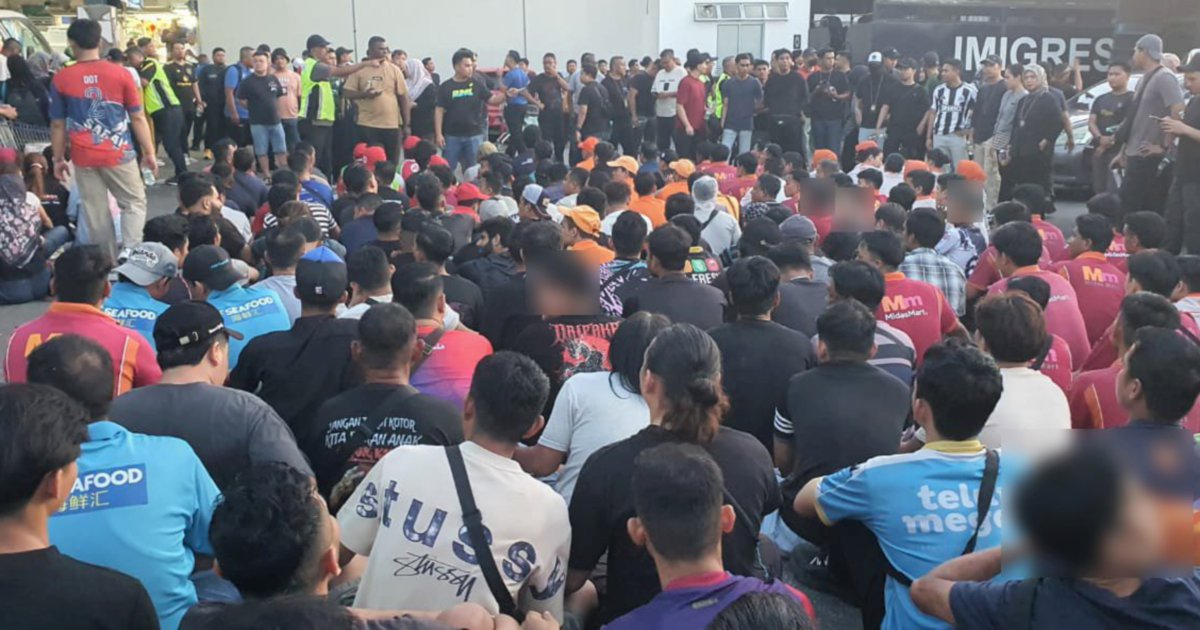
Authorities in Johor Baru have dismantled what appears to be an elaborate migrant documentation fraud operation, resulting in the detention of 226 undocumented workers and uncovering a systematic abuse of Malaysia's border processes. The investigation reveals a troubling pattern of loopholes in immigration controls that enabled foreign nationals to maintain the appearance of legal status whilst working unlawfully, raising fresh questions about enforcement capacity and border management in one of Southeast Asia's busiest transit zones.
At the centre of the scheme stood an Indonesian fishmonger who engineered a remarkable workaround to his legal predicament. For four consecutive years, this individual crossed back into Indonesia monthly to obtain official passport stamps, then returned to Malaysia to continue undeclared employment. The arrangement allowed him to circumvent residency requirements whilst maintaining the documentation veneer needed to avoid detection. His operation highlights how migration networks exploit technical gaps in enforcement, using legitimate border infrastructure—the regular crossing and stamping process—as cover for illegitimate labour practices.
The broader implications of this case extend well beyond a single entrepreneur's ingenuity. The existence of such a sustained scheme suggests systematic weaknesses in how authorities track migrant movements and employment verification. If a single fishmonger could maintain this arrangement for forty-eight months without intervention, the operation indicates that checks at immigration counters, workplace inspections, and cross-agency data sharing may operate in isolation rather than as an integrated system. For Malaysia, which hosts one of the largest migrant workforces in the region—estimated at over three million people—these vulnerabilities represent a significant regulatory challenge.
Johor's role in this operation is particularly significant given the state's geography and economic structure. As a major manufacturing, agricultural, and service hub adjacent to Singapore, Johor draws constant waves of cross-border workers. The Johor Bahru port and land crossing see tens of thousands of movements daily, creating immense administrative strain. Within this volume, sophisticated schemes can operate undetected for years. The four-year duration of this particular network suggests that sporadic enforcement actions, whilst symbolically important, may lack the systematic rigour necessary to dismantle established trafficking or employment fraud operations.
The detention of 226 migrants raises separate humanitarian and procedural concerns. While immigration violations warrant enforcement action, the scale of the operation indicates that many workers may have been trapped within exploitative networks they did not design. In Malaysian immigration raids, documentation determines outcome; workers without proper papers face detention and deportation regardless of whether they were knowing participants in fraud or simply victims of traffickers and employment agents who positioned them in illegal situations. The raid outcome will likely result in deportations, but without robust investigation into how these individuals were recruited and placed, the operation that enabled them will potentially reconstitute elsewhere.
The passport stamping mechanism itself—ostensibly a control designed to track movement—became the very instrument of evasion. This paradox reflects a broader pattern across Southeast Asia where migration regulations, whilst comprehensive on paper, contain exploitable seams when enforcement remains fragmented. Indonesia, the origin country in this case, does not prevent its citizens from obtaining legitimate passport stamps even if those citizens intend to work illegally abroad. Malaysia's immigration officers, processing thousands of stamps daily at border posts, lack the time and cross-referenced data needed to identify patterns suggesting circular fraud. The system is built for volume, not for pattern detection across time.
Regional labour migration patterns make Johor particularly vulnerable to such schemes. Indonesian workers constitute the largest migrant group in Malaysia, representing approximately 1.8 million of the documented workforce. The proximity of Riau and Sumatra to Johor, combined with established kinship networks and community connections, creates natural pathways for irregular employment arrangements. Unlike migrant workers in Gulf states or East Asia, who typically lack home country proximity, Malaysian-based migrants from Indonesia and Bangladesh can more easily maintain dual presence across borders. The monthly passport stamping scheme exploited this structural advantage inherent to regional labour mobility.
Authorities have not publicly disclosed the full operational details of the network—whether the fishmonger directly recruited other workers, whether employment agents facilitated placement, or whether he merely pioneered a method subsequently adopted by others. These details matter for understanding whether this represents an isolated entrepreneurial solution or a reproducible template potentially adopted across Johor's fishing and food processing industries. If the latter, the 226 detainees may represent only the visible portion of a much larger systematic problem. The duration of the operation—four years before disruption—suggests that this fraud method may already be widely understood and implemented across migrant networks.
The enforcement action itself, whilst commendable in scale, confronts Malaysia with uncomfortable questions about resource allocation. The immigration raids that produce headline numbers of detentions tend to be labour-intensive, resource-concentrated operations. The equivalent effort invested in systematic border data analysis, inter-agency intelligence sharing, or workplace inspection protocols might prevent fraudulent schemes from operating for years in the first place. Johor's immigration authorities, perpetually understaffed relative to migrant volumes, face constant pressure to choose between reactive enforcement (raids) and preventive investigation (pattern detection). This case suggests that the reactive approach, however visible, allows sophisticated schemes to operate far longer than they should.
For Malaysian policymakers, the episode illustrates how regional labour dependence creates regulatory challenges that enforcement raids alone cannot resolve. Malaysia needs approximately 1.5 million documented migrant workers across construction, agriculture, hospitality, and manufacturing sectors—sectors that face chronic labour shortages from local workers. Yet the framework for managing this workforce remains porous at critical junctures. The passport stamping loophole represents just one of many potential evasion mechanisms within a system designed primarily for control rather than realistic labour market management. Addressing such vulnerabilities requires either accepting larger, more carefully regulated migrant workforces, or investing substantially in the enforcement infrastructure necessary to maintain restrictions effectively.
The Johor case will likely prompt renewed calls for immigration enforcement campaigns. However, sustainable solutions require moving beyond the cycle of raids and deportations that have characterised Malaysia's approach for decades. The monthly passport stamps that enabled years of undetected work suggest that Malaysia's immigration system processes migrants as administrative units rather than understanding them within employment networks and labour market dynamics. Until enforcement strategy evolves to address these structural factors, similar schemes will continue to emerge across the region's most significant migrant corridors.

