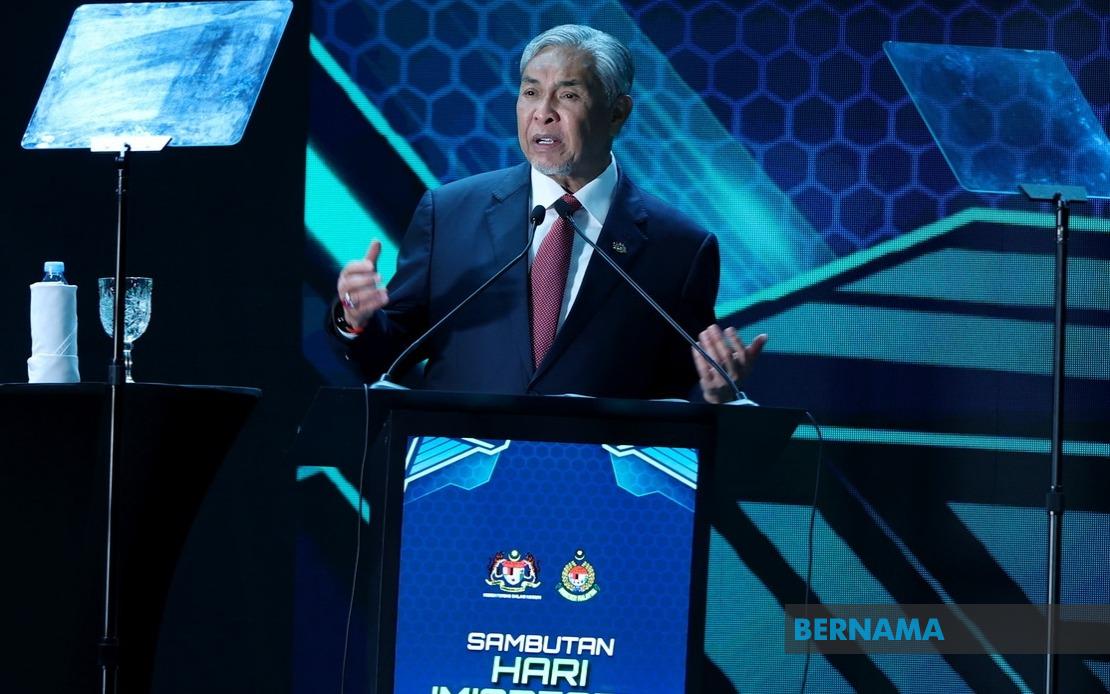
Deputy Prime Minister Datuk Seri Dr Ahmad Zahid Hamidi has thrown his weight behind efforts to overhaul employment conditions for Malaysia's immigration workforce, signalling government readiness to invest in the personnel who guard the nation's borders and generate substantial revenue. Speaking at the 2026 Immigration Day celebration in Cyberjaya, Zahid endorsed Home Minister Datuk Seri Saifuddin Nasution Ismail's proposal to restructure the Immigration Officer Service Scheme, a move that could reshape how the department attracts and retains talent in an increasingly competitive civil service landscape.
The push for service scheme improvements reflects broader recognition within government circles that immigration officers occupy a uniquely demanding position within Malaysia's public sector apparatus. These frontline personnel manage everything from passport processing and visa applications to border control operations and national security intelligence gathering, responsibilities that extend far beyond routine administrative tasks. By advocating for enhanced career pathways and strategic post restructuring, Zahid has effectively positioned immigration employment as a priority area requiring immediate bureaucratic attention and resource allocation.
Zahid's backing adds significant political momentum to Saifuddin Nasution's initiative, particularly given his standing as the country's second-highest official and his influence over interagency coordination. He explicitly urged the Chief Secretary to the Government Tan Sri Shamsul Azri Abu Bakar and Public Service director-general Tan Sri Wan Ahmad Dahlan Abdul Aziz to give the proposal serious consideration, framing it not as a peripheral HR concern but as a matter warranting elevated decision-making. This approach suggests the push for reform has moved beyond departmental advocacy into higher-order government strategy.
Central to the case for improvement is the Immigration Department's outsized economic contribution relative to its profile in public discourse. Zahid identified the department as Malaysia's third-largest revenue-generating agency, a designation that underscores how immigration operations directly finance state functions through visa fees, passport charges, border processing revenues, and associated administrative income. Despite this significant fiscal contribution, immigration officers have historically received compensation and career recognition that observers argue falls short of their economic value creation and the weight of their responsibilities.
The current service scheme structure has apparently constrained recruitment and retention, challenges particularly acute given Malaysia's need to maintain professional, well-trained personnel capable of managing sophisticated border operations in an era of complex global migration patterns, security threats, and transnational criminal activity. Career advancement limitations and uncompetitive remuneration packages relative to alternative employment in the private sector have likely contributed to talent drain, potentially compromising both operational effectiveness and institutional knowledge preservation. The proposed restructuring aims to address these labour market dynamics directly.
Zahid's emphasis on integrity and avoiding controversy during his address to immigration personnel added another dimension to the discussion. He characterised immigration officers as the nation's frontline defenders against sovereignty threats, a framing that connects workplace conditions directly to national security capacity. By suggesting that improved service terms would reinforce rather than weaken institutional integrity, Zahid implicitly rejected arguments that better conditions represented excessive expenditure, instead positioning them as an investment in border security and governance quality.
The timing of these proposals within the 2026 immigration reform agenda indicates a longer-term strategic vision extending beyond immediate personnel concerns. The Immigration Day theme, "Charting a New Face of Immigration," suggests the department is undergoing broader modernisation beyond service scheme adjustments. This context implies that employment improvements may form part of a wider initiative to upgrade immigration operations, potentially including technological infrastructure, procedural streamlining, and international cooperation frameworks that collectively position Malaysia's immigration system for future challenges.
For Malaysian citizens and residents, improved immigration officer recruitment and retention carries direct implications. A better-resourced, more stable immigration workforce would theoretically reduce processing delays, enhance service quality for passport and visa applicants, and strengthen border security operations that ultimately protect public safety. The professionalism and job satisfaction of immigration personnel directly affects the citizen experience of border crossing, documentation processing, and related state services.
Regionally, Malaysia's immigration system handles substantial cross-border movement within Southeast Asia, connecting it to broader ASEAN migration and security frameworks. Enhanced officer capacity and improved service delivery positions Malaysia as a more reliable regional partner in mobility initiatives, counterterrorism cooperation, and coordinated border management. Neighbouring countries with significant Malaysian workforce populations particularly benefit from efficient, professional immigration administration on both sides of shared frontiers.
The bureaucratic pathway forward requires coordination across multiple government entities. Rather than a unilateral decision, the proposal must navigate Chief Secretary and Public Service directorate-general review, suggesting that implementation timelines remain uncertain. However, Zahid's public endorsement significantly increases political pressure on these bodies to prioritise the matter, effectively elevating it within competing budgetary and administrative claims on government attention.
The economics of improved service schemes deserve consideration alongside sentiment. Additional compensation and expanded career structures represent genuine expenditure, but immigration revenue generation could theoretically offset or partially offset costs, making the investment internally partially self-financing. Such analysis would likely feature prominently in budgetary discussions within the Finance Ministry and other relevant departments assessing the proposal.
Moving forward, the proposal will likely face scrutiny regarding specific implementation details: which posts warrant restructuring, how many new positions the expansion would create, what salary adjustments are contemplated, and whether promotions would accelerate for existing personnel. These particulars will ultimately determine both the initiative's cost and its effectiveness in attracting and retaining high-quality officers capable of managing Malaysia's complex immigration landscape in an era of heightened security concerns and evolving migration patterns.

