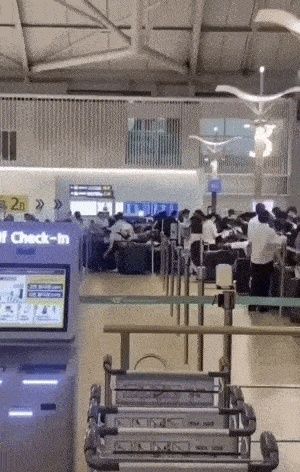
Incheon Airport is moving to fortify its check-in procedures after a series of disruptive incidents involving suspected Chinese bulk traders have left airport personnel injured and passenger flow severely disrupted. The situation escalated when a video from early July showed dozens of passengers abandoning designated queue lines and aggressively pushing luggage carts past the airport's standard zigzag barriers to reach airline counters first. The footage, which circulated widely online, prompted airport authorities to acknowledge a pressing safety problem that extends beyond simple queue-jumping to encompass physical altercations and deliberate circumvention of established passenger management systems.
The traders involved in these incidents are part of a phenomenon known as "daigou"—small-scale commercial operators who purchase discounted duty-free merchandise in bulk from South Korean shops and airports, then transport and resell these goods at marked-up prices across China and other Asian markets. This parallel economy has long existed on the margins of international travel, but the concentration of such traders on specific routes and at particular times has created visible friction points within major transportation hubs. What distinguishes recent events at Incheon from routine passenger congestion is the apparent coordination and aggressiveness with which these traders operate, treating airline queues not as orderly systems but as obstacles to be overcome.
During July alone, airport officials documented at least five separate incidents matching this pattern, according to reports from Yonhap News Agency. In each case, employees attempting to redirect passengers back into proper queuing arrangements faced resistance and sustained injuries in the process. The physical confrontations underscore a broader challenge facing Asian airports: how to maintain operational order and staff safety when faced with groups motivated by commercial gain rather than ordinary travel needs. The injuries reported among Incheon's personnel have raised questions about whether existing protocols adequately protect workers managing high-volume international terminals.
Incheon Airport's response involves two complementary strategies. First, the facility is evaluating the installation of plastic partitions within its existing queue barrier system, a design modification intended to make it physically more difficult for passengers to cross lateral barriers or skip ahead. This architectural approach acknowledges that enforcement alone may prove insufficient when dealing with determined traders operating under time pressure to secure limited seats. Second, airport staff have intensified their presence in departure halls, conducting more frequent inspections and actively managing passenger flow during peak travel periods. These personnel reinforcements serve both as deterrents and as rapid-response mechanisms should similar incidents occur.
The underlying capacity issue contributing to this problem reflects broader trends in aviation between South Korea and China. Airlines operating major routes connecting Incheon to Chinese destinations have deployed larger aircraft in recent months, effectively increasing seat availability by approximately 100 additional positions on certain flights. While increased capacity typically benefits legitimate travelers by reducing congestion and improving accessibility, it has simultaneously attracted greater numbers of daigou traders seeking to exploit these expanded opportunities. The arithmetic is straightforward: more seats mean greater profit potential for bulk purchasers, creating stronger incentive structures for the kind of queue-disruption incidents now plaguing the airport.
Chinese regulatory authorities have previously implemented enforcement measures targeting the daigou phenomenon, specifically tightening oversight of bulk imports and resale operations. According to Incheon Airport officials, stricter Chinese enforcement in recent periods had temporarily reduced the volume of daigou departing South Korea, creating a lull in queue-related incidents. However, this respite appears fragile, and airport management recognizes that policy fluctuations across the border can quickly translate into renewed pressure on Incheon's infrastructure. The temporary nature of previous improvements has prompted authorities to adopt a more permanent stance toward structural modifications and sustained vigilance.
For Malaysian readers and Southeast Asian observers, these developments carry particular relevance. The daigou phenomenon is not confined to South Korea; similar trader networks operate across regional hubs including Kuala Lumpur International Airport, Singapore Changi, and Bangkok's Suvarnabhumi. As e-commerce transforms retail patterns and duty-free shopping remains attractive across Asia, airports throughout the region face comparable pressures from commercial operators seeking to exploit arbitrage opportunities between markets. Incheon's experience suggests that individual airports may struggle to address this challenge through local measures alone, particularly when cross-border regulatory frameworks remain uncoordinated.
The incident also illuminates tensions between facilitating commerce and maintaining operational security. Daigou traders generate genuine economic activity, purchasing goods that support South Korean retailers and creating demand for airline capacity. Yet their methods—queue-jumping, physical confrontation, and deliberate circumvention of orderly processes—create negative externalities affecting legitimate travelers and imposing costs on airport employees. This tension reflects broader questions about how to accommodate informal commercial networks within formal institutional structures designed for individual passenger travel rather than bulk business operations.
Looking ahead, Incheon Airport's approach of combining architectural modifications with enhanced enforcement may offer a model worth examining elsewhere in Asia. However, sustainable solutions likely require coordination at multiple levels: airports implementing physical and procedural safeguards, airlines potentially implementing restrictions on bulk luggage or passenger behavior, and governments establishing clearer regulatory frameworks for duty-free purchasing limits and resale operations. Without such comprehensive approaches, individual interventions risk merely displacing the problem rather than resolving it fundamentally. As regional airports grapple with similar challenges, the lessons emerging from Incheon will shape security and operational strategies across Southeast Asian hubs.

