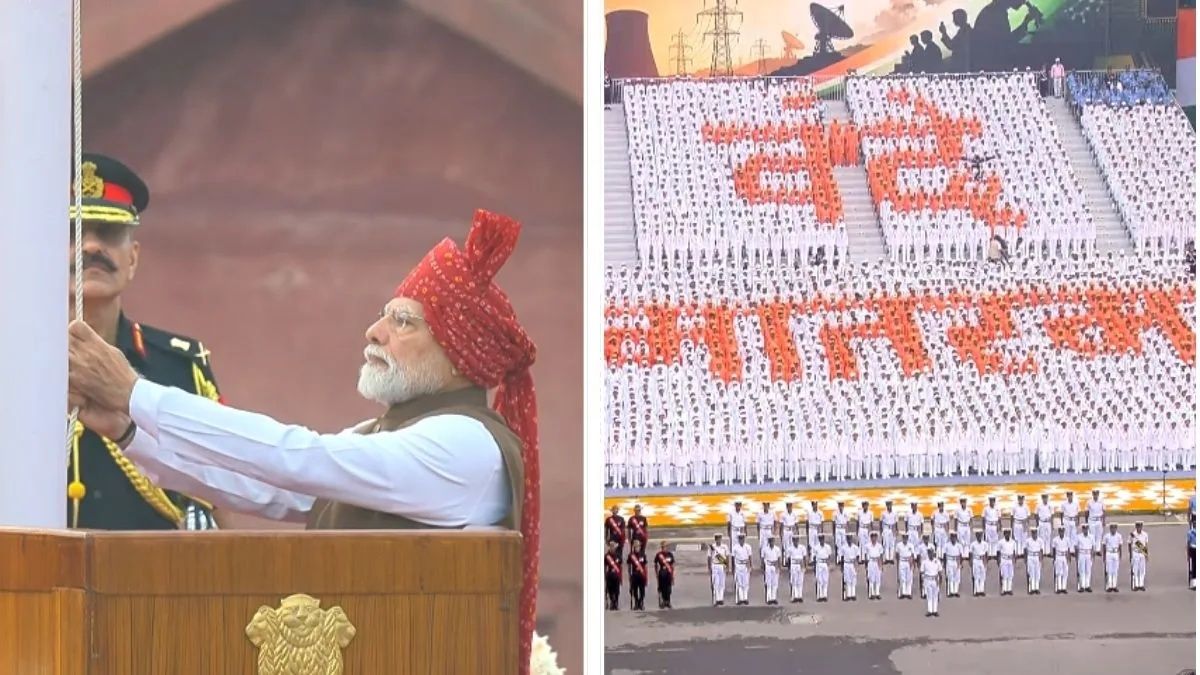
Prime Minister Narendra Modi articulated India's most significant long-term development goal on Saturday during the nation's 80th Independence Day celebrations, declaring that the country will become a developed nation by 2047. Speaking from the Red Fort in New Delhi, Modi framed this objective as more than a mere economic target, positioning it as a statement of national resolve and collective confidence. The vision, termed 'Viksit Bharat' (developed India), represents a conscious shift in how India views its trajectory and signals the country's intention to reshape its global standing through deliberate economic and social advancement over the next two decades.
Modi's articulation of this goal carried particular significance given India's status as the world's most populous country. He emphasised that when a nation of India's scale commits to such transformation, it sends ripples through global perceptions and international relations. The Prime Minister stressed that achieving this vision requires more than governmental action alone—it demands citizens to embrace larger ambitions, move beyond incremental thinking, and maintain unwavering determination. His repeated emphasis on the need to "dream big" suggested a deliberate attempt to reshape the national mindset away from what he characterised as self-imposed limitations that have historically constrained India's potential.
Contextualising this vision within India's recent economic history, Modi drew stark contrasts with the country's earlier vulnerabilities. He referenced India's previous membership in the so-called "Fragile Five" bloc of emerging economies—a designation from around 2013 that included countries vulnerable to external shocks and capital flight. According to Modi's assessment, India has since transcended that categorisation, transitioning into a distinct position as a substantial and rapidly expanding economy. This reframing serves multiple purposes: it acknowledges past constraints while celebrating progress and establishing psychological momentum for future achievement.
To substantiate the 2047 vision's credibility, Modi cited concrete sectoral achievements accumulated over the preceding twelve years of his administration. Defence manufacturing capacity has expanded fourfold, a particularly significant metric for a nation investing heavily in military self-sufficiency and indigenous production capabilities. The handloom and small-scale manufacturing sectors, represented by Khadi and Gramodyog products, have experienced a fivefold surge—a development with considerable implications for rural employment and artisanal preservation in India's hinterlands. Electronic manufacturing witnessed sevenfold growth, positioning India as an increasingly competitive hub in global supply chains. Mobile phone production jumped by a third, while digital transaction volumes doubled, metrics that underscore India's ongoing digital transformation and the financial inclusion agenda that has expanded banking access to hundreds of millions of previously unbanked citizens.
The Independence Day ceremony witnessed a symbolic milestone that Modi highlighted as emblematic of the nation's evolving relationship with its heritage and modernity. For the first time since independence in 1947, the complete rendition of 'Vande Mataram'—the nationalist song from India's independence struggle—resounded at the Red Fort during the 15 August celebrations. Modi characterised this moment as historic, suggesting that the integration of this cultural touchstone into the highest state ceremony reflected India's reconnection with its independence legacy whilst forging ahead with contemporary aspirations. The flag hoisting itself, conducted with a ceremonial 21-gun salute delivered by the 1721 Field Battery using indigenous 105mm Light Field Guns, underscored India's commitment to military modernisation through domestic manufacturing.
Beyond the aspirational rhetoric of the 2047 vision, Modi grounded his address in immediate contemporary realities. He acknowledged recent flooding that had devastated multiple regions across India, extending expressions of national solidarity to affected families. This acknowledgment served to balance the long-term vision with recognition of pressing humanitarian challenges, signalling that the development agenda encompasses immediate relief and support mechanisms alongside decade-spanning transformation goals. The Prime Minister's assurance that the entire nation stood in support of flood-affected communities provided a counterweight to the grandiose nature of the 2047 project, demonstrating simultaneous attention to crisis management and visionary planning.
For Malaysian and broader Southeast Asian observers, this Indian initiative carries significance beyond subcontinental boundaries. India's development trajectory directly influences regional economic dynamics, trade relationships, and the competitive positioning of Southeast Asian economies within Asian supply chains. A successfully developed India by 2047 would reshape the region's economic hierarchy and potentially reallocate capital flows and investment patterns across the continent. The emphasis on indigenous manufacturing, particularly in defence and electronics, reflects India's strategic autonomy agenda—a positioning that affects regional security calculations and technology partnership opportunities for neighbouring nations.
The 2047 vision also emerges against the backdrop of global economic competition and the shifting international order. By anchoring India's development ambitions to a precise temporal milestone, Modi creates accountability mechanisms and focuses political energy on measurable outcomes. This approach contrasts with vaguer aspirational statements and provides investors, policymakers, and citizens with a clear target against which progress can be gauged. The psychological effect of such a declaration—communicating to both domestic and international audiences that India has shed defensive postures and embraced assertive growth projections—represents a substantive shift in India's self-presentation on the global stage.
The sectoral achievements Modi enumerated suggest that the 2047 vision does not rest on purely rhetorical foundations. The demonstrated capacity for rapid scaling in manufacturing, digital services, and defence production indicates that India possesses institutional mechanisms and entrepreneurial ecosystems capable of sustaining accelerated growth trajectories. However, the transition from current middle-income status to developed-country classification will require addressing persistent structural challenges: education quality, healthcare delivery, infrastructure gaps in rural regions, and environmental sustainability. The vision implicitly acknowledges these challenges by calling for collective resolve and bigger thinking, suggesting that Modi recognises that merely extending current growth trends will prove insufficient for crossing the development threshold by 2047.

