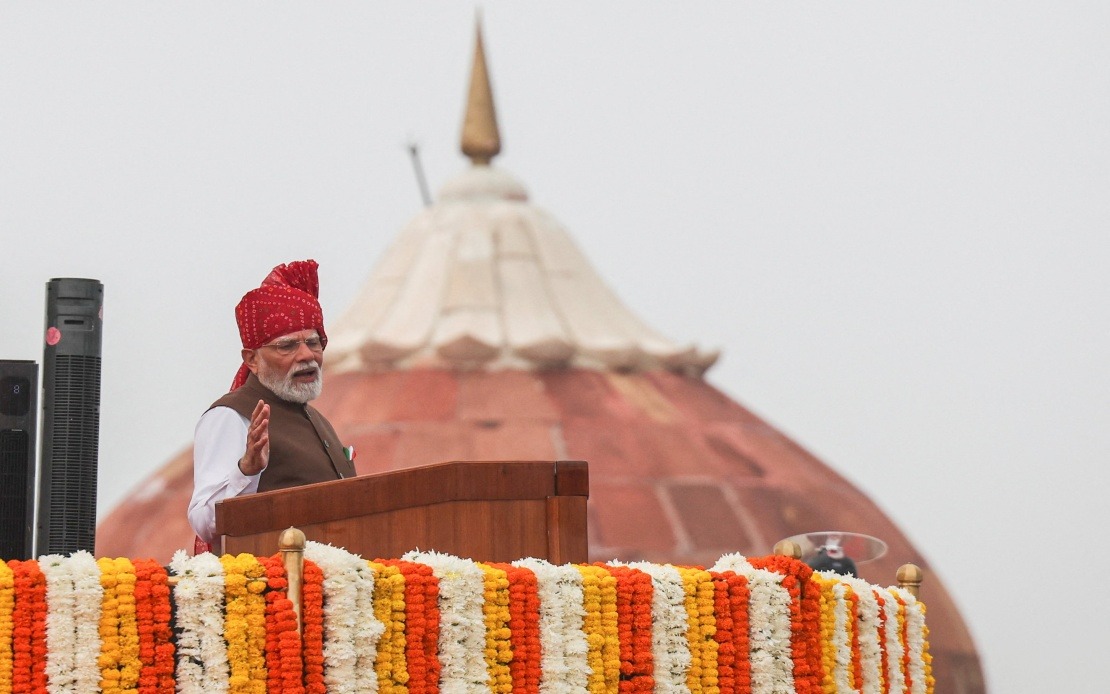
Indian Prime Minister Narendra Modi used the country's Independence Day address to articulate a comprehensive strategy for domestic technological and industrial advancement, framing self-reliance across critical sectors as essential to India's emergence as a developed economy within the next two decades. Speaking from the Red Fort in Delhi, Modi positioned semiconductor manufacturing, nuclear energy infrastructure, renewable generation and defence production as the cornerstones of a broader push toward economic sovereignty and reduced import dependency.
The semiconductor sector received particular emphasis in Modi's vision, with the Prime Minister noting that three fabrication plants have already begun operations and announcing expectations for five to eight additional facilities to commence production within the next seven to eight years. This trajectory reflects India's attempt to capture a meaningful share of global chip manufacturing, an industry increasingly viewed as strategically vital following recent supply chain disruptions affecting regional economies including Malaysia. For Southeast Asian economies competing in the semiconductor supply chain, India's manufacturing expansion carries significant implications, potentially reshaping sourcing patterns and creating both opportunities for collaboration and fresh competition in the region.
On nuclear energy, Modi articulated an ambitious infrastructure roadmap targeting 100 gigawatts of installed capacity by 2047, fundamentally repositioning atomic power as central to India's energy security. The government plans to commission five new nuclear reactors within the current decade, a significant acceleration from recent installation rates. More consequentially, Modi highlighted India's recent achievement in mastering fast-breeder nuclear technology and advancing toward fuel self-sufficiency—a development that would substantially diminish reliance on international nuclear fuel markets and potentially alter regional energy diplomacy.
India's renewable energy accomplishments demonstrate tangible progress within this overarching framework. Solar capacity has expanded dramatically from 2 gigawatts to 160 gigawatts over twelve years, positioning India among global renewable energy leaders. This expansion carries relevance for Malaysian policymakers and industry analysts tracking regional clean energy transitions and supply chain opportunities within the renewable sector.
Beyond established energy sources, Modi signalled aggressive exploration for offshore oil and gas reserves, committing 850 billion rupees—equivalent to approximately US$8.9 billion—toward surveying areas previously characterized as economically unviable. This resource development strategy reflects India's determination to secure hydrocarbon supplies domestically, reducing exposure to international oil price volatility and geopolitical supply disruptions that routinely affect energy-importing nations throughout Southeast Asia.
Defence manufacturing emerged as another pillar of India's self-reliance initiative, with Modi emphasizing indigenous capability development across drone technology, counter-drone systems and hypersonic defence technologies. This focus addresses India's historical dependence on foreign military procurement and represents a significant industrial policy reorientation toward domestic defence production. The emphasis on advanced military technologies suggests India increasingly views technological sovereignty in defence-critical domains as non-negotiable for strategic autonomy.
Underlying these sectoral initiatives is a broader cultural and economic messaging campaign promoting domestic consumption and manufacturing. Modi appealed directly to Indian citizens to prioritize locally-produced goods, acknowledging the trade-off between short-term affordability of imported products and longer-term capability development. This consumer-facing dimension complements industrial policy by attempting to create sustained domestic demand for newly-developed products, reducing reliance on export markets for production viability.
The 2047 timeframe itself carries symbolic weight, coinciding with India's centennial of independence. By anchoring self-reliance objectives to this milestone, Modi connects economic modernization with national identity and historical narrative, potentially amplifying political support for industrial policy measures that may impose near-term costs through import restrictions or protection for emerging domestic industries.
For Southeast Asian observers, India's self-reliance framework presents a complex picture with mixed implications. Enhanced Indian technological and manufacturing capacity could strengthen the region's broader ecosystem through technology transfer, joint ventures and complementary supply chain integration. Simultaneously, aggressive Indian industrial policy and tariff protection could redirect investment flows away from Southeast Asian competitors and complicate regional trade relationships. Malaysia particularly faces strategic considerations given its established semiconductor manufacturing presence and renewable energy ambitions—Indian expansion in both domains creates partnership opportunities but also intensified competition for foreign investment and technical talent.
The nuclear and renewable energy dimensions carry additional regional resonance, as Southeast Asian nations pursue their own energy security objectives amid climate transition pressures. India's technological achievements in fast-breeder reactors and solar deployment offer potential knowledge-sharing possibilities, though technology transfer dynamics remain constrained by strategic competition and intellectual property considerations.
Modi's articulation of self-reliance reflects a broader developmental philosophy that questions whether import-dependent growth models adequately serve national interests over extended timeframes. This perspective contests the post-1990s liberalization consensus that dominated South Asian economic policy, reinstating state-directed industrial strategy as legitimate governance approach. The approach carries risks if pursued through excessive protectionism or inefficient domestic champions, yet also demonstrates recognition that certain technologies and capabilities warrant strategic development beyond pure market mechanisms.

