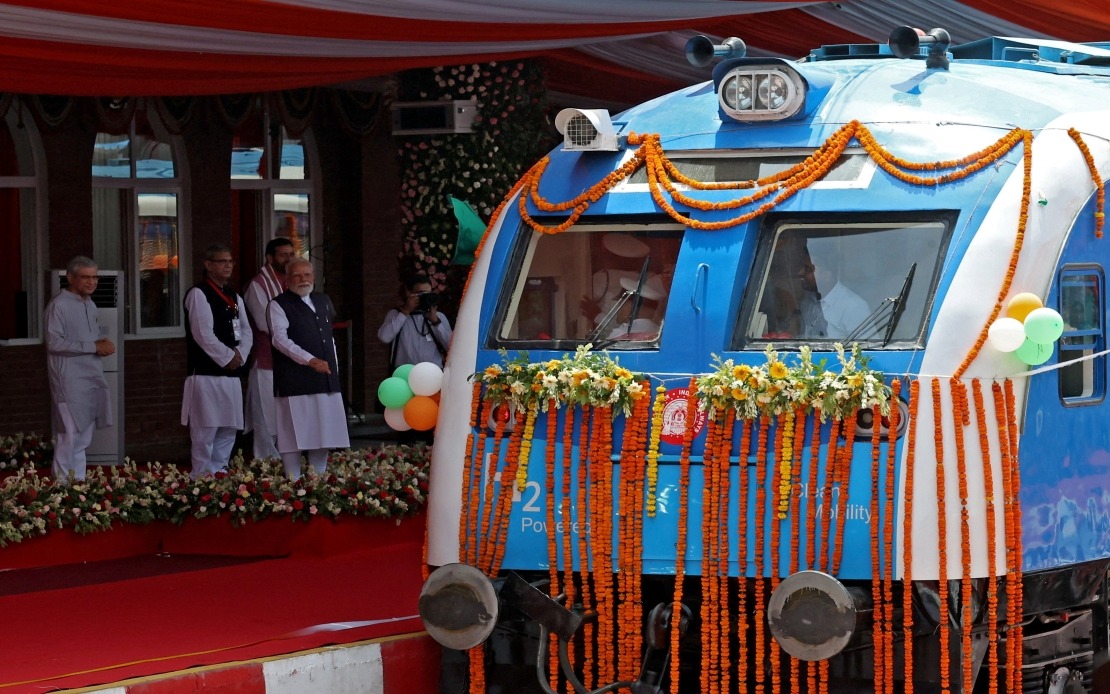
India has taken a decisive step into the hydrogen economy by flagging off its first hydrogen-powered train, a milestone that reflects the country's commitment to transitioning away from fossil fuel-dependent rail infrastructure. Prime Minister Narendra Modi inaugurated the service on Friday, launching a 10-coach train that will operate on the 89-kilometre corridor connecting Jind and Sonipat in Haryana state. This development positions India among an exclusive group of nations—China, Germany, Japan, and the United States—already operating hydrogen fuel cell trains, demonstrating that New Delhi is serious about modernising its extensive railway network through clean energy technologies.
The significance of this achievement extends beyond mere technological accomplishment. This is the first instance of India deploying an indigenously developed hydrogen fuel cell system for railway operations, underscoring the country's growing capacity for domestic innovation in green transport solutions. Rather than relying entirely on imported technology, Indian engineers and institutions have successfully adapted and implemented hydrogen fuel cell technology specifically designed for rail applications, a capability that could facilitate faster rollout across the broader railway system and reduce dependency on foreign expertise for future expansion.
At the technical core of this breakthrough is a 1,200-kilowatt Proton Exchange Membrane Fuel Cell, a device that generates electricity through an electrochemical reaction between hydrogen and oxygen molecules. The elegance of this system lies in its simplicity and cleanliness: the only emissions produced are water vapour and heat, eliminating the particulate matter, nitrogen oxides, and carbon dioxide associated with diesel locomotives that have dominated Indian railways for decades. This fundamental shift in propulsion technology represents one of the most environmentally benign forms of rail transport currently available, with implications for air quality and public health across cities and regions served by major railway corridors.
The operational parameters of this inaugural service reveal both ambition and pragmatic restraint. The train has received regulatory approval to operate at speeds of up to 75 kilometres per hour, although its design specification allows for operation at 110 kilometres per hour, suggesting room for performance optimisation and potential speed increases as operators gain confidence and experience with the technology. This cautious approach to initial deployment reflects standard practice when introducing new propulsion systems to revenue service, allowing engineers to gather real-world performance data before pushing the system to its full capability.
For Malaysia and the broader Southeast Asian region, India's hydrogen train initiative carries important strategic implications. As the subcontinent develops indigenous expertise in hydrogen fuel cell technology for rail transport, opportunities emerge for knowledge sharing and potential collaboration within Asia. Malaysia's own rail expansion projects, including mass rapid transit development and regional rail connectivity initiatives, could eventually benefit from transfer of this technology and operational expertise. The Jind-Sonipat corridor essentially serves as a testing ground that will generate practical insights applicable to similar climate and geographical conditions found throughout South Asia and Southeast Asia.
The hydrogen-powered train also reflects deeper policy momentum in India towards decarbonising transportation. Indian Railways, responsible for moving over 1.2 billion passengers annually, is one of the world's largest railway networks and a significant consumer of fossil fuels. Transitioning even a portion of this vast fleet to hydrogen or other clean technologies could yield enormous environmental benefits, reducing both operational carbon emissions and improving air quality in densely populated urban centres where trains operate. This pilot programme signals that policymakers view hydrogen as a serious long-term solution rather than a mere experimental curiosity.
The sourcing and supply chain for hydrogen fuel, however, remains a critical consideration for scaling this technology across India's railway network. The success of this initial service will depend partly on establishing reliable, cost-effective hydrogen production and distribution infrastructure, particularly in northern India where the Jind-Sonipat route is located. Current hydrogen production in India relies heavily on steam methane reforming of natural gas, which still generates carbon emissions, though significantly less than conventional diesel train operation. Future development of green hydrogen through electrolysis powered by renewable energy would create a fully sustainable system, representing the ultimate environmental benefit.
Economic considerations will ultimately determine how rapidly hydrogen train technology proliferates across Indian Railways. While operating costs per kilometre may eventually prove competitive with diesel, initial capital expenditure on hydrogen-powered trains and refuelling infrastructure requires substantial investment. The government's apparent commitment to this technology, demonstrated through the prime ministerial launch and domestic development focus, suggests that policy support and potential subsidies may help bridge any economic gap relative to conventional trains during the introduction phase. This cost-benefit calculus will be carefully watched by transport planners across Asia seeking to optimise spending on railway modernisation.
The geopolitical dimension of this development should not be overlooked. India's successful deployment of hydrogen train technology strengthens its position as a technology innovator within the Global South and reinforces its credentials as a nation capable of indigenous technological advancement rather than mere consumption of foreign innovations. This capability could enhance India's diplomatic influence in climate discussions and clean technology partnerships, while also creating potential export opportunities if Indian companies can manufacture and export hydrogen train systems to other developing nations facing similar pressure to decarbonise their transport infrastructure.
Looking forward, the Jind-Sonipat service will generate critical operational data regarding hydrogen fuel cell reliability, maintenance requirements, passenger acceptance, and economic performance across a real-world rail corridor. These findings will directly inform planning for potential expansion to other routes within India and could shape decisions by rail authorities across Southeast Asia regarding technology selection for future railway projects. Success here could accelerate India's transition away from diesel locomotives and establish hydrogen as a viable alternative to electrification for non-electrified routes where overhead catenary infrastructure would be prohibitively expensive or technically challenging.
The launch of this hydrogen-powered train represents more than a single technological achievement; it signals a fundamental shift in how India approaches railway modernisation. By combining public investment in clean technology with domestic innovation capacity, India has demonstrated a pathway that other developing nations might follow. For Malaysia and regional observers, this initiative serves as both inspiration and practical case study in how emerging economies can leapfrog conventional technologies and directly adopt advanced clean transport solutions, potentially transforming railway operations across Asia within the coming decades.

