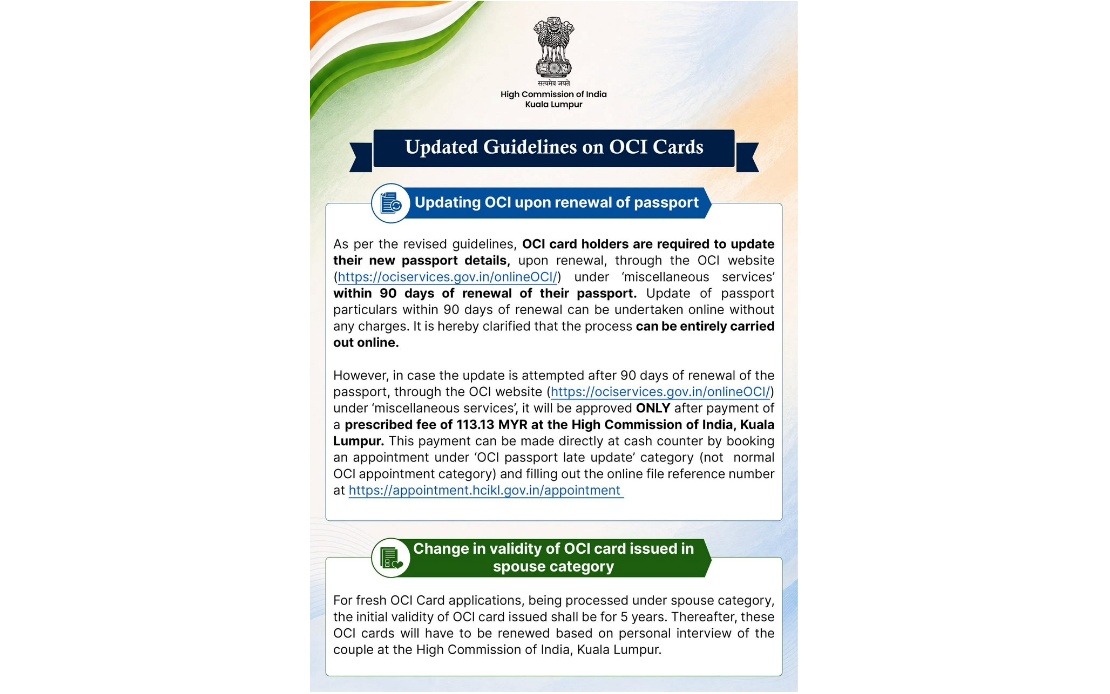
The High Commission of India in Kuala Lumpur has introduced a streamlined but time-sensitive process for Overseas Citizen of India (OCI) cardholders who renew their passports, reflecting New Delhi's efforts to modernize administrative procedures for diaspora communities across Southeast Asia. Under the revised framework announced this week, OCI cardholders must now lodge updated passport information through the dedicated OCI portal within a 90-day window following passport renewal, with the entire transaction conducted digitally at no cost to the applicant.
This transitional grace period represents a significant administrative convenience for the estimated hundreds of thousands of Indian nationals and persons of Indian origin residing throughout Malaysia and the broader region. The online filing mechanism eliminates the necessity for physical office visits during the initial update phase, reducing bureaucratic friction that has historically delayed such administrative adjustments. The High Commission's emphasis on digital processing aligns with broader regional trends toward e-governance and reflects India's push to modernize its consular operations in key diaspora markets across Southeast Asia, where Malaysia remains a critical hub for Indian business and professional communities.
However, the guidelines introduce a financial penalty for those who miss the deadline. Any applicant seeking to update their passport particulars after the 90-day period expires will incur a prescribed fee of RM113.13, payable at the High Commission's cash counter in Kuala Lumpur. This two-tier system creates an incentive structure designed to encourage timely compliance while generating revenue from late applications. The mechanism requires applicants who miss the deadline to book an appointment specifically under the "OCI passport late update" category rather than standard OCI categories, necessitating that they provide their online file reference numbers to streamline processing.
For Malaysian residents and those across Southeast Asia who hold OCI status, this procedural change carries practical implications worth noting. The 90-day window is neither excessively restrictive nor entirely generous, requiring OCI cardholders to integrate passport renewal follow-up into their administrative routines. Given that passport renewals often occur during international travel or at times of significant administrative transition, the deadline warrants immediate attention upon completion of passport reissuance to avoid incurring the late-application fee. The system's reliance on online filing through the official OCI portal means applicants must possess basic digital literacy and access to the platform, which could present challenges for elderly diaspora members or those with inconsistent internet connectivity.
The High Commission's announcement also signalled a substantial restructuring of OCI validity provisions for applications submitted under the spouse category, a significant change for binational couples and those seeking OCI status through marriage to Indian citizens. Previously, OCI cards issued through this pathway operated under different validity arrangements. The new protocol stipulates that fresh applications processed under the spouse category will receive an initial validity period of five years rather than indefinite or longer-term provisions that may have existed previously. This modification appears designed to introduce a verification checkpoint into the spouse-category process, recognizing that marital circumstances and residence patterns can change significantly over longer periods.
Following the initial five-year validity period, the renewed guidelines mandate that both spouses must appear in person at the High Commission of India in Kuala Lumpur for a formal interview before OCI card renewal can be processed. This requirement introduces an element of personal verification and direct administrative contact that contrasts with the largely remote processes available for other OCI procedures. The in-person interview requirement ensures the High Commission can assess the continuing validity of the spouse relationship and confirm both parties' commitment to the OCI status, mitigating potential fraud or misuse of the spouse category. For couples across Malaysia and the broader region, this means that maintaining OCI status through the spouse category now demands periodic renewal efforts and coordinated travel to the capital for official interviews.
The practical ramifications of these spouse-category changes merit consideration for Malaysian families with mixed Indian and non-Indian nationalities. The five-year validity period aligns with common passport renewal cycles in many countries, potentially creating administrative synchronization opportunities for families managing multiple citizenship documents. However, the mandatory interview requirement imposes time and travel costs that may be burdensome for couples with young children or complex work schedules. The High Commission's decision reflects a trend toward tightening verification procedures across Indian consular operations, responding perhaps to concerns about spousal OCI applications and the need to ensure legitimacy of such claims.
The revised guidelines represent part of India's broader administrative modernization drive within its Southeast Asian diplomatic missions, responding to growing diaspora populations and the complexities of managing large volumes of consular applications. Kuala Lumpur, as Malaysia's capital and a major regional hub, hosts one of India's busiest diplomatic missions in the region, serving not only Malaysian residents but also Indian nationals transiting through Malaysia for work, education, and business purposes. The introduction of tiered fee structures and mandatory interviews reflects institutional capacity constraints and the High Commission's efforts to prioritize resource allocation across competing consular demands.
Applicants seeking clarity on the revised OCI procedures can access comprehensive details through the official OCI portal and the High Commission's dedicated appointment website, both of which have been updated to reflect the new guidelines. The digital infrastructure supporting these processes has been designed to accommodate high volumes of simultaneous applicants, though system performance during peak periods may vary. The High Commission's announcement through social media platforms demonstrates an effort to reach diaspora communities through channels they actively use, bypassing traditional print media and ensuring information reaches tech-savvy professionals who represent a significant portion of OCI cardholders in Malaysia.
For those planning to renew their passports in the coming months, the message from the High Commission is unambiguous: secure your OCI passport update within 90 days to avoid the late-application fee and associated bureaucratic inconvenience. The system's efficiency gains come with the expectation of individual responsibility for timely compliance. This represents a broader shift in consular administration, where convenience through digital platforms comes paired with consequences for non-compliance, encouraging diaspora members to maintain current documentation and engage proactively with administrative requirements rather than deferring such matters indefinitely.

