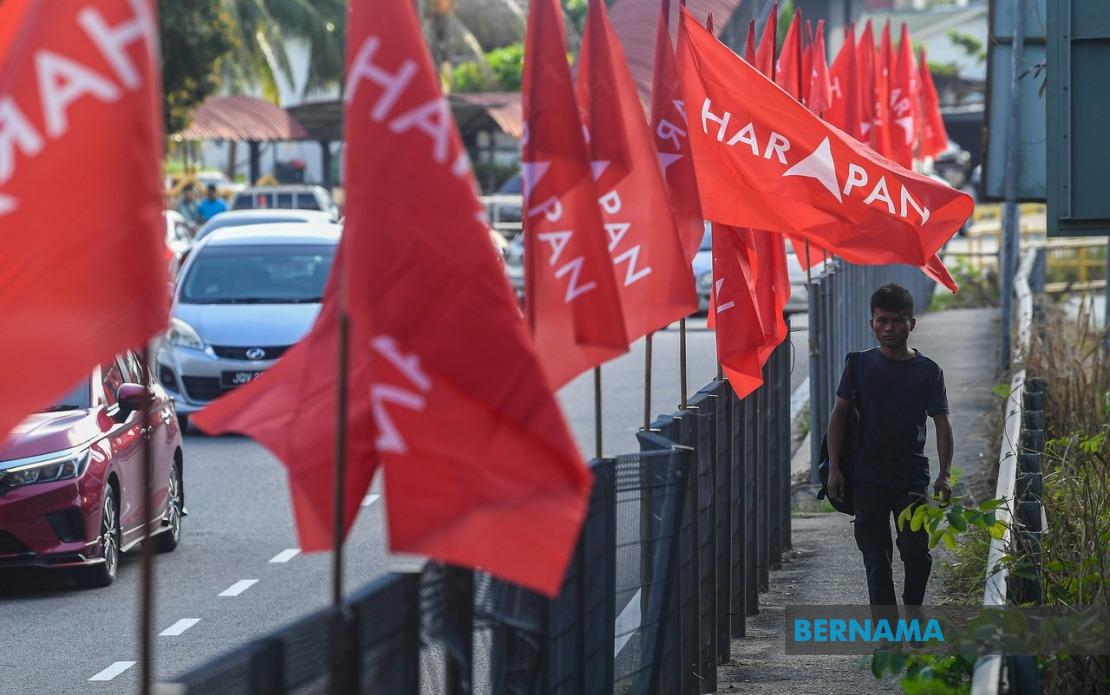
Pakatan Harapan is banking on the Indian community to deliver victory in Johor's upcoming state election on July 11, with party leaders framing the ballot as a referendum on political continuity and economic management rather than a routine polling exercise. Dr Gunaraj George, a member of Parti Keadilan Rakyat's (PKR) Central Leadership Council and Sentosa state assemblyman, has positioned India-Malaysian voters as potentially decisive in a closely contested electoral contest where margins in mixed constituencies could prove critical to overall outcomes.
While Johor's Indian population represents a minority share of the electorate, their concentration and voting patterns could influence results in approximately 25 State Legislative Assembly seats classified as mixed or marginal, according to Gunaraj's calculations. This strategic assessment reflects a broader recognition in Malaysian electoral politics that swing voters within minority communities can amplify their influence beyond their raw numerical size, particularly in constituencies where no single ethnic group commands an overwhelming majority. The coalition's emphasis on this demographic reveals sophisticated targeting aimed at consolidating support among voters who may not have been fully engaged by previous political messaging.
The appeal to Indian voters rests fundamentally on an argument about macroeconomic management and institutional stability. Gunaraj contended that contemporary global conditions—including economic uncertainty, geopolitical tensions, and inflationary pressures affecting household budgets—demand a government capable of maintaining investor confidence and delivering sustained employment growth. This framing positions political continuity not as partisan advantage but as pragmatic necessity, suggesting that electoral disruption could undermine Malaysia's economic trajectory during a vulnerable period. The messaging attempts to transcend communal appeals by anchoring political choice to universal concerns about living standards and financial security.
The MADANI reform agenda has emerged as central to the coalition's appeal to all voter communities, including Indian Malaysians. According to Gunaraj, the government's tenure spanning more than three-and-a-half years has produced measurable outcomes that warrant continuation, citing concrete budget allocations and policy initiatives designed specifically to address community concerns. This evidence-based approach represents a deliberate strategy to shift electoral discourse from personality-driven politics toward substantive evaluation of governance performance, inviting voters to assess coalitional competence based on demonstrable results rather than abstract promises.
A particularly significant policy achievement cited is the resurrection and enhancement of the Malaysian Indian Transformation Unit (MITRA) allocation. The government increased funding from RM100 million to RM150 million—the first increase in nearly a decade—and Prime Minister Datuk Seri Anwar Ibrahim has reportedly committed to progressive expansion of these resources to address contemporary needs. Beyond the budgetary increase itself, Gunaraj emphasised that MITRA's operational framework has been transformed to incorporate greater transparency, public accountability, and parliamentary oversight of fund deployment. This distinction between increased allocation and improved governance of resources speaks to concerns that public money directed toward community development was historically managed without adequate scrutiny or systematic measurement of outcomes.
Educational investment has constituted another dimension of the government's appeal to Indian communities. Increased allocations for Tamil National-Type Schools (SJKT)—which serve predominantly Indian student populations—represent tangible support for educational infrastructure and teacher development. These funding increases address longstanding concerns within the Indian community about resource disparities affecting vernacular education, particularly as such schools navigate demographic pressures and changing educational preferences among younger Indian Malaysian families. Coupled with expanded Technical and Vocational Education and Training (TVET) programmes, the government's portfolio presents education as a pathway to economic opportunity rather than a consumption item subject to budget constraints.
Religious institution support and cash assistance programmes constitute additional elements of the coalition's pitch to Indian voters. Maintenance grants for places of worship, including temples, address infrastructure preservation concerns while signalling government respect for religious spaces. The rollout of cash assistance schemes—Sumbangan Tunai Rahmah (STR) and Sumbangan Asas Rahmah (SARA)—has provided direct income support to lower-income households regardless of ethnicity, though their impact on Indian communities merits specific attention given wealth distribution patterns. Support for micro, small, and medium enterprises addresses entrepreneurial aspirations within Indian business communities who have historically faced disproportionate barriers to accessing capital and markets.
The broader institutional reform agenda accompanying these specific community-focused policies represents an attempt to anchor the coalition's appeal to principled governance rather than distributional politics alone. Gunaraj referenced the government's emphasis on anti-corruption enforcement, institutional accountability, and policy inclusivity as creating conditions for development benefits to permeate all social segments rather than concentrating among politically favoured constituencies. This positioning of political choice as fundamentally about governance quality and systemic integrity may resonate particularly with Indian communities concerned about economic marginalisation and institutional discrimination affecting business opportunities and public resource allocation.
The Johor election carries significance beyond state-level politics given its role in signalling broader national electoral sentiment. Johor remains Malaysia's second-most populous state and maintains substantial economic importance as a manufacturing and logistics hub. Coalition performance in the state will provide indicators regarding coalition cohesion, the resonance of MADANI messaging, and the sustainability of the unity government formed after the 2022 federal election. For Indian communities specifically, the election represents an opportunity to demonstrate voting influence that could translate into enhanced policy responsiveness and resource allocation recognition in subsequent periods.
Pakatan Harapan's contest across all 56 state seats reflects confidence in its electoral positioning despite national and global headwinds affecting government popularity. The coalition's explicit cultivation of Indian community support through both policy delivery and strategic messaging suggests recognition that electoral mathematics in Malaysian contests frequently depend on mobilising minority communities whose turnout and voting patterns fluctuate based on perception of government responsiveness to specific grievances. Whether this targeted appeal generates the polling boost the coalition anticipates will become evident on July 11, with broader implications for how Malaysian political parties conceptualise coalition-building and community engagement in future electoral contests.
The campaign dynamics in Johor will ultimately test whether voters prioritise continuity and institutional stability as framed by coalition messaging, or whether other concerns—including dissatisfaction with cost-of-living pressures, local governance performance, or alternative political visions—prove more salient in determining electoral outcomes. The Indian community's role, as Gunaraj characterises it, extends beyond its numerical representation to encompassing its potential as a swing constituency capable of amplifying broader patterns of electoral sentiment across different demographic groups.

