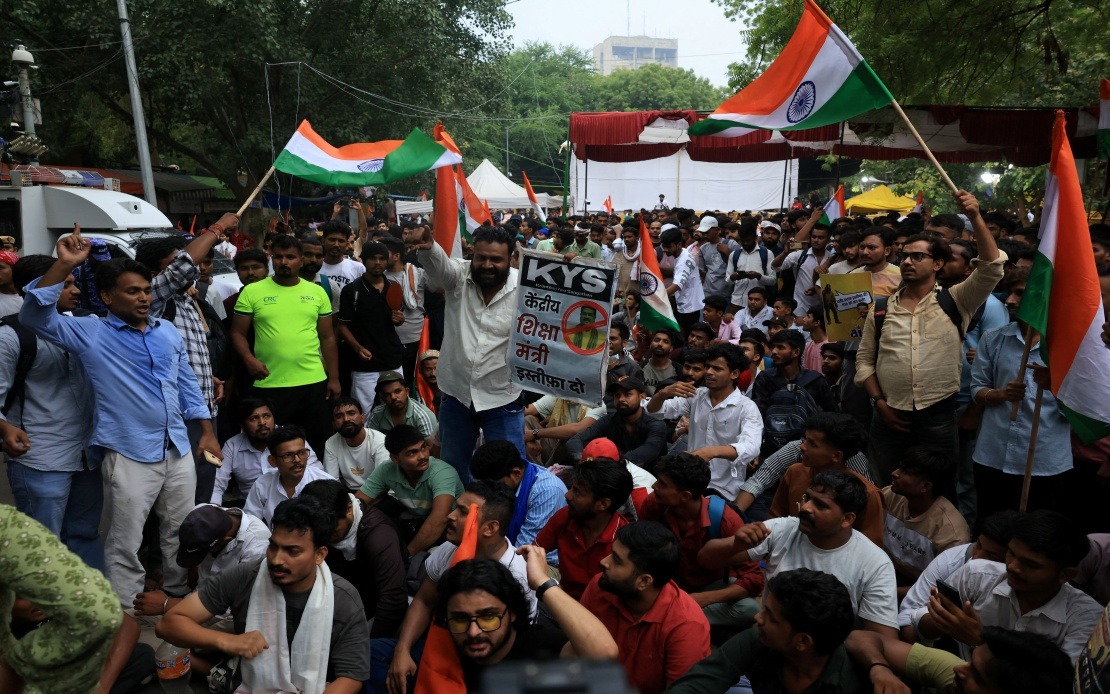
A groundswell of youth activism swept through India's capital on Monday as thousands of demonstrators converged on New Delhi to push for sweeping changes to the nation's academic infrastructure. The protest, organised under the banner of a "Sansad Chalo" (march to parliament) campaign, saw police implement crowd-control tactics to prevent marchers from breaching security cordons surrounding the parliament building. The demonstration underscores growing frustration among India's younger generation with what they perceive as structural deficiencies in the country's education system, a sentiment that has resonated across the youth-centric movement behind the rally.
The timing of Monday's protest coincided with the commencement of the Monsoon Session of the Indian Parliament, adding political weight to the demonstration. Prime Minister Narendra Modi vacated the parliament complex in a protective convoy as law enforcement personnel managed the burgeoning crowds in surrounding thoroughfares. The heightened security response reflected official concern about the scale and momentum of the mobilisation, which organisers claim has attracted millions of followers through digital platforms, illustrating the movement's capacity to harness online engagement for offline action.
Police authorities had previously imposed restrictions on public gatherings, setting the stage for confrontation when marchers sought to breach barricades erected along key routes leading to the parliamentary precinct. The tension that erupted as demonstrators attempted to press forward against police lines highlighted the friction between citizens exercising their right to petition their representatives and state mechanisms tasked with maintaining order. Such confrontations have become increasingly familiar in Indian political discourse, where youth-driven movements challenge traditional governance structures through unconventional protest strategies.
The newly-launched movement backing the march represents a departure from India's established protest movements, leveraging social media and online networks to mobilise participants rather than relying solely on traditional organisational structures. The claim of millions of online adherents suggests the campaign has tapped into widespread discontent among younger Indians regarding educational quality, accessibility, and relevance to contemporary employment landscapes. This digital-first approach has proven effective at rapidly scaling demonstrations, as evidenced by the thousands who appeared on the streets of New Delhi despite police impediments.
For Malaysian observers, the Indian education reform movement carries particular significance given the shared regional context of educational challenges across South Asia and Southeast Asia. Both India and Malaysia grapple with questions about curriculum modernisation, graduate employability, and equitable access to quality schooling. The Indian youth movement's willingness to mount direct pressure on parliament reflects broader regional anxieties about whether existing educational frameworks adequately prepare students for economic realities and whether governance institutions remain responsive to younger generations' needs.
The scope and visibility of Monday's protest suggests education reform has ascended the political agenda in India at a moment when the country faces intensifying competition in global knowledge economies. Youth frustration with academic systems extends beyond India's borders, with similar movements gaining traction across Southeast Asia as students and young professionals question whether curricula emphasise skills demanded by contemporary labour markets. The Indian demonstration thus speaks to transnational patterns of youth activism around education policy, even as specific grievances and contexts vary by country.
Security tightening across New Delhi's key districts following the march indicates authorities regarded the protest as sufficiently significant to warrant enhanced protective measures. Such responses can either suppress future activism or galvanise additional mobilisation, depending on perceptions of police conduct and political receptiveness to reform demands. The Indian government will face pressure to address the education concerns raised while balancing maintenance of public order, a tension increasingly visible in democracies where youth participation in street-level politics challenges traditional power structures.
The protest movement's emergence during parliament's monsoon session presents advocates with a window to lobby elected representatives directly, though police barriers functioned to prevent physical access to the legislative chamber. This mismatch between demonstrators' capacity to mobilise and their inability to penetrate security cordons raises questions about the efficacy of disruptive protest tactics in effecting policy change. Nevertheless, the sheer numbers mobilised and the digital reach claimed by organisers suggest the movement possesses resources to sustain pressure through multiple channels beyond street demonstrations.
Education remains a foundational policy domain across South and Southeast Asia, shaping economic competitiveness and social mobility. The Indian youth movement's focus on academic reform reflects recognition that educational structures inherited from previous eras may inadequately serve contemporary societies. For Malaysian policymakers and observers, the Indian experience offers lessons about the political salience of education grievances among younger populations and the capacity of digital-savvy movements to mount sustained campaigns on this issue.
The convergence of thousands of protesters in New Delhi despite police restrictions demonstrates that education reform has mobilised sufficient discontent to overcome barriers to participation. Whether Monday's demonstration catalyses substantive policy responses or merely represents episodic activism remains to be seen, but the movement's organisational capacity and digital infrastructure suggest it possesses tools to maintain momentum. The broader implication extends across the region: governments dismissing youth demands for educational modernisation risk underestimating the organisational prowess and political determination that younger generations can muster when mobilised around institutional reform.

