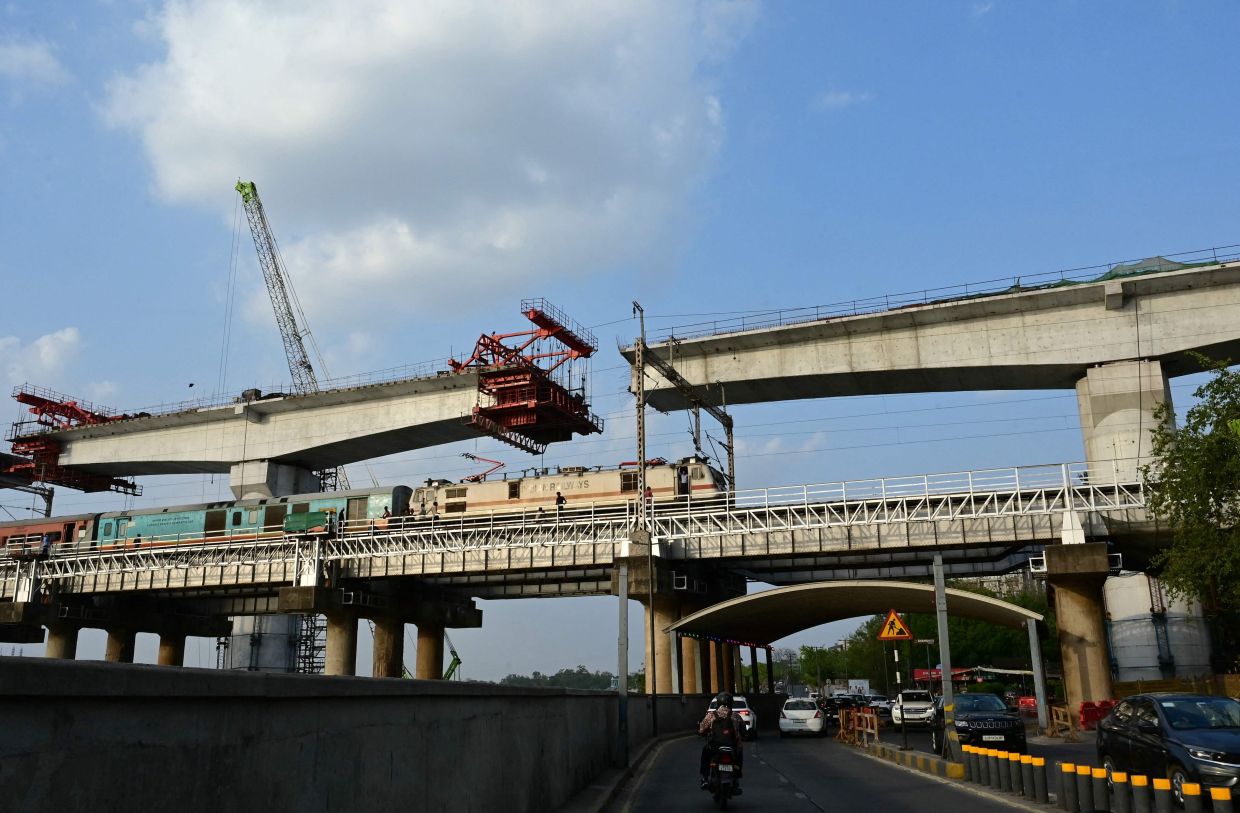
India's flagship bullet train project is finally gaining traction, with railway officials confirming that the nation's inaugural high-speed corridor will begin passenger operations in 2027, nearly ten years after construction commenced. The announcement represents a significant moment for New Delhi's broader vision of transforming its colonial-era rail infrastructure into a modern, electrified network capable of moving people and freight at speeds previously unseen in South Asia. The government views this inaugural service as far more than a single transport link—it is positioning the venture as a foundational stepping stone for an ambitious national framework that could eventually reshape how Indians travel between major cities and economic hubs.
The Mumbai-Ahmedabad High Speed Rail Corridor, stretching 508 kilometres along India's western coast, will initially connect the diamond-cutting hub of Surat with the industrial city of Vapi, separated by roughly 100 kilometres. According to Dharmendra Tewari, additional director general of Indian Railways, substantial construction work across the full corridor is already underway, with this first operational segment serving as the proof of concept for the wider vision. The section between these two cities will demonstrate the viability of Japan's Shinkansen technology—licensed specifically for this project—operating within the Indian context, facing local terrain, climate, and operational challenges that will inform all subsequent high-speed developments.
The journey from conception to near-reality has been neither swift nor straightforward. The project was formally launched in 2017 through a high-profile partnership between then-Prime Minister Narendra Modi and Japanese counterpart Shinzo Abe, with an optimistic target of completion by 2023. That timeline has now shifted by approximately four to five years, reflecting the complex realities of executing such an ambitious infrastructure undertaking. The government has earmarked 17 billion US dollars for the complete corridor, with Japan's International Cooperation Agency providing an 81 percent loan through Tokyo's development financing mechanisms. However, Indian media reports suggest that persistent delays, combined with escalating land acquisition expenses, may ultimately push the final cost substantially higher—a reminder of how infrastructure projects in populous nations can face mounting pressures as implementation progresses.
For regional observers across Southeast Asia, India's commitment to this project carries particular significance. The success or failure of the Mumbai-Ahmedabad corridor will likely influence how other South and Southeast Asian nations approach their own high-speed rail aspirations. Several countries in the region are simultaneously evaluating similar projects, and India's experience—both technical and financial—will serve as a crucial reference point. The corridor's engineering challenges are formidable: construction includes a 21-kilometre tunnel cutting through mountainous terrain and the nation's first undersea rail tunnel, a component that remains incomplete and represents a significant technological milestone for Indian railway engineering.
When fully operational by late 2028, the complete corridor will dramatically reshape connectivity between Mumbai, India's 22-million-strong financial capital, and Ahmedabad, a rapidly expanding city in Modi's home state of Gujarat. The journey time will compress to just under two hours—compared with six hours on conventional rail routes or four to five hours by air when airport procedures are factored in. This transformation carries implications beyond mere travel convenience; it will create an effective economic corridor linking two major metropolitan areas and their respective industries, potentially accelerating business integration and talent mobility across western India.
The timing also positions the corridor to support Ahmedabad's hosting of the 2030 Commonwealth Games, an event India views as a crucial stepping stone toward its broader ambition to stage the 2036 Olympic Games. The bullet train becomes not only a transportation facility but a symbol of India's modernization narrative and its readiness for major international events. Railway officials emphasize that the knowledge, technical expertise, and operational capabilities developed through this project will directly feed into subsequent high-speed corridors, creating a multiplier effect across India's transport infrastructure.
Beyond the immediate Mumbai-Ahmedabad connection, the government has floated an expansive vision encompassing seven high-speed rail corridors totaling approximately 4,000 kilometres. These proposed networks would create what officials term "growth connectors," linking key economic and administrative centers across the nation. One proposed east-west route would stretch from New Delhi through Varanasi—Modi's parliamentary constituency and one of Hinduism's holiest cities—to Siliguri, the strategic gateway connecting India's northeastern states with the rest of the country. A second north-south corridor would run from Ahmedabad through Mumbai, then southeastward to link the technology hubs of Pune, Hyderabad, and Chennai, effectively creating an interconnected network of India's most economically dynamic regions.
These proposals remain aspirational at present, lacking defined timelines or implementation schedules. Yet they reflect an ideological commitment to using high-speed rail as an engine for national integration and economic development. For Malaysian and Southeast Asian policymakers watching India's transformation, the message is clear: India is betting significantly on rail modernization as a cornerstone of twenty-first-century infrastructure strategy. The success of the Surat-Vapi segment will largely determine whether these grander ambitions materialize or remain permanently sidelined.
India's broader railway modernization efforts provide important context for understanding the bullet train's significance. The nation operates one of the world's longest rail networks, encompassing approximately 85,000 kilometres of track capable of speeds of 110 kilometres per hour or above—roughly 80 percent of all lines. Last year, Indian Railways carried 7.41 billion passengers and moved 1.67 billion tonnes of freight, demonstrating the massive scale at which the system operates. The domestically developed Vande Bharat trains, capable of reaching 180 kilometres per hour, carried nearly 40 million passengers in their inaugural year of service, proving that Indians are receptive to faster rail travel when quality services are provided.
The bullet train, however, represents a qualitative leap—designed for 350 kilometres per hour maximum speed and 320 kilometres per hour operational velocity, it will be substantially faster than existing services. This capability, combined with improved comfort standards and reduced travel times, could fundamentally shift how Indians think about intercity travel, potentially drawing passengers from both conventional rail and air transport. The project embodies Modi's vision, articulated since his 2014 election, of embedding high-speed rail within India's development framework.
For Malaysia and other Southeast Asian nations, India's trajectory offers important lessons about scaling infrastructure ambitions in populous, economically diverse regions. The delays and cost pressures affecting the Mumbai-Ahmedabad corridor illustrate that even technologically advanced projects face significant implementation challenges in complex environments. Simultaneously, India's persistence in moving the project forward—and its continued commitment to the broader seven-corridor vision—suggests confidence that high-speed rail will ultimately prove essential to the nation's economic future. The 2027 opening of the Surat-Vapi segment will either validate that confidence or raise awkward questions about whether such megaprojects remain realistic for large Asian economies facing competing infrastructure demands.
Regional investors and infrastructure planners across Southeast Asia are watching closely. A successful Indian bullet train network could encourage similar projects elsewhere in the subcontinent and across Asia more broadly. Conversely, if the project encounters further delays or cost explosions, it may dampen enthusiasm for comparable undertakings. The corridor thus represents far more than a transportation link between two Indian cities—it is a test case for whether high-speed rail remains viable and desirable as a development strategy for the region's largest economies, and a signal about India's commitment to infrastructure modernization in the coming decade.

