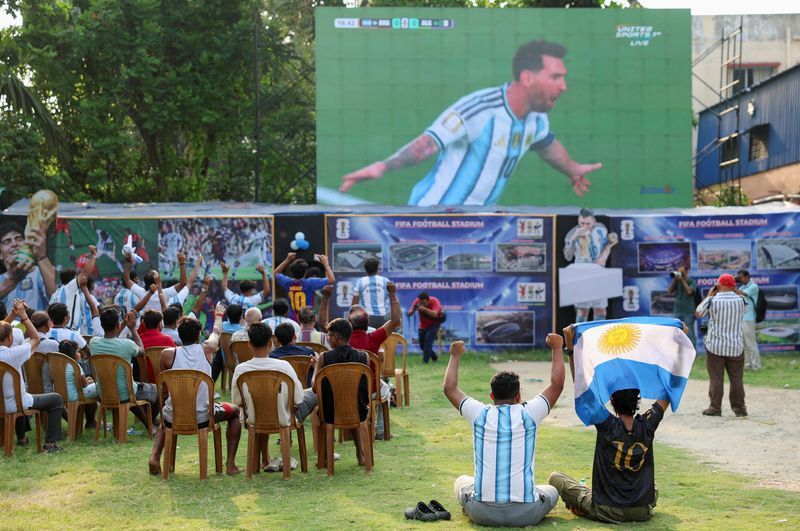
While the 2026 FIFA World Cup unfolded across continents, Gourav Roy, a software engineer from San Francisco, undertook an extraordinary 6,000-mile journey across the United States to witness the tournament's climactic matches. For Roy, this pilgrimage represented a substitute for a lifelong aspiration that now seems increasingly unattainable: watching his nation, India, compete on football's grandest stage. His story encapsulates the frustration of millions of Indian football enthusiasts who have grown accustomed to disappointment, their dreams relegated to the sidelines as deeper institutional problems corrode the sport's potential in a country of 1.45 billion people.
India's standing in world football starkly illustrates squandered opportunity. Currently languishing at 138th in the global rankings, the nation has failed even to secure qualification for next year's Asian Cup, a continental tournament that should be within reach for a country of India's resources and population. The contrast is particularly stark when examining which nations have secured spots in the 2026 World Cup: smaller Caribbean and African nations with populations a fraction of India's size, such as Curacao and Cape Verde, have achieved what India cannot. This disparity underscores not a lack of talent or potential, but rather systemic dysfunction at the heart of Indian football governance and development.
Indian football stakeholders consistently identify a constellation of interconnected problems that have calcified into structural obstacles. The youth development infrastructure remains severely underdeveloped, professional pathways are ill-defined, and most critically, the sport lacks the institutional coherence necessary for genuine progress. The All India Football Federation (AIFF), tasked with steering national football policy, operates amid fragmentation, coordinating inadequately with a patchwork of state associations that operate with minimal uniformity or shared vision. This decentralisation, ostensibly designed to accommodate India's geographical expanse and diversity, has instead created a vacuum wherein strategic planning withers and grassroots initiatives remain sporadic and inconsistent.
Ravi Puskur, chief executive of the Indian Super League club FC Goa, articulated the magnitude of the undertaking required for meaningful reform. In his assessment, establishing proper systems and reorganising governance structures would demand a minimum four-year cycle, followed by an additional 20 to 25 years of sustained development before India could realistically challenge for World Cup qualification. This timeline underscores the depth of institutional decay, suggesting that even optimistic projections extend well beyond the horizon of current administrators and policymakers, creating perverse incentives for short-term fixes rather than foundational restructuring.
The Indian Super League, established in 2014 with backing from Reliance Industries, one of India's largest business conglomerates, represented the most ambitious attempt to commercialise and popularise domestic football beyond cricket's overwhelming cultural dominance. Yet even this well-capitalised initiative has failed to generate transformative change. The partnership between AIFF and Reliance fractured in 2025 as negotiations collapsed amid complex regulatory disputes centred on the federation's constitutional framework and governance structure. Consequently, the ISL now operates without a decisive strategic partner or clear broadcaster arrangement, leaving clubs suspended in uncertainty and contributing to the broader institutional paralysis afflicting Indian football.
Geographic and cultural barriers compound institutional failures. Football enjoys meaningful followings only in scattered regions: West Bengal, Goa, Kerala, Mizoram, and Manipur constitute the sport's traditional strongholds, creating a fragmented fan base insufficient to generate the commercial momentum and political will necessary for transformative investment. In contrast, cricket's dominance across the nation continues unchallenged, absorbing talent, resources, media attention, and national obsession. Any football administrator attempting to mobilise resources or prioritise youth development must contend with this entrenched cultural hierarchy, wherein football remains perpetually positioned as secondary entertainment.
Alongside institutional weaknesses, technical deficiencies in youth player development reveal the gap separating Indian football from competitive international standards. Lalnghinglova Hmar, an AIFF executive committee member and Mizoram's sports minister, outlined the disparity with specificity: in South Korea and Japan, young players compete in over 40 competitive matches annually, a threshold that India struggles to approach. Most Indian under-15 players participate in merely 12 to 15 competitive fixtures yearly, and some national youth squad callups occur after players have accumulated fewer than 20 competitive appearances. The shortage of qualified coaching personnel worsens this situation; numerous states lack functional youth leagues, rendering it mathematically impossible for Indian youth to accumulate the competitive experience necessary to develop into world-class footballers. This developmental deficit compounds annually, progressively widening the gap between Indian players and their counterparts in East Asian and Southeast Asian nations.
India's vastness, paradoxically, represents both an asset and liability in addressing these challenges. The nation's massive population and emerging middle class theoretically constitute an enormous market capable of sustaining professional football infrastructure. Yet this same size renders implementing uniform standards and coordinated development programmes extraordinarily difficult. AIFF's capacity to impose coherent youth league structures or coaching standards across twenty-eight states remains severely constrained, necessitating willing cooperation from fragmented state associations with competing priorities and limited resources. As Hmar noted, meaningful progress requires that even half of India's states implement functional grassroots systems, a threshold that current governance structures appear incapable of achieving.
Recent financial instability within the ISL has further deteriorated the competitive environment. Salary suspensions imposed on players during the previous season forced clubs to curtail development programmes and youth investment, directly undermining talent cultivation initiatives. This instability contradicts the assurances that stability attracts investment; instead, uncertainty breeds retrenchment, creating a self-reinforcing cycle wherein financial volatility justifies reduced spending, perpetuating the very conditions that discourage investor confidence and commercial commitment.
The Indian government's potential involvement in football reform through alternative mechanisms offers a glimmer of possibility, albeit distant. India's bid to host the 2036 Olympics has prompted consideration of a "sports passport" scheme permitting athletes of Indian origin to represent the country, a mechanism that AIFF leadership believes could enhance national team competitiveness through diaspora recruitment. However, this proposal remains legislative speculation rather than imminent policy, and even sympathetic observers acknowledge that absorbing foreign-trained players cannot substitute for deficient domestic development systems.
Hmar issued a cautionary observation particularly relevant for Southeast Asian neighbours similarly navigating football development: India cannot afford complacency, as competing nations are advancing at accelerated rates. Even assuming accelerated Indian progress, the relative gains achieved by rivals elsewhere suggest that stagnation is, paradoxically, a form of regression. This dynamic underscores the peculiar challenge confronting large, populous nations with fragmented development systems: marginal improvement becomes insufficient when international competitors are simultaneously modernising their infrastructure and youth pathways. India's football community faces a moving target that distances with each passing year absent fundamental institutional transformation.
As Roy remarked with resigned philosophy, Indian football fans must "love without expectation," a resignation born of decades observing systemic failures and unrealised potential. His observation that a hypothetical 64-team World Cup format might offer "more hope" reflects the desperation increasingly characteristic of Indian football sentiment. Even expansion mechanisms designed to increase participation cannot gift India qualification without concurrent domestic institutional renewal. Until AIFF, state associations, corporate stakeholders, and the government align behind coherent development strategies extending beyond electoral cycles and quarterly earnings reports, India's World Cup dream will remain precisely what it has been for generations: distant, elusive, and perpetually deferred.

