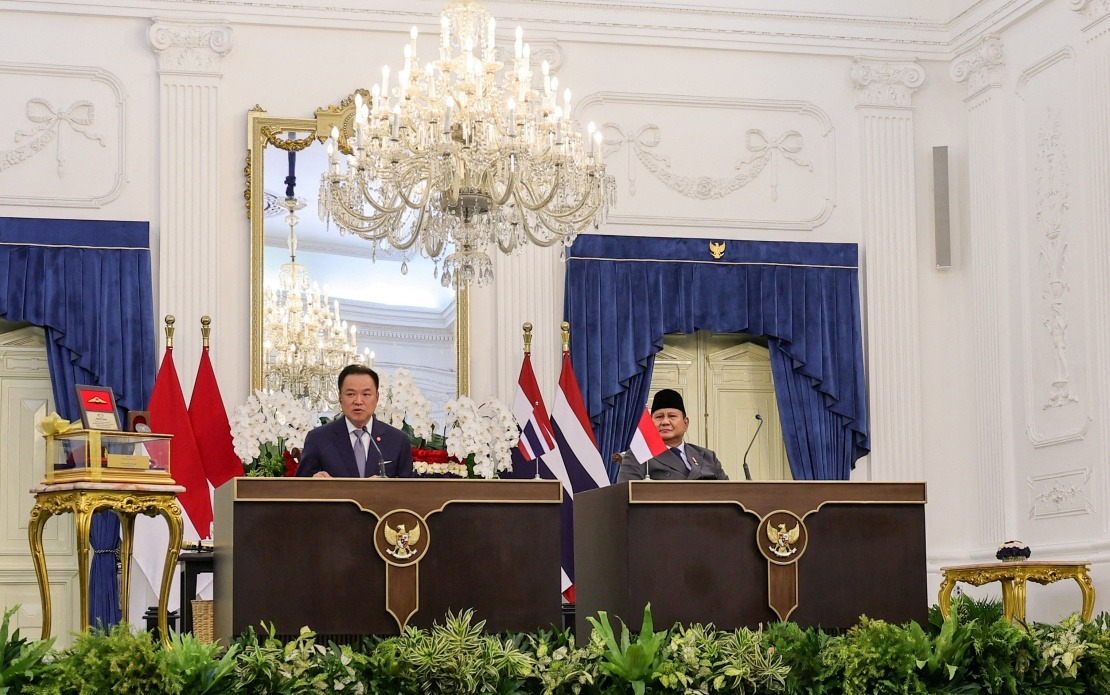
During a leaders' consultation at Jakarta's Merdeka Palace on Monday, Indonesian President Prabowo Subianto and Thai Prime Minister Anutin Charnvirakul renewed their nations' commitment to ASEAN's peace-building agenda in Myanmar, signalling that regional cohesion remains paramount as instability continues to grip the country and reverberate across Southeast Asia. The bilateral summit underscored Jakarta's role as a stabilising force within ASEAN while demonstrating that Thailand, under its new administration, intends to remain actively engaged in regional diplomacy alongside its larger neighbour.
At the joint press conference, President Prabowo emphasised that Indonesia and Thailand viewed the preservation of ASEAN unity and centrality as indispensable to addressing Myanmar's protracted conflict. The two nations reaffirmed their backing for the Five-Point Consensus, a framework adopted by ASEAN in 2021 that calls for immediate cessation of violence, inclusive dialogue among all stakeholders, humanitarian assistance, and a special ASEAN envoy's mediation efforts. By publicly recommitting to these principles, both countries signalled that despite Myanmar's deteriorating security situation and humanitarian crisis, they remain unwilling to abandon multilateral approaches in favour of unilateral intervention, a significant stance given the conflict's complexity and the involvement of multiple armed factions.
Beyond Myanmar, the talks revealed that Indonesia and Thailand view transnational crime as an increasingly urgent threat requiring coordinated responses. President Prabowo highlighted that online scam syndicates represent a growing challenge across the region, with criminal networks leveraging digital technologies to target vulnerable populations across multiple countries. The acknowledgment reflects a sobering reality for Southeast Asia: organised crime has evolved far beyond traditional trafficking and drug smuggling, now encompassing sophisticated cybercrime operations that extract millions from victims annually. Thailand's Prime Minister specifically referenced his country's role in facilitating the repatriation of nearly 1,000 Indonesian victims of such scams, a concrete example of how transnational criminal enterprises create humanitarian challenges requiring cross-border cooperation.
The framework both nations agreed upon represents a significant escalation in their commitment to dismantling these criminal networks. Intelligence sharing mechanisms will enable both countries' security agencies to track financial flows across borders, identify suspects operating in multiple jurisdictions, and coordinate arrests and prosecutions. Joint investigations will allow law enforcement teams to work within each other's jurisdictions, accelerating the pace at which cases progress. Financial tracking capabilities prove particularly important given that online scam operations typically launder proceeds through multiple countries before consolidating funds in safe havens. By coordinating on this dimension, Indonesia and Thailand aim to disrupt the economic viability of these enterprises, making them less attractive to potential recruits and investors.
The agreement to develop a Transnational Referral Mechanism addresses a critical gap in regional responses to organised crime: the chaotic situation victims face after rescue. Currently, individuals trafficked or exploited across borders often remain in legal limbo, uncertain of their rights and unable to access repatriation assistance. A formalised referral mechanism would establish clear protocols for identifying victims, determining their nationality and immigration status, connecting them with appropriate support services, and ensuring dignified return to their countries of origin. For Malaysian readers, this development carries particular significance, as Malaysia has become both a transit point and destination for transnational criminal activity, and would likely benefit from similar mechanisms adopted within broader ASEAN frameworks.
Thailand's proposals for expanded defence industry collaboration reveal a pragmatic shift toward deepening military ties. The offer to supply 36 amphibious wheeled armoured vehicles to Indonesia represents more than a simple equipment transfer; it reflects Thai defence manufacturers' capabilities and suggests emerging defence industrial cooperation that could see more robust exchanges in future years. Such collaborations typically include technical training, maintenance arrangements, and potential joint production or assembly agreements. For Indonesia, acquiring modern amphibious vehicles enhances its capacity to respond to maritime security challenges, territorial defence operations, and humanitarian assistance scenarios across its vast archipelago.
Prime Minister Anutin's emphasis on regular joint military training and maritime security cooperation underscores Thailand's commitment to practical, sustained engagement with Indonesian counterparts. Maritime security cooperation holds particular importance given that both nations share waters with significant strategic and commercial value. Joint patrols, coordinated surveillance, and harmonised protocols for responding to maritime incidents all strengthen collective capacity to deter unauthorised activity and respond to genuine emergencies. Anutin's inclusion of wildlife trafficking in his proposed cooperation agenda reflects growing recognition that environmental crime, including illegal wildlife trade, represents a significant transnational threat requiring regional approaches rather than isolated national efforts.
The timing of Anutin's visit merits attention. As Thailand's 32nd prime minister, having assumed office in September 2025, his journey to Jakarta for bilateral consultations signals that Bangkok intends to maintain Indonesia as a priority diplomatic and strategic partner. That this constituted the first official visit by a Thai prime minister to Indonesia in 15 years highlights how political transitions and competing regional priorities had previously disrupted high-level bilateral engagement. The summit's occurrence shortly after Anutin's election suggests that Thailand's new administration has quickly identified ASEAN cooperation and bilateral partnerships with major regional players as foundational to its foreign policy. For Indonesia, the visit affirms its continued centrality within ASEAN decision-making and its role as an indispensable partner for addressing shared regional challenges.
The two-pronged approach—maintaining commitment to Myanmar peace efforts while simultaneously deepening practical security cooperation on transnational crime—reflects a sophisticated understanding of regional stability. The Myanmar conflict continues to generate refugee flows, disrupt cross-border trade, and create ungoverned spaces exploited by criminal enterprises. By pursuing both the diplomatic path through ASEAN mechanisms and the practical path through enhanced law enforcement cooperation, Indonesia and Thailand acknowledge that sustainable peace requires addressing both conflict resolution and the criminal ecosystems that thrive amid state fragility. This integrated approach offers lessons for how Southeast Asian nations might manage multiple simultaneous crises, and suggests that bilateral partnerships can complement rather than substitute for multilateral frameworks.
The broader implications extend throughout the region. Malaysia and other ASEAN members facing similar transnational crime challenges will observe whether the Indonesia-Thailand model proves effective in disrupting online scam networks and criminal syndicates. The success or failure of their joint investigations, intelligence sharing, and victim repatriation efforts will likely influence whether similar agreements proliferate among other ASEAN dyads. Furthermore, the willingness of both nations to invest diplomatically and operationally in Myanmar peace efforts, despite limited immediate prospects for breakthrough, signals that ASEAN members remain committed to the principle of constructive engagement even when results prove elusive. This steady commitment, maintained without triumphalism or abandonment, may ultimately prove more valuable than more confrontational approaches in preserving regional architecture during turbulent periods.

