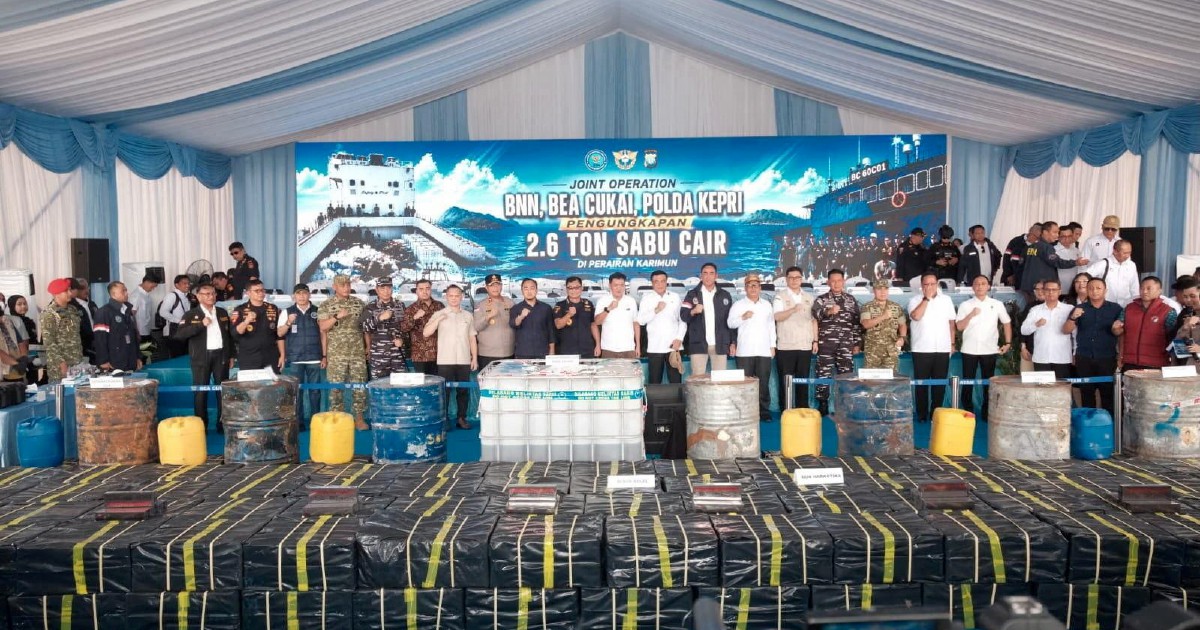
Indonesian law enforcement has arrested 10 Myanmar nationals accused of involvement in an international drug smuggling operation, according to authorities who unveiled details of the enforcement action during a Friday press conference in Jakarta. The operation centred on the discovery of 2.6 metric tonnes of liquid methamphetamine aboard a commercial vessel flying a Tanzanian flag, underscoring the region's vulnerability to sophisticated maritime drug trafficking networks that exploit legitimate shipping corridors.
The interception represents a substantial seizure by regional standards and highlights Indonesia's strategic position as both a transit point and frontier in the battle against methamphetamine distribution across Southeast Asia. The liquid form of the drug—particularly difficult to detect through conventional screening methods—suggests an operation conducted by traffickers with considerable technical expertise and access to clandestine production facilities likely located in the Golden Triangle or neighbouring areas. Such seizures have become increasingly common as criminal syndicates adapt their methods to evade detection at land borders, instead routing contraband through maritime channels where enforcement presence remains comparatively sparse.
Myanmar has emerged as a primary source of methamphetamine destined for regional markets, with production concentrated in areas beyond central government control. The arrest of Myanmar nationals follows established patterns whereby traffickers from source countries personally oversee shipments destined for distribution networks across Thailand, Malaysia, Indonesia, and beyond. This hands-on involvement by nationals from the country of origin reflects both the value of these operations and the trust dynamics within transnational criminal organisations that demand direct supervision during critical logistics stages.
The Tanzanian flag registered to the vessel exemplifies a common tactic within international trafficking networks: the use of ships bearing flags of convenience from distant nations with limited maritime oversight capacity. Such registry systems complicate investigations and create jurisdictional ambiguities that traffickers exploit to their advantage. The combination of a Tanzanian flag, Myanmar nationals, and an Indonesian interception zone illustrates the multinational character of modern drug smuggling, where criminal enterprises operate across multiple legal systems simultaneously.
Indonesia has intensified maritime enforcement operations in recent years, reflecting heightened political will to combat narcotics trafficking and an increased allocation of resources to coast guard and naval operations. The timing of this announcement demonstrates the government's commitment to publicising successful interdictions, which serve dual purposes of deterrence and domestic political benefit by showcasing law-and-order credentials. However, experts note that each major seizure represents merely a fraction of overall trafficking volumes moving through regional waters, with authorities estimating that successful interceptions account for perhaps 10 to 20 percent of actual smuggling attempts.
The implications for Malaysian authorities are significant, as methamphetamine destined for Indonesian markets often transits through Malaysian ports or territorial waters. Enhanced cooperation between Indonesian and Malaysian enforcement agencies has been formalised through bilateral agreements, yet operational coordination remains constrained by resource limitations and differing institutional priorities. This particular bust underscores the necessity for Malaysian security agencies to maintain vigilance regarding transshipment activities in Malaysian waters and ports, where drugs bound for final distribution throughout Southeast Asia frequently change vessels.
The seizure volume of 2.6 metric tonnes equates to millions of individual doses, representing substantial retail value when distributed through street-level networks. At regional pricing, such a consignment would generate tens of millions of dollars in revenue for trafficking organisations, illustrating the extraordinary profitability that motivates continued investment in smuggling operations despite enforcement risks. The arrested individuals likely represent operational personnel rather than decision-makers within trafficking hierarchies, suggesting that the criminal networks behind this operation remain largely intact and positioned to resume activities through alternative routes.
Liquid methamphetamine specifically presents distinctive enforcement challenges compared to crystalline forms. Its apparent licit applications—potentially disguised as industrial chemicals or solvents—create plausible deniability scenarios that complicate port inspections. The detection of this shipment therefore indicates either sophisticated intelligence work, routine cargo screening that happened to succeed, or informant cooperation within the trafficking network itself. Indonesian authorities have occasionally benefited from cooperation agreements with international drug enforcement agencies including those from the United States and Australia, though specific details regarding operational methods remain typically classified.
The broader context involves Myanmar's governance crisis and territorial fragmentation, which have facilitated the expansion of drug production beyond state control. Various armed ethnic organisations and criminal syndicates operate with minimal interference in regions where central authority remains weak or absent. This structural condition ensures an abundant supply of precursor chemicals and finished products for trafficking networks that can organise maritime transport with sufficient sophistication to evade regional enforcement efforts, at least temporarily. Unless substantial progress occurs in addressing Myanmar's internal conflicts and state capacity, methamphetamine production and trafficking will likely persist at elevated levels throughout the decade.
The arrest and prosecution of these 10 Myanmar nationals will proceed through Indonesian courts, where foreign drug trafficking convictions carry substantial penalties including lengthy imprisonment terms. However, prosecution alone cannot address the underlying supply and demand dynamics perpetuating the trade. Effective countermeasures require sustained investment in enforcement infrastructure, enhanced regional information-sharing protocols, and ultimately, addressing root causes including addiction treatment capacity and economic alternatives to narcotics cultivation in source areas. Until comprehensive approaches are implemented across Southeast Asia, high-volume smuggling operations will continue generating recurring enforcement successes that, while noteworthy, represent tactical victories within a strategically challenging landscape.

