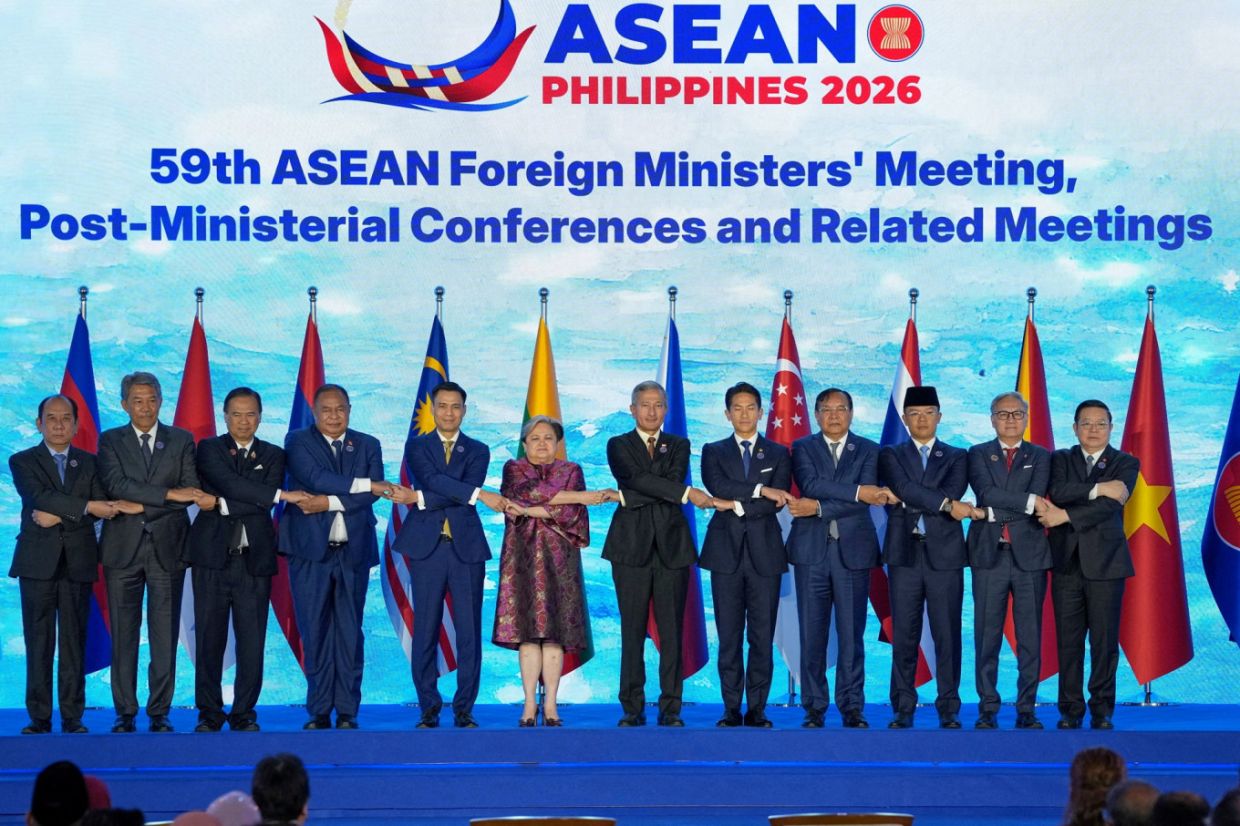
Indonesia has thrown down a gauntlet to the Association of Southeast Asian Nations, demanding the 11-member bloc move beyond declarations and transform its ambitious promises into concrete achievements. The challenge carries particular weight as Asean grapples with a convergence of crises—from the Middle East conflict's economic ripple effects to persistent territorial disputes in Southeast Asian waters—all testing the organisation's capacity to speak and act as one. Foreign Minister Sugiono framed the moment as a defining juncture for Asean's credibility, asking pointedly whether the bloc that just expanded to include Timor-Leste can actually deliver on its foundational pledges to safeguard regional stability.
The intervention came during Manila's hosting of the 59th Asean Foreign Ministers Meeting, where senior diplomatic delegations convened to hammer out unified positions before engaging with external partners. The timing reflects Jakarta's concern that without demonstrable progress on longstanding issues, Asean risks appearing ineffectual precisely when its role as a stabilising force becomes more crucial. The agenda encompassed several interlocking problems—the economic fallout cascading from Middle East tensions, the stalled negotiations over maritime conduct rules in the South China Sea, and the deteriorating humanitarian situation in Myanmar—each with implications that stretch well beyond Southeast Asia's borders.
The Middle East conflict has injected fresh urgency into Asean's discussions, yet also exposed a strategic vulnerability that worries Jakarta. As energy supplies face disruption following tensions around the Strait of Hormuz, several member states have rushed to diversify their energy imports, increasingly turning to China for alternative sources including solar panels and other renewable technologies. The Philippines, acting as this year's Asean chair, more than doubled its solar panel imports from China during the first five months of 2024 compared to the same period in 2023. This dependency shift subtly alters the regional balance of power at a moment when Asean needs maximum leverage in negotiations with Beijing over contested waters. Sugiono's emphasis on tangible delivery may partly reflect anxiety about the bloc's eroding negotiating position as member states pursue individual economic interests.
The Code of Conduct for the South China Sea exemplifies the gap between Asean's aspirations and its execution. For nearly a quarter-century, the bloc has laboured to establish binding rules governing behaviour in one of the world's most strategically important and contested waterways. Yet despite incremental progress, a final agreement remains elusive. Sugiono's blunt statement—"Our people have waited 24 years for rules at sea. They should not wait for another year"—reflects palpable frustration that diplomatic process has substituted for substantive outcomes. The unspoken subtext carries implications for Malaysia and other littoral states with competing claims: without enforceable regional rules, individual nations remain vulnerable to pressure from larger powers, making Asean's collective framework essential for smaller economies' security.
At the same time, the Middle East crisis has given ministers fresh cause for concern about Asean's economic resilience. Joint statements acknowledged the potential fallout on member economies, the safety of nationals working abroad, and the importance of bolstering healthcare access in vulnerable communities. Yet the worry extends deeper—to systemic exposure to external shocks that Asean as a whole remains inadequately equipped to absorb or mitigate. The bloc's reliance on global supply chains and energy markets means that distant conflicts impose real costs on Southeast Asian households and businesses, raising questions about whether Asean's internal architecture can adequately cushion such impacts.
Myanmar remained a thornier challenge, with the Five-Point Consensus—Asean's 2021 peace roadmap—dominating a dedicated retreat session among ministers. Implementation has stalled amid persistent divisions about how to engage Junta leader Min Aung Hlaing and his military government. While Sugiono reported that member states articulated "progressive" positions during the session, the careful diplomatic language masked ongoing disagreement. The prospect of reforming Asean's special envoy mechanism and recalibrating how progress is measured suggests the bloc recognises its existing approach has fallen short, yet remains uncertain about the path forward. For a region already dealing with humanitarian catastrophe, the slowness of Asean's response underscores the limits of consensus-based diplomacy when member states hold fundamentally different interests.
Philippine Foreign Secretary Theresa P. Lazaro signalled that the Myanmar review might be completed by November's leaders' meeting, but such timelines have slipped before. The challenge lies not in diplomatic procedure but in the hard political choices about whether and how Asean can pressure or incentivise military compliance with agreed frameworks. Some members view sustained engagement and dialogue as the path forward; others question whether talk without consequences changes behaviour. These fault lines reflect deeper differences about whether Asean's unity should supersede pressure on individual members deemed to violate shared principles—a tension that has plagued the organisation since its founding commitment to non-interference in internal affairs.
The foreign ministers' discussions underscore a broader paradox confronting the bloc. Asean has expanded its membership and deepened its institutional architecture, yet its ability to shape events within and beyond its borders has not proportionally increased. The admission of Timor-Leste as the 11th member, celebrated at May's summit, represented a symbolic expansion of Asean's reach and relevance. Yet even with this newcomer, the bloc struggles to achieve binding outcomes on issues where member interests diverge or where external powers apply countervailing pressure. Sugiono's emphasis on "delivering promises" implicitly acknowledges that Asean's credibility hinges not on the boldness of its vision but on its capacity to translate words into action.
The subsequent engagement with dialogue partners—including the United States, China, and Russia—will test whether Asean can present a unified voice on contentious geopolitical issues. These external meetings represent both an opportunity and a risk: a chance to amplify Asean's collective weight in global councils, but also a temptation for individual members to seek bilateral advantage by breaking ranks. For Malaysia and other mid-sized economies without superpower status or overwhelming economic heft, Asean's solidarity remains essential for maintaining relevance and protecting interests. Yet that solidarity requires member states to subordinate immediate national gain to longer-term collective benefit—a calculus not always obvious when economic pressures mount or security threats loom.
The question Sugiono posed—can Asean deliver on its promises?—carries implications well beyond the current agenda items. It asks whether a regional bloc built on consensus and non-interference can adapt to an era of sharper geopolitical competition and rising external pressure. It asks whether Southeast Asian nations prioritise unity or pursue individual advantage when confronted with economic incentives or security challenges emanating from larger powers. For Malaysian policymakers and the broader region, the answer will shape whether Asean remains a meaningful framework for advancing collective interests or gradually morphs into a discussion forum lacking teeth. The next months will prove revealing.

