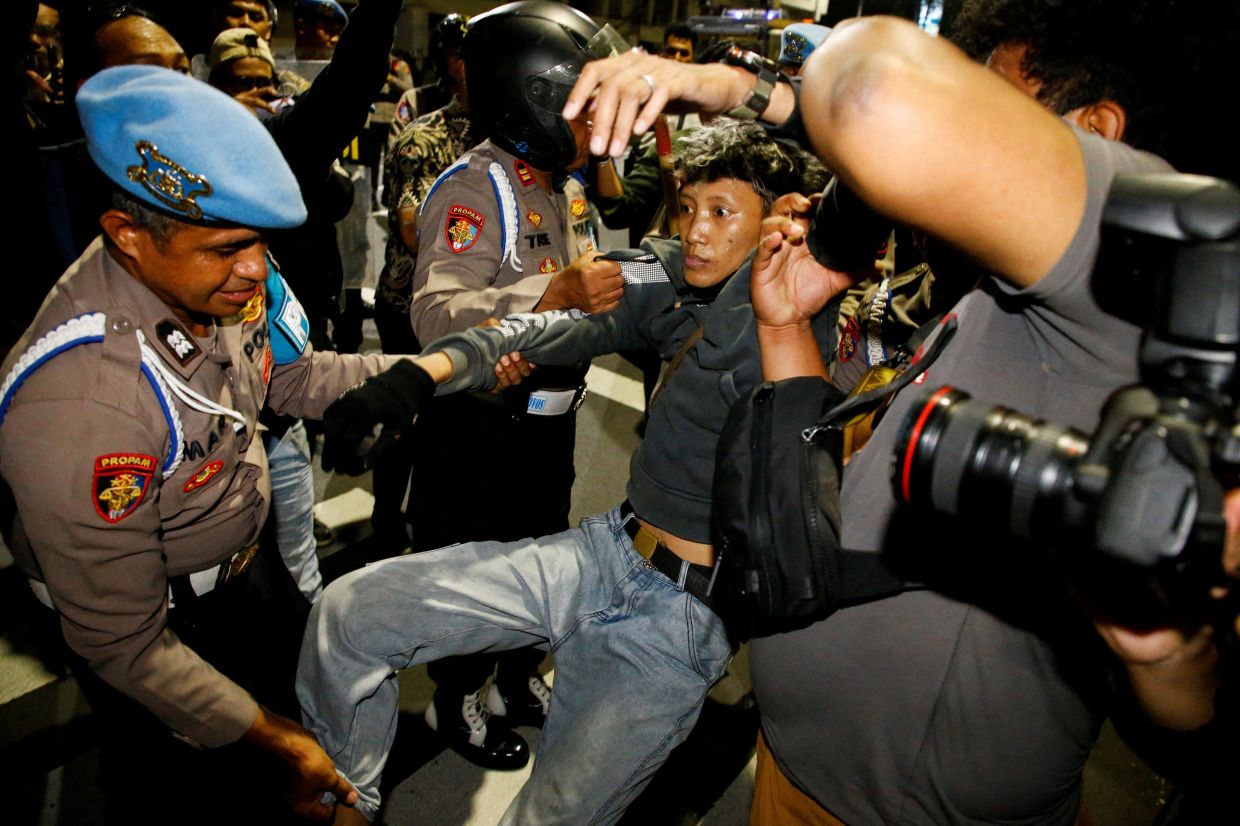
Indonesian police have formally charged four individuals in connection with an anti-government demonstration held in Surabaya, the country's second-largest city, as tensions simmer over economic policies and social welfare programmes that have sparked outrage across Southeast Asia's most populous economy. The charges were announced by Surabaya police chief Luthfie Sulistiawan on Sunday, following Friday's rally near a government building that drew approximately 100 participants protesting twin government initiatives that have galvanised public opposition in recent weeks.
The demonstration centred on two contentious government policies: a substantial fuel price increase implemented this month and the continuation of a multi-billion-dollar free school meals scheme that has become ensnared in scandal and health crises. The non-subsidised petrol price hike, which raised costs by roughly 30 per cent, reflects Jakarta's efforts to manage mounting budget deficits exacerbated by Middle East geopolitical tensions affecting global oil markets. For Indonesia, a significant oil-producing nation that paradoxically remains a net importer, the policy underscores the delicate balance between energy independence and fiscal sustainability in a heavily subsidised economy.
Friday's gathering in Surabaya turned confrontational when some participants threw rocks and firecrackers at police, prompting law enforcement to employ what officials characterised as "firm actions" to restore order and clear the protest site. The escalation during what began as a peaceful assembly illustrates the volatile nature of demonstrations against austerity measures in a nation where public services remain politically sensitive. Authorities initially detained 24 people at the scene but released most without charges, a pattern suggesting police were distinguishing between organisers and peripheral participants in the broader movement.
The four individuals now facing formal charges have been accused of property destruction and assault against police officers, marking the most serious legal consequences thus far. Additionally, six other detainees remain under investigation after authorities reported detecting substances indicative of drug use, suggesting police are pursuing multiple investigative angles beyond the core protest allegations. This tiered approach to accountability reflects how Indonesian authorities are categorising different levels of involvement in the demonstration.
The Surabaya protest represents one manifestation of wider discontent simmering across Indonesia regarding government economic decisions. In Jakarta, the capital, thousands of students have mobilised to voice opposition both to the fuel price adjustment and to the embattled free meals programme, creating a sustained movement that transcends regional boundaries. The convergence of these two grievances suggests that Indonesians increasingly view the government's policy agenda as interconnected aspects of an overarching economic hardship affecting ordinary families.
The free school meals initiative, initially promoted as a flagship anti-malnutrition strategy, has become severely damaged by cascading crises. Tens of thousands of students and beneficiaries have fallen ill following consumption of programme meals, generating concerns about food safety standards and supply chain integrity. These mass poisonings have eroded confidence in government capacity to implement large-scale welfare projects efficiently, particularly when coupled with emerging evidence suggesting systemic corruption within the programme's administration. Although authorities have partially suspended operations pending investigations, the reputational damage persists, making the scheme a focal point for broader criticism of government competence.
For Malaysia and other Southeast Asian nations, Indonesia's experience carries instructive implications regarding the political risks inherent in rapid subsidy restructuring. When governments attempt to address fiscal imbalances through price liberalisation, public backlash can be swift and sustain momentum across multiple grievances simultaneously, as demonstrated by Jakarta's ability to fuse fuel and welfare concerns into a cohesive protest movement. The interaction between austerity policies and pre-existing public service failures creates compounding legitimacy challenges for administrations.
The charges against the four Surabaya protesters must be understood within the context of Indonesia's broader legal framework governing public assembly and dissent. Security forces retain considerable discretion in determining whether demonstrations constitute legitimate political expression or unlawful public disorder, a dynamic that shapes how protest movements evolve and whether participants face criminal liability. The selective prosecution approach—charging some for property damage while investigating others for drug possession—suggests authorities are constructing differentiated legal narratives to justify enforcement actions to various audiences.
Indonesia's experience managing simultaneous economic reform and public welfare implementation challenges underscores the complexity of governance in large, diverse economies with entrenched subsidy systems. The Middle East conflict's impact on global energy markets provided the immediate trigger for fuel price adjustment, yet the decision has become entwined with pre-existing anxieties about government competence, as evidenced by the food poisoning crises and corruption allegations surrounding parallel welfare programmes. This convergence ensures that fuel price protests transcend narrow economic grievances to encompass broader legitimacy questions.
Looking ahead, the police decision to pursue formal charges against protest participants may either deter future demonstrations or intensify conviction among opposition movements that the government is prioritising enforcement over dialogue. The outcome will likely depend on whether charges are ultimately sustained in courts and how the judiciary calibrates proportionality between alleged misconduct and legal consequences. For Indonesia's broader political trajectory, the challenge lies in addressing legitimate public grievances about economic policy and service delivery while maintaining social stability—a balancing act that has proven elusive for many developing democracies navigating comparable pressures.

