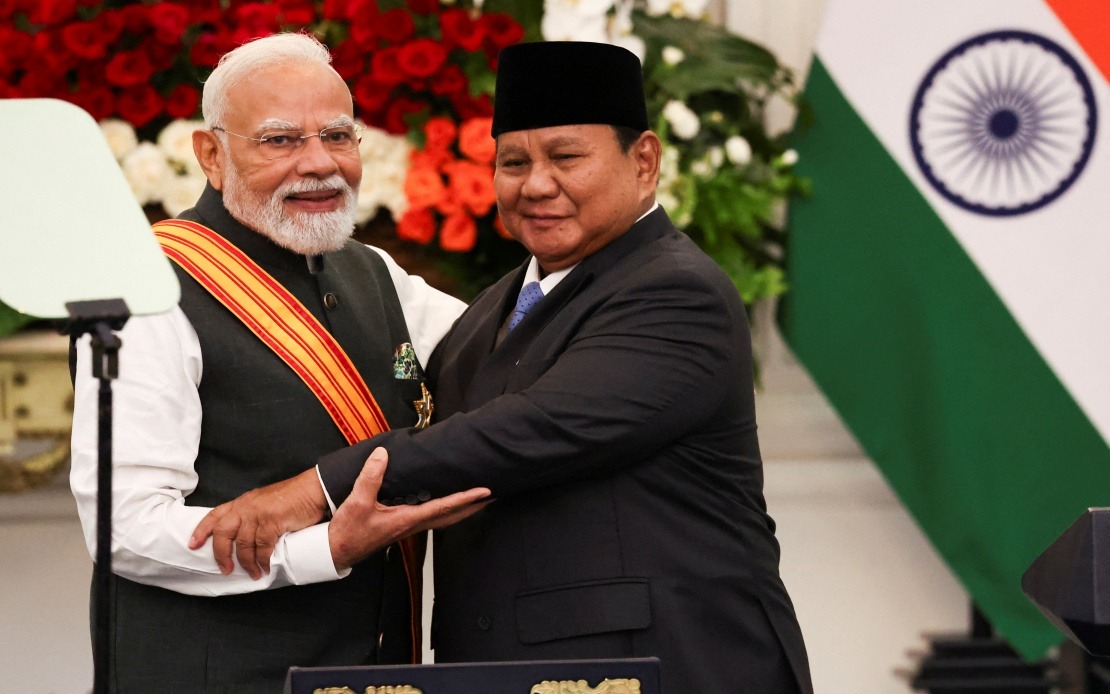
Indonesia has bestowed its highest state honour upon Indian Prime Minister Narendra Modi during an official state visit to Jakarta, marking a significant diplomatic milestone in the two nations' relationship. President Prabowo Subianto presented the award at the Merdeka Palace, underscoring Indonesia's commitment to deepening ties with its Indian counterpart and recognising Modi's instrumental role in elevating bilateral cooperation to unprecedented levels.
The presidential citation emphasised Modi's leadership qualities and his concrete contributions toward fortifying the Indonesia-India Comprehensive Strategic Partnership, a framework that encompasses defence, trade, cultural exchange, and maritime cooperation. Prabowo specifically highlighted Modi's sustained efforts in expanding collaborative ventures between the two countries, noting that the recognition also acknowledged India's tangible support for various development initiatives that have benefited Indonesia's economic and social progress.
Modi's three-day visit to Indonesia represents a reciprocal diplomatic engagement, following President Prabowo's own visit to New Delhi earlier in the year. These high-level exchanges underscore the strategic importance both governments place on their partnership, particularly given the evolving geopolitical landscape in South and Southeast Asia where India and Indonesia are increasingly positioned as anchor states shaping regional dynamics and multilateral institutions.
The honour carries historical resonance within Indonesia's diplomatic tradition. President Prabowo drew parallels with the previous conferment of the same award upon Jawaharlal Nehru, India's founding prime minister, whose visionary leadership helped establish the Non-Aligned Movement and profoundly influenced Indonesia's own approach to international relations during the Cold War era. This historical comparison underscores the enduring nature of India-Indonesia friendship and elevates Modi's visit to the status of a defining moment in contemporary bilateral diplomacy.
Prabowo characterised Modi's visit as a historic watershed, emphasising that it symbolises both nations' unwavering dedication to advancing their Comprehensive Strategic Partnership through pragmatic cooperation that generates mutual benefits. The president articulated a vision of sustained engagement across multiple domains, from economic integration and infrastructure development to defence collaboration and people-to-people exchanges that strengthen civilisational bonds.
A notable element of Prabowo's remarks involved Indonesia's aspirations within the broader international community. He expressed appreciation for India's backing of Indonesia's bid for permanent membership in BRICS, the influential bloc of emerging economies. This support carries strategic weight, as BRICS membership would amplify Indonesia's voice in global economic governance and provide greater leverage in shaping policies affecting the Global South.
The bilateral relationship rests upon deep historical and cultural foundations that predate modern state structures. Both nations share Buddhist and Hindu heritage, maritime trading traditions, and philosophical commitments to sovereignty and non-interference in internal affairs. Prabowo's statements emphasised that contemporary cooperation builds upon these civilisational commonalities, creating a durable foundation that transcends short-term political calculations or transient geopolitical shifts.
For Malaysia and the broader Southeast Asian region, this diplomatic initiative carries multifaceted implications. India's strengthening ties with Indonesia, the largest economy and most populous country in ASEAN, signals India's deliberate pivot toward the region as part of its Act East policy. This engagement provides counterbalance to China's dominant economic influence in Southeast Asia whilst respecting ASEAN's principle of strategic autonomy. Malaysia, as a fellow ASEAN member and significant partner to India, stands to benefit from the stabilising effects of a robust Indonesia-India partnership that promotes regional prosperity and reduces great-power competition.
The ceremonial aspects of Modi's visit, including the formal state honour, also project soft power messaging. By recognising Modi's achievements and India's contributions to Indonesian development, Prabowo signals to Indian investors, businesses, and civil society that Indonesia welcomes deeper engagement. This diplomatic messaging facilitates enhanced trade flows, technology transfers, and cultural exchanges that can accelerate development across both economies.
Modi's state visit likewise reflects India's strategic recalibration within Asia. As India pursues expanded influence in the Indo-Pacific region and seeks to counterbalance other powers' growing assertiveness, cultivating robust partnerships with ASEAN nations remains central to its grand strategy. Indonesia, straddling the Indian and Pacific Oceans and commanding crucial maritime straits, holds particular geopolitical significance for India's long-term positioning.
The Comprehensive Strategic Partnership framework connecting Indonesia and India encompasses security cooperation, including naval exercises and defence technology collaboration, which have assumed greater importance amid regional maritime tensions and piracy concerns. Enhanced defence ties allow both nations to collectively address transnational security challenges whilst maintaining their respective strategic autonomy.
Looking forward, Modi's visit and the accompanying honour appear designed to institutionalise India-Indonesia cooperation at the highest political levels, ensuring continuity regardless of electoral cycles in either country. The diplomatic emphasis on historical parallels with Nehru and the Non-Aligned Movement suggests both leaders recognise shared values regarding international law, multilateralism, and resistance to hegemonic pressures.
As Southeast Asian nations navigate complex great-power competition and seek to maintain strategic space, the Indonesia-India partnership exemplified by Modi's visit offers a constructive model of mutually beneficial cooperation rooted in shared civilisational values rather than ideological alignment or zero-sum competition. For Malaysia and other regional actors, this partnership development reinforces the importance of cultivating diverse international relationships that enhance collective prosperity and stability.

