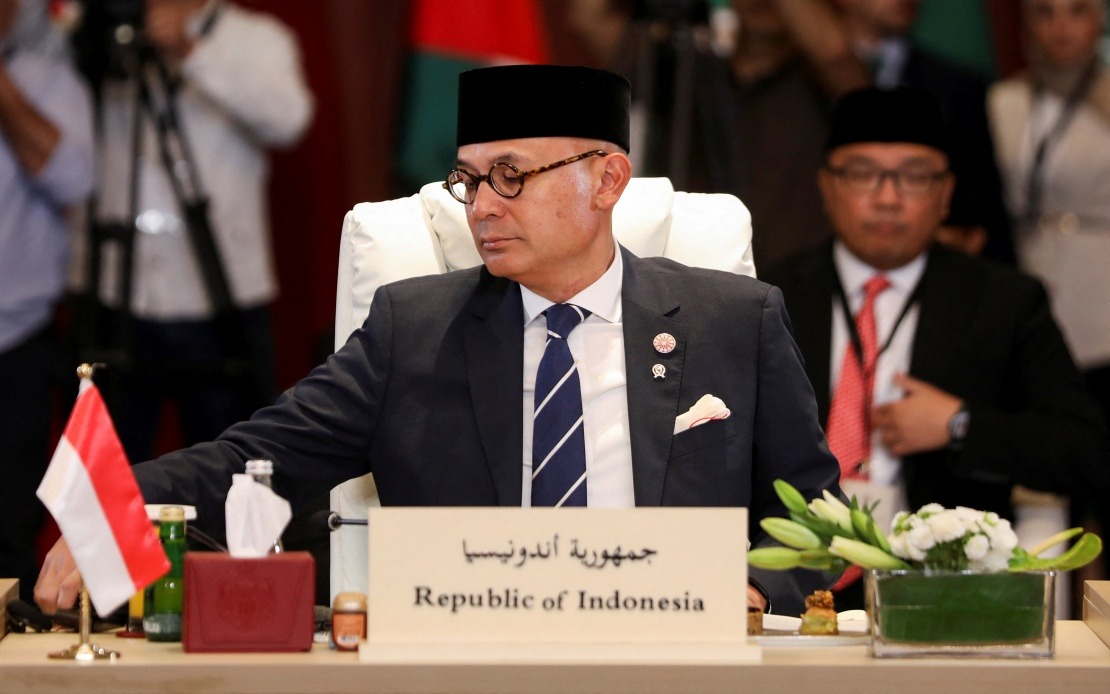
Indonesia has amplified its diplomatic efforts to forge a cohesive international response to the Palestinian question, moving beyond rhetorical gestures to propose concrete mechanisms for unified action. Speaking at the Ministerial Meeting on Jerusalem in Amman on Wednesday, Deputy Foreign Minister Arrmanatha Nasir—representing Foreign Minister Sugiono—articulated Jakarta's position that persistent division within the international community has historically weakened pressure on Israel and allowed violations to escalate without coordinated consequences.
The core of Indonesia's argument rests on a strategic observation: Israel has consistently capitalised on fractured international responses to pursue its interests with minimal unified resistance. By framing the Palestinian cause as a universal human rights issue rather than exclusively a Muslim concern, Indonesia seeks to broaden the coalition beyond traditional constituencies and appeal to nations on grounds of international law, sovereignty, and regional stability. This rhetorical shift reflects Jakarta's sophisticated understanding that durability requires transcending religious or cultural divisions that might limit participating nations.
Indonesia has outlined five specific measures to strengthen Palestinian support on the global stage. The first involves forging a common strategic framework grounded in unity of purpose and coordinated action. The second emphasises strict adherence to international law and compliance with rulings from the International Court of Justice, positioning the Palestinian question within the established rules-based international order. The third calls for expanding the number of states recognising Palestine as a sovereign entity, leveraging diplomatic recognition as both a symbolic and substantive achievement. The fourth concentrates on protecting Islamic holy sites, particularly Al Aqsa Mosque, acknowledging that spiritual and cultural heritage preservation resonates across Muslim-majority nations. The fifth focuses on tangible reconstruction efforts in Gaza and strengthening Palestinian institutional capacity in Jerusalem.
The geopolitical context underpinning Indonesia's initiative reflects dramatic shifts in the West Asian landscape. Illegal Israeli settlements in the West Bank have expanded significantly in recent years, Israel's military operations have extended into Gaza, Syria, and Lebanon, and the strategic rivalry between the United States and Iran has intensified regional volatility. These developments have created a confluence of crises that Jakarta argues demands abandonment of incremental or reactive diplomacy in favour of proactive, coordinated strategy. Indonesia's emphasis on this changing context suggests that incremental approaches have failed to constrain Israeli actions or advance Palestinian interests.
Indonesia explicitly reaffirmed its principled position that the Hashemite Custodianship over Jerusalem's holy sites must be preserved and respected internationally. More substantively, Jakarta reiterated its recognition of Palestine's right to independence in accordance with established international legal frameworks. This positioning is significant for Southeast Asian readers because it demonstrates how Indonesia—as the world's largest Muslim-majority democracy and a regional power—articulates security interests through appeals to law and institutionalised norms rather than sectarian mobilisation. For Malaysian observers, Indonesia's diplomatic approach offers instructive contrasts and parallels to how Malaysia itself navigates these contested issues.
The ministerial gathering itself represented a substantial diplomatic achievement, bringing together officials from Malaysia, Algeria, Saudi Arabia, Iraq, Egypt, Türkiye, Tunisia, Somalia, Pakistan, Morocco, Palestine, and Qatar, alongside the Secretary-General of the League of Arab States. The breadth of participation—spanning North Africa, the Middle East, and South Asia—testified to widespread concern about Israeli actions, though the absence of major powers including the United States, European nations, and others underscored the polarisation surrounding these matters within the international community. For Indonesia and its diplomatic partners, expanding this coalition remains an ongoing challenge.
The meeting's joint statement rejected unilateral relocations of diplomatic missions to Jerusalem as violations of international law, a direct reference to the controversial decisions by the United States and a handful of other nations. Beyond formal rebukes, participants endorsed launching a coordinated media campaign to educate global public opinion about Israeli actions and their destabilising consequences for regional and international peace. This strategic communications component suggests that the coalition recognises its limited capacity to alter Israeli policy directly and therefore seeks to shift global narratives and constrain the diplomatic space available to Israel's defenders.
For Southeast Asian policymakers and observers, Indonesia's initiative carries significant implications. It demonstrates how middle-power diplomacy can attempt to shape responses to conflicts beyond the region while maintaining strategic autonomy from great-power competition. The emphasis on international law and institutional mechanisms reflects an approach that privileges rules-based frameworks—concepts equally relevant to Southeast Asian concerns about maritime law, territorial disputes, and major-power restraint. Additionally, Indonesia's framing of the Palestinian question as a universal human rights matter rather than a sectarian issue may resonate with attempts to build inclusive coalitions across diverse societies and belief systems.
Yet the effectiveness of Indonesia's coalition-building remains uncertain. Historical precedent suggests that diplomatic initiatives on the Israeli-Palestinian question face formidable obstacles, particularly when major powers maintain divergent positions and geopolitical interests in the region. The absence of transformative outcomes from decades of international activism raises questions about whether coordinated messaging and reaffirmed principles can alter material capabilities or political incentives. Indonesia's proposal for strengthening Palestinian institutions and protecting holy sites addresses symptoms rather than addressing the underlying political settlement that would require Israeli concessions on territory, settlements, and Palestinian statehood.
The timing of Indonesia's intervention—amid escalating regional tensions involving Iran, Syria, Lebanon, and broader US-China competition—suggests that Jakarta views the Palestinian question as increasingly intertwined with systemic regional instability. Rather than treating it as a discrete bilateral dispute, Indonesia positions Palestine within a broader architecture of international law, regional security, and humanitarian obligation. This analytical frame potentially opens space for countries not traditionally aligned with Arab causes to participate, though it also raises expectations that coalitions can translate solidarity into concrete diplomatic or material outcomes.
Moving forward, Indonesia's success will depend partly on whether it can sustain coalition cohesion amid other regional crises and divergent national interests among participating states. It will also require mechanisms to translate joint statements into coordinated voting patterns in international forums, sustained media campaigns, and diplomatic pressure campaigns targeting both Israeli policymakers and their international supporters. For Malaysian readers observing these developments, Indonesia's diplomatic leadership illustrates how regional powers navigate complex international questions while attempting to balance principles, partnerships, and pragmatism in an era of multipolar competition.

